September 29: A Ravine in Kiev, a Market in Freefall, and a Child on the Throne of Spain
September 29 carries weight of a particular kind. On this day in 1941, a two-day massacre began at a ravine outside Kiev that killed 33,771 Jewish men, women, and children — one of the largest single mass killings of the Holocaust, accomplished in forty-eight hours with bureaucratic organization and industrial efficiency. Sixty-seven years later, on September 29, 2008, the Dow Jones Industrial Average fell 777 points in a single day — the largest point drop in its history — as Congress rejected a bank bailout package and global financial markets registered in real time what the collapse of American financial institutions actually meant. And in 1833, a two-year-old girl was proclaimed Queen of Spain upon her father's death, beginning a reign that would be defined by the instability that surrounds a throne occupied by a child and contested by those who believe they have a better claim to it. Three September twenty-ninths. Three days when systems of human organization produced their worst or most unstable outcomes — and the world had to reckon with what that meant.
Babi Yar
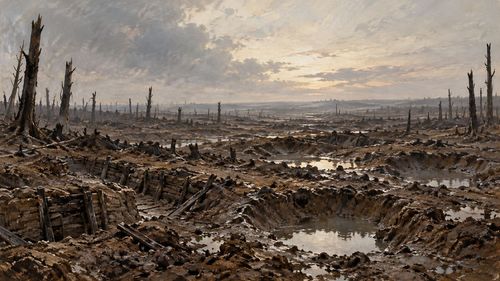
On September 29 and 30, 1941, Nazi Einsatzgruppe C — a mobile killing unit of the SS — with the support of German military units and Ukrainian auxiliary police, assembled the Jewish population of Kiev at the Babi Yar ravine on the city's outskirts and murdered 33,771 people over two days. The Jews of Kiev had been ordered to report with their documents, money, and warm clothing, told they were to be resettled; they were instead marched to the ravine, forced to surrender their belongings and undress, and shot. The operation was conducted with systematic efficiency: German records documented the precise body count. Babi Yar was not an improvised atrocity — it was a planned, coordinated, and documented mass execution, carried out by units whose specific assignment was the murder of Jewish populations in the German-occupied Soviet Union following Operation Barbarossa. It remains one of the largest single massacres of the Holocaust and one of the largest mass killings of the Second World War.
The ravine at Babi Yar continued to be used as a killing site after September 29-30, 1941. Over the following months and years, the Nazis murdered additional thousands there — Soviet prisoners of war, Roma, psychiatric patients, Ukrainian nationalists, and others — bringing the total estimated number of those killed at Babi Yar to somewhere between 100,000 and 150,000 people. In 1943, as the German army began its retreat from the Soviet Union, prisoners were forced to exhume and burn the bodies in an effort to conceal the evidence of the massacre. The site was not memorialized by the Soviet government — which suppressed specific acknowledgment of the Holocaust's targeting of Jewish people in favor of a generic "Soviet victims" narrative — until decades after the war. A monument acknowledging the Jewish victims was not erected until 1991, when Ukraine became independent. The poet Yevgeny Yevtushenko wrote his poem "Babi Yar" in 1961, condemning Soviet silence about the massacre, and Dmitri Shostakovich set it to music in his Thirteenth Symphony. The 33,771 people murdered at Babi Yar on September 29 and 30, 1941 — the Babiczkys and the Bermans, the Finkelsteins and the Goldbergs, the mothers and the fathers and the children — deserve to be named, even when we can only gesture at the scale of what was done there.

777 Points
On September 29, 2008, the Dow Jones Industrial Average fell 777.68 points — at the time the largest single-day point drop in the index's history — closing at 10,365.45, a loss of approximately $1.2 trillion in market value in a single session. The immediate trigger was the House of Representatives' rejection, by a vote of 228 to 205, of the Emergency Economic Stabilization Act — the $700 billion Troubled Asset Relief Program (TARP) that the Bush administration and Federal Reserve had proposed as a mechanism for purchasing toxic mortgage-backed assets from failing financial institutions. The rejection was bipartisan; many Republicans objected on free-market ideological grounds, while many Democrats objected to what they characterized as a bailout of Wall Street institutions whose reckless practices had caused the crisis. The markets' response to the vote was immediate and severe: the Dow's 777-point drop communicated, in the language of financial markets, the stakes of a financial system that had been borrowing against itself for a decade and was now beginning to collapse.
The market crash of September 29, 2008, was a single day in the middle of the worst financial crisis since the Great Depression — the product of years of deregulation, overleveraged financial institutions, fraudulent mortgage lending, and the creation of increasingly complex financial instruments that obscured the underlying risk until the housing market began to fall and the entire architecture built on top of it began to collapse with it. Congress passed a revised version of TARP on October 3, 2008, four days later, and the bailout that followed prevented the complete collapse of the American financial system at the cost of enormous public subsidy to the institutions whose practices had produced the crisis. The broader recession that the financial crisis triggered cost millions of Americans their jobs, their homes, and their savings; the recovery was slow and uneven, and its political consequences — including a sustained loss of public trust in financial and governmental institutions — have shaped American politics in the years since. The 777-point drop on September 29, 2008, was a number that captured, in a single index measurement, the accumulated cost of choices made over a decade by people who had believed the system was too complex to fail and had been wrong.

The Child Queen
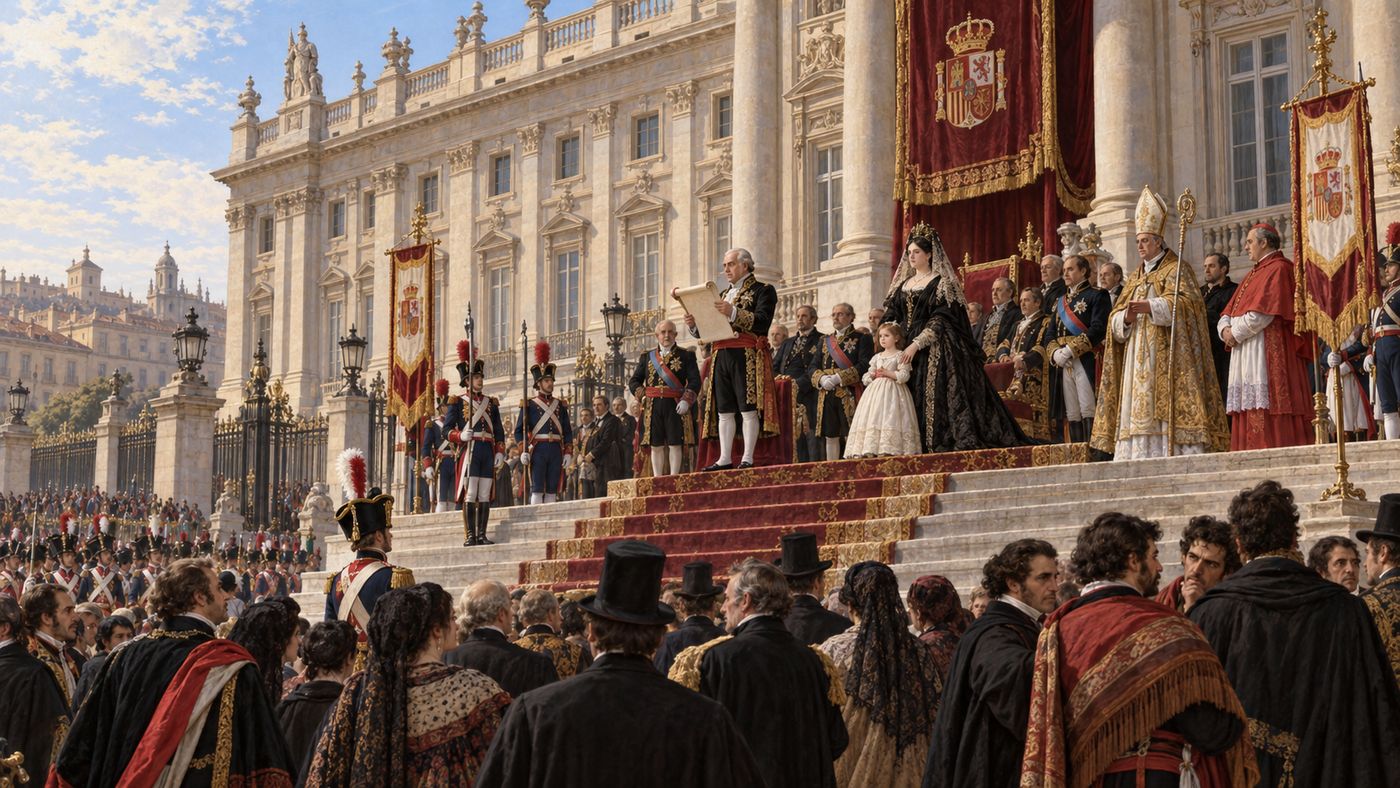
On September 29, 1833, King Ferdinand VII of Spain died, and his two-year-old daughter was proclaimed Isabella II, Queen of Spain — a succession that immediately ignited a constitutional crisis. Ferdinand had changed the law of succession shortly before his death to allow his daughter to inherit the throne, overturning the Salic Law that would have passed the crown to his brother, the Infante Carlos. Carlos refused to accept the change, claimed the throne himself, and launched the First Carlist War — a civil conflict between the Isabelline forces supporting the child queen's regency government and the Carlist forces supporting the pretender — that lasted from 1833 to 1840. Isabella's mother, Maria Christina of the Two Sicilies, served as regent and navigated the military and political crisis with enough skill to preserve her daughter's throne through the war's conclusion, though at the cost of significant constitutional concessions to the liberal factions whose military support sustained the crown.
The reign that began on September 29, 1833, when a two-year-old was proclaimed queen, lasted until 1868, when Isabella II was deposed in a liberal revolution and went into exile in France — a reign of thirty-five years defined throughout by the instability that a contested succession had introduced from its first day. She never effectively consolidated political authority; her reign was characterized by a series of constitutions, military coups, and changing governments that reflected the failure of the Spanish political system to settle on a stable constitutional framework. She was later reconciled with the Spanish crown in exile, abdicated formally in 1870 in favor of her son, and died in Paris in 1904. The child proclaimed queen on September 29, 1833, spent her life on a throne that her father's final act of succession had made necessary to fight for — and that the instability of her own reign eventually made impossible to hold.