


26 October
October 26: Thirty Seconds at the O.K. Corral, a Voice at Number One, a President Falls
October 26: Thirty Seconds at the O.K. Corral, a Voice at Number One, a President Falls
Three October 26ths defined by power — who holds it, who challenges it, and the singular kind that needs no gun or office to stop a room
Power rarely announces itself cleanly. It arrives in a thirty-second burst of gunfire in an Arizona alley that takes decades of films, novels, and mythology to properly process. It arrives in the voice of a twenty-two-year-old from Newark, New Jersey, hitting a note on a pop ballad that makes every other voice on the radio suddenly seem slightly insufficient. And it ends — as it ended for an eighteen-year authoritarian ruler of South Korea — not through revolution or election but through the action of the man who was supposed to be its most loyal guardian. October 26 holds all three: a gunfight that became a legend, a number one that announced a generation's greatest singer, and an assassination that ended an era no one had thought was ending.
Tombstone
On October 26, 1881, in a vacant lot near the O.K. Corral in Tombstone, Arizona Territory, a gunfight lasted approximately thirty seconds and produced three dead men, two wounded lawmen, and enough mythology to fill a century of Western films. The men who squared off that afternoon had been building toward it for months. On one side stood Virgil Earp, the town marshal, accompanied by his brothers Wyatt and Morgan and their consumptive friend Doc Holliday. On the other stood Ike and Billy Clanton and Frank and Tom McLaury, members of a loose cattle-rustling network known as the Cowboys that had been feuding with the Earps over control of Tombstone's lucrative combination of law enforcement, gambling, and political influence. When Virgil moved to disarm the Cowboys, someone fired — and thirty seconds later, Billy Clanton and both McLaury brothers were dead or dying.
The gunfight that took place on Fremont Street — it was not actually at the O.K. Corral, which was nearby — was not the end of the story. A Tombstone judge cleared the Earps and Holliday of wrongdoing, but the verdict did not settle the community's divisions. Morgan Earp was murdered the following March. Virgil was crippled by a shotgun ambush. Wyatt, with Doc Holliday, conducted a vendetta that killed several suspected participants in Morgan's murder before the survivors scattered. The thirty seconds near the O.K. Corral have been retold so many times — in films, novels, television series, and academic histories — that the actual event has become almost impossible to see beneath the layers of interpretation. What remains true is that Tombstone, Arizona, on October 26, 1881, was a place where the line between law and lawlessness was a matter of which side you were on when the shooting started.
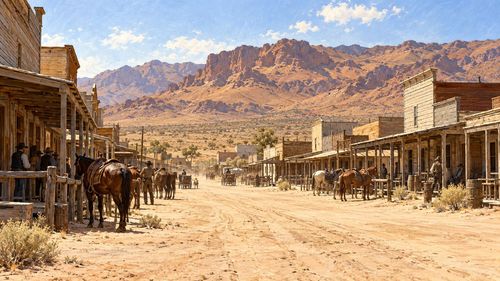
Tombstone, Arizona Territory in its 1880s prime — a booming silver mining town where the line between law and lawlessness was defined by who was holding the badge.
The Voice
On October 26, 1985, Whitney Houston's "Saving All My Love for You" reached number one on the Billboard Hot 100, giving the twenty-two-year-old singer from Newark, New Jersey her first chart-topping single. Houston had been released by Arista Records the previous year and her debut album had already produced two top-ten hits, but this was the moment that confirmed what the music industry had suspected since her gospel-trained voice had first drawn serious attention: that Houston possessed something rarer than a great voice — she possessed a perfect one. The technical gifts were extraordinary even by the standards of an industry full of extraordinary singers: a three-octave range, flawless intonation, the ability to sustain and ornament a note with a precision that sounded effortless and required enormous control. But the quality that separated Houston from simply technically accomplished singers was her capacity to make those gifts feel inevitable — as if the song had been waiting specifically for her voice to complete it.
The career that "Saving All My Love for You" launched produced some of the best-selling recordings in history: The Bodyguard soundtrack, which remains the best-selling soundtrack album of all time; "I Will Always Love You," whose climactic note became one of the most replicated moments in contemporary vocal performance; a string of number ones that ran through the 1980s and into the 1990s. Houston's later years were marked by a struggle with addiction that reduced her voice and complicated her public image, and she died in February 2012 at the age of forty-eight. What she left behind is a body of recorded work that represents the full upper range of what a human voice can do with a song — and the memory of a twenty-two-year-old whose voice, hitting a radio at the right moment in October 1985, made everything else on the dial sound slightly less than what music could be.
A 1980s recording studio — the environment where Whitney Houston's voice was first captured on tape, and where a generation's most celebrated vocal career began to take shape.
❦
The Director's Table
On October 26, 1979, South Korean President Park Chung Hee was shot and killed at a private dinner at a KCIA safehouse in Seoul by Kim Jae Kyu, the director of the Korean Central Intelligence Agency — one of Park's oldest associates and the man who ran the most powerful intelligence apparatus in the country. Park had ruled South Korea since his 1961 military coup, transforming a desperately poor agrarian nation into an emerging industrial economy through a combination of state-directed development, authoritarian control, and the systematic suppression of political opposition. His eighteen years in power had produced the "Miracle on the Han River" — one of the most rapid economic transformations in modern history — while crushing labor rights, imprisoning dissidents, and governing through a security state that Kim himself had helped build and operate.
Why Kim killed Park at that dinner table remains genuinely contested. Kim testified at his subsequent trial that he had acted to save Korean democracy from an increasingly repressive ruler — that Park's crackdown on dissent had gone too far and that Kim had decided, at enormous personal risk, that someone had to stop it. Prosecutors and many historians argue that the motivations were more personal: factional rivalry within the regime, resentment over Park's growing reliance on other advisors, or the calculation that Park's political position was becoming untenable and that Kim needed to position himself for what came next. Kim was convicted of treason and executed in 1980. Park's death did not produce the democratic opening his assassin claimed to seek — it produced instead a period of political chaos followed by another military coup, led by General Chun Doo-hwan, that extended authoritarian rule for another decade. South Korea would not hold its first democratic presidential election until 1987.
Seoul in the late 1970s — the capital of a nation transformed by eighteen years of Park Chung Hee's authoritarian rule, whose sudden end on October 26, 1979 did not produce the democratic future his assassin claimed to be delivering.