Recent Content

November 13: Fantasia Premieres, Franklin Writes About Balloons, Augustine Is Born

November 13: Fantasia Premieres, Franklin Writes About Balloons, Augustine Is Born

Read more
November 12: The Last Immigrant, the Web Is Born, Trotsky Cast Out

November 12: The Last Immigrant, the Web Is Born, Trotsky Cast Out

Read more
Nov. 11, 2011: Skyrim Launches on 11/11/11

Nov. 11, 2011: Skyrim Launches on 11/11/11

Read more
November 11: The War Ends, the Unknown Soldier, Angola Free

November 11: The War Ends, the Unknown Soldier, Angola Free

Read more
Nov. 10, 2001: China Wins WTO Approval

Nov. 10, 2001: China Wins WTO Approval

Read more
logo
  • Introduction

  • Lessons From The Past

  • Cultural Awareness and Diversity

  • Appreciation for Progress

  • Understanding Political and Social Dynamics

  • Preserving Cultural Heritage

  • Conclusion

Nov. 6, 2011: Geoffrey Mutai Shatters the New York City Marathon Course Record Across Five Boroughs

On a crisp Sunday in New York, a Kenyan runner turned a famously punishing course into a stage for the fastest marathon the city had ever seen.

On Nov. 6, 2011, roughly 47,000 runners poured across the Verrazano-Narrows Bridge for the 41st New York City Marathon. Most were chasing personal goals. At the front, Kenya's Geoffrey Mutai was chasing something larger: a race that had never been run as fast as he was about to run it.

The Fastest Mile

The New York course is no one's idea of a speed trap. It crosses five boroughs and five bridges, with long climbs and tight turns that tend to reward patience over pace. For years, the course record had stood at 2 hours, 7 minutes, 43 seconds, set by Ethiopia's Tesfaye Jifar in 2001. Mutai ran the race as though that number were a suggestion. He and his countryman Emmanuel Mutai, who is no relation, broke away from the field and traded the lead deep into the race, pushing each other through Manhattan and into Central Park. Geoffrey Mutai broke the tape in 2:05:06, taking more than two and a half minutes off the old mark. Emmanuel Mutai followed in 2:06:28, which would also have beaten Jifar's record. The pair had turned a duel into a demolition of the record book, and the old mark was left behind by two men instead of one.

The same day, Ethiopia's Firehiwot Dado won the women's race in 2:23:15, adding a second victory to the day's results. Mutai's time carried an asterisk of sorts: because New York's point-to-point course drops in elevation between start and finish, the sport's governing body does not ratify such times as world records. That did not blunt the achievement in the city itself. Mutai had run faster than anyone ever had on those streets, and he did it on a course whose hills are famous for slowing people down. The record that mattered to New Yorkers was the one that belonged to their own race, and by the end of the afternoon it belonged to him. Rarely has an unofficial mark felt so definitive.

[#~image_alt_1~#]

More History

21 October 2026

Post

November 13: Fantasia Premieres, Franklin Writes About Balloons, Augustine Is Born

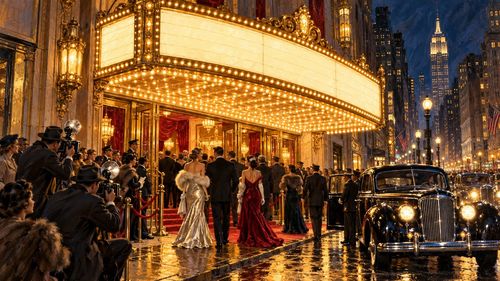
November 13: Fantasia Premieres, Franklin Writes About Balloons, Augustine Is Born Three November 13ths defined by visionaries who saw further than everyone around them — an animator who believed cartoons could carry high art, a polymath who recognized a new frontier before it had a name, and a theologian who mapped the interior of the human soul with a precision that still holds Vision is the capacity to see what something could be before anyone else has decided what it is. Walt Disney saw it in a bag of mushrooms dancing to Tchaikovsky and a dinosaur dying to Stravinsky, and bet a studio's future on the idea that animation could do what no film had attempted. Benjamin Franklin saw it in a silk bag filled with hot air drifting over Paris, and immediately began calculating its scientific applications while the city around him was still simply staring upward in wonder. And in a provincial Roman city in fourth-century North Africa, a restless, brilliant, deeply contradictory man named Augustine saw, in his own tumultuous inner life, the raw material for a theology of the human condition that the Western world has been working with ever since. November 13 belongs to all three. The Sorcerer's Apprentice   On November 13, 1940, Walt Disney's Fantasia premiered at the Broadway Theatre in New York City in a special roadshow engagement with live orchestra and a new stereophonic sound system called Fantasound — the first commercial use of multi-channel audio in a film. The audience encountered eight animated sequences set to classical music: Bach's Toccata and Fugue in D Minor rendered as pure abstract color and form; Tchaikovsky's Nutcracker Suite performed by dancing mushrooms, flowers, and fairies; Dukas's The Sorcerer's Apprentice featuring Mickey Mouse as a hapless magician's understudy; and Stravinsky's The Rite of Spring reimagined as a visualization of Earth's formation and the age of dinosaurs. Disney had conceived the film as a "concert feature" — a new genre that would be continuously updated with new sequences as the repertoire expanded. He believed it would change the relationship between classical music and popular audiences permanently. It did not, at first, change anything except Disney's finances. Fantasia was an immediate commercial failure, losing money on its initial release and forcing Disney to abandon the roadshow format for a conventional theatrical run that stripped out the Fantasound system entirely. Critics were divided — some recognized its ambition, others found its interpretation of classical music presumptuous or its imagery kitsch. The concert feature sequels were never made. Disney himself was deeply wounded by its reception. But the film refused to disappear. Re-releases in the 1950s and 1960s — particularly at colleges, where it found a new audience who watched it in states of consciousness that Disney had not anticipated — rebuilt its reputation. It was added to the National Film Registry in 1990 and is now recognized as one of the most artistically ambitious films in the history of American cinema. The film that lost Disney's company money in 1940 has since grossed more than $76 million in domestic theatrical releases alone. The vision that seemed too strange to succeed turned out to be simply ahead of its time.   The Broadway Theatre in New York on the night of November 13, 1940 — where Fantasia's premiere introduced an audience to something the film industry had never attempted before. What Goes Up On November 13, 1783, Benjamin Franklin — seventy-seven years old, serving as American ambassador to France, already famous on two continents as a scientist, diplomat, writer, and founding father — sat down in Paris and wrote a letter to his friend Jean-Baptiste Le Roy describing the astonishing spectacle of balloon flight that had been electrifying the French capital for months. The Montgolfier brothers had demonstrated unmanned hot air balloon ascents that summer, and on November 21, just eight days after Franklin's letter, the first free flight carrying human passengers would take place over Paris. Franklin had watched the experiments closely and, characteristically, had moved past the spectacle to the implications. His letter catalogued potential scientific applications: measuring atmospheric conditions at altitude, studying wind patterns, making meteorological observations that were impossible from the ground. He saw, in a silk bag full of hot air, the beginning of systematic aerial science. The letter also contained an exchange that has become one of science history's most quoted anecdotes. When a bystander at one of the balloon demonstrations asked what the invention was good for, Franklin replied — or is reported to have replied, since the attribution is not certain — "What is the use of a newborn baby?" The response perfectly captured his intellectual method: the recognition that the value of a new technology is not immediately legible, and that the question of use should be deferred until the technology has had time to demonstrate what it can become. Franklin was right about balloons in ways that took decades to fully manifest — weather balloons became essential to meteorology, military observation balloons changed warfare, and the understanding of atmospheric dynamics that balloon flights enabled laid groundwork for everything that followed in aviation. The old man watching silk bags drift over Paris understood, as he usually did, what he was actually looking at. Paris in the autumn of 1783, gripped by balloon fever — where Benjamin Franklin watched the Montgolfier demonstrations and saw, immediately, more than spectacle. ❦ Thagaste, 354   On November 13, 354 AD, in the Roman African city of Thagaste — in what is now northeastern Algeria — a boy was born to a pagan father named Patricius and a devoutly Christian mother named Monica. His name was Aurelius Augustinus, and he would become Augustine of Hippo: bishop, theologian, philosopher, and one of the most consequential thinkers in the history of Western civilization. The life he lived before arriving at that position was, by his own account, marked by intellectual restlessness, moral inconsistency, and a decade-long adherence to the dualist Manichaean sect before his dramatic conversion to Christianity in a garden in Milan in 386 AD — a conversion he described, in his Confessions, as the culmination of a long struggle between his will and his desires that he could not resolve by himself. The Confessions Augustine wrote after his conversion is generally regarded as the first autobiography in the modern sense — a sustained, intimate account of an interior life, addressed directly to God but clearly also to the reader, tracing the psychological and spiritual arc of a self in the process of becoming. It introduced to Western literature and theology the concept of interiority — the idea that the self has an inner life as complex and as significant as its outward actions. His theological works — The City of God, his treatises on grace and free will, his elaboration of original sin — shaped Catholic doctrine for a thousand years and influenced Protestant theology through Calvin and Luther as directly as any ancient source. Augustine died in 430 AD as the Vandals besieged Hippo. He had spent his life trying to understand why human beings consistently fail to do what they know to be good — a question that has not become less relevant in the sixteen centuries since he first asked it.   Roman North Africa — the world into which Augustine was born on November 13, 354 AD, and whose Mediterranean intellectual culture shaped the thinker who would reshape Western Christianity.

21 October 2026

Post

November 12: The Last Immigrant, the Web Is Born, Trotsky Cast Out

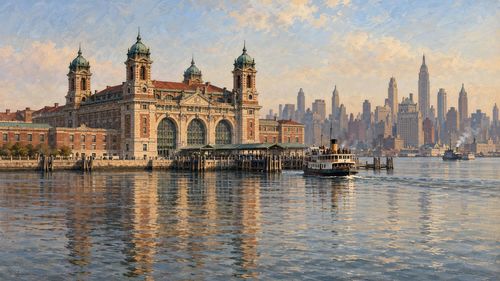
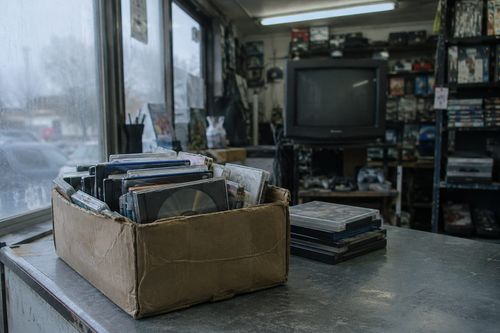
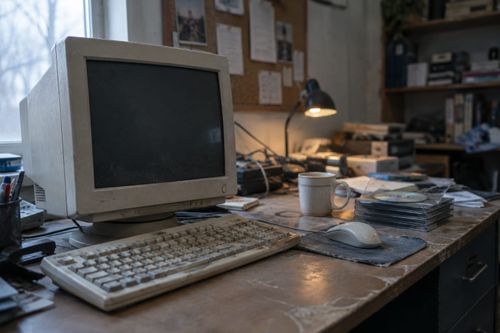
November 12: The Last Immigrant, the Web Is Born, Trotsky Cast Out Three November 12ths defined by thresholds — one closed after welcoming millions, one opened a door to a new kind of world, and one slammed shut on a man who had helped build the system that destroyed him Thresholds define us. The door you walk through, the proposal you submit, the party that expels you — each one marks the line between what came before and what comes after. November 12 has seen three of them close or open with consequences that echoed for generations. An immigration station that had processed more than twelve million people quietly shut its doors and sent its last detainee home. A computer scientist at a Swiss physics laboratory submitted a document his supervisor marked "vague but exciting" that would become the blueprint for the World Wide Web. And a revolutionary who had helped overthrow one Russian government and build the next was cast out of the party he had given his life to — the first step on a road that ended with an ice axe in Mexico City thirteen years later. The Last Ferry   On November 12, 1954, a Norwegian merchant seaman named Arne Peterssen became the last person processed through Ellis Island before the federal immigration station in New York Harbor officially closed its doors after sixty-two years of operation. Between 1892 and 1954, Ellis Island had admitted more than twelve million immigrants — Italians, Jews, Poles, Russians, Greeks, Hungarians, and dozens of other nationalities — processing them through a system of medical inspections, legal reviews, and registration that could take hours or, for those who were detained for further examination, days or weeks. At its peak, in 1907, the island processed more than a million arrivals in a single year. The men, women, and children who passed through its Great Hall and emerged onto its ferry dock to Manhattan represented one of the largest voluntary human migrations in history. By 1954, the pattern of American immigration had changed so substantially — through the restrictive quota laws of the 1920s, the Depression, World War II, and the postwar shift to air travel and other ports of entry — that Ellis Island was processing only a few dozen arrivals a day, and was being used primarily as a detention center for people awaiting deportation hearings. Its closure was quiet, practical, and almost entirely unmarked at the time. The building fell into severe disrepair over the following decades before being designated a national monument and restored, reopening to visitors in 1990. Today Ellis Island receives more than two million visitors annually, many of them descendants of the people who passed through it — Americans whose names, and whose country, bear the imprint of what happened on that small island in New York Harbor between 1892 and the day the last ferry left.   Ellis Island in New York Harbor — the threshold through which more than twelve million immigrants passed between 1892 and the day it quietly closed on November 12, 1954. Vague but Exciting On November 12, 1990, Tim Berners-Lee, a British computer scientist working at CERN — the European Organization for Nuclear Research — in Geneva, Switzerland, published a formal proposal titled "WorldWideWeb: Proposal for a HyperText Project." His supervisor, Mike Sendall, returned it with a handwritten annotation in the margin: "Vague but exciting." The proposal described a system for managing information at CERN using hypertext — a method of linking documents so that a reader could navigate between them by clicking on embedded references, rather than having to know in advance where information was stored. Berners-Lee had been thinking about the problem since 1980, when he wrote a personal program called ENQUIRE to help him keep track of software projects and the people working on them. The 1990 proposal was the document that turned that personal tool into a public architecture. The World Wide Web that Berners-Lee's proposal inaugurated was not the internet itself — the internet, as a network of connected computers, had existed since the late 1960s. What Berners-Lee invented was the system of hypertext documents, URLs, HTTP, and HTML that made the internet navigable by ordinary people without technical expertise. He built the first web server and the first web browser, both running on a NeXT computer at CERN in late 1990, and he made the crucial decision to release the Web's underlying standards without patent or royalty, making them freely available to anyone who wanted to use them. That decision — to give away what might have been the most valuable intellectual property in human history — is what made the Web what it became. Berners-Lee was knighted in 2004. He has since expressed concern about some of what the technology he invented has been used to do, and has spent recent years advocating for a more equitable and less exploitative version of the Web he gave the world for free. A 1990s computer science laboratory — the environment where Tim Berners-Lee developed the proposal his supervisor called "vague but exciting," and that became the blueprint for the World Wide Web. ❦ The Expelled   On November 12, 1927, Leon Trotsky was expelled from the Soviet Communist Party — the organization he had helped found, the movement whose October Revolution he had organized, and the government whose Red Army he had built and led to victory in the Russian Civil War. His expulsion was the culmination of a power struggle with Joseph Stalin that had been building since Lenin's death in 1924, a struggle that Trotsky had consistently underestimated and that Stalin had prosecuted with a patience and ruthlessness that Trotsky's more open, theoretical style of politics was entirely unequipped to match. Trotsky believed the argument would be won on the merits of ideas. Stalin understood that in the Soviet system, the argument was won by controlling the party apparatus, the press, and the appointments — all of which he had methodically accumulated while Trotsky wrote pamphlets. Expelled from the party in November 1927, Trotsky was exiled from the Soviet Union entirely in 1929, eventually settling in Mexico City after being refused entry by Britain, France, Norway, and several other countries. From exile he wrote prolifically — histories of the Russian Revolution, critiques of Stalinism, analyses of fascism, and the founding documents of the Fourth International, his attempt to build an alternative to the Stalinist Communist International. Stalin, who could not tolerate a living critic of his authority with Trotsky's intellectual stature and revolutionary credentials, dispatched agents to find him. On August 20, 1940, a Soviet agent named Ramón Mercader entered Trotsky's study in Coyoacán and struck him with an ice axe. Trotsky died the following day. The man who had helped make the Russian Revolution had been destroyed by it — thirteen years after the party that expelled him on November 12, 1927 made the first move.   Red Square in Moscow — the seat of the Soviet power that expelled Trotsky on November 12, 1927, and that would pursue him across three continents until 1940.

21 October 2026

Post

Nov. 11, 2011: Skyrim Launches on 11/11/11

On Nov. 11, 2011, a Palindrome-Perfect Release Date Sent Millions of Players Into the Snowy Mountains of Skyrim Bethesda's fantasy epic arrived on 11/11/11, and a game built around a vast open world began its long, strange afterlife. Few release dates are as tidy as Nov. 11, 2011. Bethesda Softworks put The Elder Scrolls V: Skyrim on shelves on 11/11/11, a day that looked as though it had been designed for a fantasy blockbuster. For many players, the winter that followed disappeared into its mountain passes. Dragonborn Day   Skyrim, developed by Bethesda Game Studios, was the fifth main entry in The Elder Scrolls series. It launched simultaneously on PC, Xbox 360 and PlayStation 3. The game dropped players into the northern province of Skyrim as the Dragonborn, a hero able to absorb the power of slain dragons and speak it aloud as a "Shout." The date had been revealed the year before, in a trailer shown at the 2010 Spike Video Game Awards, which gave fans nearly a full year to circle it on the calendar. The pitch was freedom more than plot. A main quest existed, but the map invited players to ignore it, join guilds, hunt bears, brew potions or simply walk toward the nearest unexplored peak. Plenty of them started the game with a goal and ended the evening somewhere else entirely, with no idea how they had gotten there. The most famous quest in the game was, for many, the one they never got around to finishing. Critics largely embraced the result, and Skyrim took the top prize, Game of the Year, at the 2011 Spike Video Game Awards the following month. Its reach outlasted any review cycle. Bethesda reissued the game for new hardware again and again, including a Special Edition in 2016 and a version for Nintendo's Switch, and players kept building mods that rewrote its rules. The community's favorite joke, that the game would be ported to nearly anything with a screen, became less a joke than a business plan. A release date chosen for its symmetry had, in the end, produced a game that nobody seemed able to put down for good.  

21 October 2026

Post

November 11: The War Ends, the Unknown Soldier, Angola Free

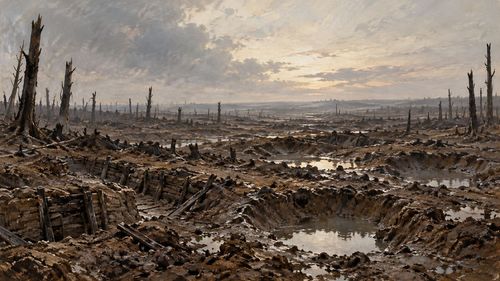
November 11: The War Ends, the Unknown Soldier, Angola Free Three November 11ths defined by the weight of sacrifice — the moment a war finally stopped, the monument built to honor those it consumed, and the independence of a nation that paid its own enormous price for the right to govern itself November 11 carries more weight than most dates on the calendar. It was chosen — deliberately, precisely — as the moment a catastrophic war would end: the eleventh hour of the eleventh day of the eleventh month, a specificity that was less about practicality than about the human need to mark enormous things with memorable symmetry. Three years later, on the same date, a nation buried an unknown soldier and asked the question that every war eventually produces: what do we owe those who cannot be named? And in 1975, on another November 11, a country on the other side of the world concluded five centuries of colonial history and asked its own version of the same question. November 11 has been asking, across a century, what we owe the people who paid the highest price. The Eleventh Hour   On November 11, 1918, at exactly 11 a.m., the guns of the Western Front fell silent after four years, three months, and fourteen days of the most destructive warfare in human history to that point. The armistice that ended World War I had been signed in a railway carriage in the Forest of Compiègne in northern France at 5:45 that morning, but its terms specified that hostilities would cease at the eleventh hour — giving both sides time to communicate the news to their forces in the field. In the hours between the signing and the ceasefire, the fighting continued. More than ten thousand men were killed, wounded, or reported missing on the final morning of the war, including 3,000 Americans — among them, Henry Gunther of Baltimore, killed at 10:59 a.m., sixty seconds before the guns stopped, making him the last known combat death of World War I. The war that ended at 11 a.m. on November 11, 1918 had consumed an estimated seventeen million lives — military and civilian — across four years of industrial-scale slaughter that had introduced poison gas, aerial bombardment, and mechanized warfare to a world that had not understood what it was beginning when the first declarations were made in the summer of 1914. The armistice was not a peace treaty — it was a ceasefire, and the peace that followed it, negotiated at Versailles, was a settlement so punitive and so poorly constructed that historians have argued, with substantial evidence, that it made the Second World War almost inevitable. The eleventh hour of the eleventh day did not end anything cleanly. It ended the shooting. The dying continued in other forms for decades.   The Western Front at the moment of the armistice — a landscape so thoroughly destroyed that silence itself felt strange, and that would take decades to heal. Known But to God On November 11, 1921 — exactly three years after the armistice — the Tomb of the Unknown Soldier was dedicated at Arlington National Cemetery in Virginia, in a ceremony presided over by President Warren G. Harding. The tomb contains the remains of an unidentified American soldier from World War I, selected from among four unknowns exhumed from American military cemeteries in France. Sergeant Edward Younger, a decorated veteran, was asked to select one of the four identical caskets — he walked among them three times before placing white roses on the one he chose, and that soldier was brought to Arlington. The inscription on the tomb reads: "Here rests in honored glory an American soldier known but to God." The question it poses — how do you honor someone whose name you cannot speak? — is one the monument answers through its own permanence and its guarded presence. The Tomb of the Unknown Soldier has been guarded continuously since July 2, 1937 — twenty-four hours a day, seven days a week, in every weather condition. The sentinels who guard it, drawn from the 3rd United States Infantry Regiment known as "The Old Guard," undergo one of the most demanding qualification processes in the American military and observe a precise ceremonial routine whose every step, pause, and movement has been exactly specified. The tomb has been expanded to include unknowns from World War II, the Korean War, and — briefly — Vietnam, though the Vietnam Unknown was subsequently identified through DNA testing in 1998 and returned to his family. The crypt designated for a Vietnam Unknown remains empty. The soldiers buried in the other crypts remain unnamed. The guard continues regardless. The Tomb of the Unknown Soldier at Arlington — guarded continuously since 1937, in every weather, at every hour, for soldiers who cannot be named. ❦ Luanda, 1975   On November 11, 1975, Angola declared independence from Portugal — ending five centuries of colonial presence that had begun when Portuguese explorer Diogo Cão reached the Angolan coast in 1484, and concluding a thirteen-year armed liberation struggle that had finally succeeded when Portugal's own government was overthrown in the Carnation Revolution of April 1974. The new Portuguese government, exhausted by colonial wars it could no longer sustain, negotiated independence agreements with its African territories. Angola's independence was declared by the MPLA — the People's Movement for the Liberation of Angola — in the capital Luanda, though two rival factions, UNITA and the FNLA, simultaneously declared their own competing governments from other cities, making it clear that independence and peace were not the same thing. The civil war that immediately followed Angolan independence was, in many ways, a Cold War proxy conflict — the MPLA received support from Cuba and the Soviet Union, while UNITA received support from the United States and apartheid South Africa. It lasted, with brief interruptions, until 2002 — twenty-seven years after independence — making it one of the longest civil wars of the twentieth century and one of its most destructive, claiming an estimated 500,000 lives and displacing millions more. Angola is today one of Africa's largest oil producers and has experienced substantial economic growth since the war's end, though the legacy of colonial extraction, civil war, and authoritarian governance has left deep structural challenges. The independence declared on November 11, 1975 was real and hard-won. The peace that should have accompanied it took another twenty-seven years to arrive.   The Angolan Atlantic coast — where five centuries of Portuguese colonial presence ended on November 11, 1975, and a nation whose future proved as complicated as its path to independence began.

21 October 2026

Post

Nov. 10, 2001: China Wins WTO Approval

On Nov. 10, 2001, Trade Ministers in Doha Approved China's Entry Into the World Trade Organization, Ending a Marathon Negotiation After fifteen years of talks, a conference room in Qatar cleared the way for the world's most populous country to join the global trading club. The world was still absorbed by the aftermath of September 11 when trade ministers gathered in Doha, Qatar, for the World Trade Organization's fourth ministerial conference. On Saturday, Nov. 10, 2001, they took up an item that had stalled, restarted and stalled again for a decade and a half: whether China would be admitted. The Long Wait   China had first sought to rejoin the system in 1986, when it applied to the General Agreement on Tariffs and Trade, the WTO's predecessor. The talks outlasted the GATT itself, which became the WTO in 1995, and dragged through years of bargaining over tariffs, agriculture, banking, telecommunications and the treatment of state-owned industries. Bilateral deals with major trading partners, including a landmark agreement with the United States in 1999, cleared the largest hurdles. By the time ministers convened in Doha, the substance was settled, and the formal approval of China's accession package was largely a matter of ceremony. It was a ceremony, though, that had taken the better part of a generation to schedule. Negotiators who began the process as young officials had grown into senior ones before it ended, and the country they were bargaining over had changed beyond recognition. The application had been filed by an economy that was still emerging from central planning; the approval came for one that was already a manufacturing powerhouse. The Doha decision was not the final step. China formally became the WTO's 143rd member on Dec. 11, 2001, after completing its own ratification process, and the self-governing island of Taiwan was approved as a member the day after China's approval, under the name Chinese Taipei. Membership bound Beijing to lower tariffs and open sectors of its economy to foreign competition, and it gave Chinese exporters more secure access to overseas markets. Over the following years, China's trade volume climbed steeply, and the country became central to global supply chains. Yet the conference where the approval happened had a different official purpose: ministers were launching a new round of trade talks, known as the Doha Development Agenda. That round was meant to be the headline, and it never concluded. The side agenda ended up outlasting the main event.  

21 October 2026

Post

November 10: Sesame Street Opens, Kevin's Home Alone, the Hope Diamond Arrives

November 10: Sesame Street Opens, Kevin's Home Alone, the Hope Diamond Arrives Three November 10ths defined by things that captured the imagination — a street that taught a generation, a house that made a holiday, and a stone that has been making people stare for three centuries Some things earn their place in the culture by being genuinely useful — by teaching children to read, or by keeping families company on a cold December afternoon, or by sitting in a museum case and silently insisting, through sheer improbability of color and size and history, that the person looking at it keep looking. November 10 has given us all three: a television street that changed how America thought about educating its youngest citizens, a film about an eight-year-old with a paint can and a plan that has outlasted every prediction about its staying power, and a blue diamond that arrived at the Smithsonian in a plain brown package and has been one of its most visited objects ever since. Can You Tell Me How to Get   On November 10, 1969, the Children's Television Workshop debuted Sesame Street on PBS — and American children's television was permanently and immediately divided into before and after. The show had been conceived by television producer Joan Ganz Cooney following a 1966 study she conducted on the potential of television as an educational tool, and it was built on a then-radical premise: that the same techniques used to make advertising memorable — repetition, jingles, short segments, vivid characters — could be used to teach preschoolers letters, numbers, and social concepts. Jim Henson's Muppets provided the characters. A cast that included actors of multiple races, on a set that depicted an urban neighborhood rather than a sanitized suburb, provided something else: a mirror for the children the show was specifically designed to reach, many of whom had never seen themselves in this context on television before. Sesame Street has now aired for more than fifty-five years, making it the longest-running children's television program in American history. It has been broadcast in more than 150 countries and adapted into local versions for dozens of cultures, with Muppet characters tailored to address specific educational and social needs — a South African version introduced an HIV-positive Muppet named Kami; an Afghan version featured a female character who modeled the importance of girls' education. More than eighty million Americans grew up watching it. Studies have consistently found that children who watch Sesame Street regularly enter school better prepared than those who don't. The show that premiered on November 10, 1969 has been, by any measure, one of the most effective educational interventions in American history — and one of the few things most Americans across every generation and political division still remember with uncomplicated warmth.   The urban neighborhood street that became, for more than eighty million American children, the most familiar address in television — warm, diverse, and designed from the ground up to teach. Merry Christmas, Ya Filthy Animal On November 10, 1990, Home Alone opened in American theaters and immediately became the highest-grossing comedy of its era — eventually earning more than $476 million worldwide on a budget of $18 million, a return that remains one of the most remarkable in Hollywood history. Written by John Hughes and directed by Chris Columbus, the film starred eleven-year-old Macaulay Culkin as Kevin McCallister, an eight-year-old (aged up slightly in the film) accidentally left behind in suburban Chicago while his enormous family flies to Paris for Christmas. What followed — two increasingly inept burglars, an elaborate series of traps, and a child whose resourcefulness is matched only by his enthusiasm for room service and junk food television — produced a comedy of such perfect internal logic that it has been replayed every holiday season for more than three decades without losing its audience. The film's longevity is the product of several things operating simultaneously: Culkin's performance, which manages to be both genuinely funny and surprisingly touching; Hughes's script, which takes its premise with complete seriousness rather than winking at the audience; and a holiday setting that anchors it to a time of year when families gather and comfort-viewing is exactly what is wanted. The booby trap sequences that occupy the film's third act have been analyzed by physicists, engineers, and personal injury lawyers — the consensus being that most of them would be significantly more lethal in reality than the film suggests. This has not diminished anyone's enjoyment. Home Alone has now been seen by multiple generations of children who have grown into adults who show it to their own children, making it one of the more reliably self-perpetuating artifacts of 1990s popular culture. The kind of snow-covered suburban house that Home Alone made iconic — warm, festive, and defended by an eight-year-old whose trap-building skills have been debated by engineers ever since. ❦ The Blue Diamond   On November 10, 1958, New York gem dealer Harry Winston mailed the Hope Diamond to the Smithsonian Institution in Washington, D.C. — via registered first-class mail, insured for one million dollars, in a plain brown package. The postage cost $2.44. The diamond that arrived in that package is one of the largest blue diamonds in the world at 45.52 carats, a deep steel-blue stone of extraordinary clarity whose color comes from trace amounts of boron in its crystal structure. Its recorded history stretches back to 17th-century India, where it was reportedly purchased — possibly stolen — from a Hindu idol by a French merchant named Jean-Baptiste Tavernier, who sold it to Louis XIV of France. It has been cut and recut several times since, passed through the French crown jewels, survived the French Revolution, appeared in London, and eventually made its way to the United States through a series of owners whose collective misfortunes gave rise to its reputation as cursed. The curse of the Hope Diamond is, by the consensus of historians, largely a confabulation — a story assembled retroactively from the misfortunes of its various owners, some of whom had those misfortunes because they were the kind of people who buy extremely expensive diamonds and live accordingly. Harry Winston, who had owned the stone since 1949 and had toured it around the country for charitable events, donated it to the Smithsonian with the straightforward explanation that he thought it belonged in a national collection where everyone could see it. He was right. The Hope Diamond is now one of the most visited museum objects in the world — more than seven million people see it annually in the Janet Annenberg Hooker Hall of Geology, Gems, and Minerals at the National Museum of Natural History. The stone that arrived in a brown paper package on November 10, 1958 has been stared at by more people than any other object in any museum on earth. The curse, apparently, is that you cannot stop looking at it.   The Hope Diamond on display at the Smithsonian — one of the most visited museum objects in the world, mailed there in a plain brown package for $2.44 in postage on November 10, 1958.

21 October 2026

Post

Nov. 9, 2004: Firefox 1.0 Challenges Explorer

On Nov. 9, 2004, Mozilla Released Firefox 1.0 and Dared the Web to Leave Internet Explorer Behind A browser built by volunteers and a nonprofit foundation stepped into a market Microsoft had all but locked up, and gave a generation of web users a reason to switch. In the fall of 2004, most people on the internet reached it through the same blue "e" icon that came preinstalled on their Windows computers. On Nov. 9 of that year, the Mozilla Foundation released Firefox 1.0, a free browser that asked users to do something that then felt faintly rebellious: download an alternative. The Underdog Browser   Firefox had a long and winding road to its launch. It grew out of code released by Netscape, the once-dominant browser maker that had lost the so-called browser wars to Microsoft. Developers began the project under the name Phoenix, later changed it to Firebird, and settled on Firefox in early 2004 after naming disputes. By then, Internet Explorer held an overwhelming share of the market, and development of it had slowed. Firefox 1.0 arrived with features that quickly became standards: tabbed browsing, a built-in pop-up blocker, and a design that put security and customization up front. For users tired of pop-up ads and spyware, the pitch was simple. The irony was hard to miss. The code that Netscape had cast off after losing the war was now being rebuilt into the most serious challenge Microsoft's browser had faced in years. What made the launch distinctive was how it was powered. Mozilla had no giant advertising budget, so it leaned on its community. Supporters spread the word online, and the foundation raised money from donors to run a full-page advertisement in The New York Times on Dec. 16, 2004, listing the names of those who contributed. The campaign turned a software release into something closer to a movement. Over the following years, Firefox's growth chipped away at Internet Explorer's dominance and pushed Microsoft to start improving its own browser again. The little browser with the fox on a globe had not toppled the giant, but it had made the giant move.  

21 October 2026

Post

November 9: The Wall Falls, a Nation Freed, a Mystery Ends

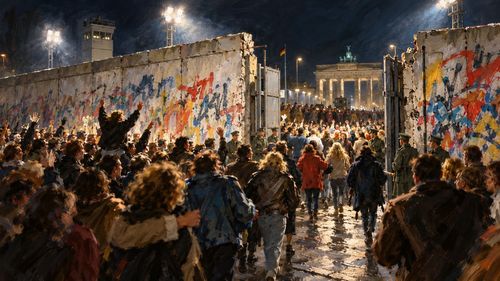
November 9: The Wall Falls, a Nation Freed, a Mystery Ends Three November 9ths defined by endings — of a wall that divided a continent, of a colonial relationship that had run its course, and of a terror in the London fog that stopped as inexplicably as it had begun Endings arrive in different ways. Some come as crowds surging toward a checkpoint, hammers raised, concrete giving way to the chisels of people who had waited twenty-eight years for this night. Some come in the formal language of treaties and declarations — a flag lowered, a handshake, a sovereignty transferred after decades of colonial administration. And some come in silence, with no explanation — a series of murders that had terrified a city for months, and then simply stopped, leaving behind only victims, theories, and one of history's most durable unsolved mysteries. November 9 holds all three kinds of ending: the jubilant, the dignified, and the unresolved. Mauerfall   On the evening of November 9, 1989, an East German Communist Party spokesman named Günter Schabowski held a press conference in East Berlin and, in response to a question from an Italian reporter, announced that new regulations allowing East Germans to travel freely to the West would take effect — he shuffled his papers — "immediately, without delay." Schabowski had not been in the meeting where the policy was discussed and did not know it was supposed to take effect the following morning after proper processing procedures were established. He had been handed the information minutes before the press conference. His answer was broadcast live across both East and West German television, and within hours, crowds had gathered at every checkpoint along the Berlin Wall, demanding passage. The guards, with no orders and no guidance, eventually stood aside. The wall was open. People poured through. The Berlin Wall had been built in August 1961 to stop the hemorrhage of East Germans — educated, skilled, and disillusioned — crossing to the West. In twenty-eight years it had killed an estimated 140 people attempting to cross it and had become the most potent physical symbol of the Iron Curtain, of the Cold War's division of Europe into two ideological blocs separated by wire and concrete and armed guards with orders to shoot. Its fall on November 9, 1989 was not a military defeat but a bureaucratic accident accelerated by the irresistible force of a population that had decided it was done. Within the year, Germany was reunified. Within two years, the Soviet Union had dissolved. The Cold War that the Wall had embodied for twenty-eight years ended, in practical terms, on the night a spokesman read from a piece of paper he didn't fully understand and changed the world.   The Berlin Wall on the night of November 9, 1989 — where twenty-eight years of division ended because a spokesman read from a piece of paper he hadn't been properly briefed on. Kingdom of Cambodia On November 9, 1953, Cambodia achieved full independence from France, completing a transition that King Norodom Sihanouk had pursued through a combination of diplomatic pressure, international appeals, and what he called his "Royal Crusade for Independence" — a personal campaign that included going abroad and refusing to return until France agreed to full sovereignty. France had administered Cambodia as a protectorate since 1863 and as part of French Indochina since 1887, a colonial relationship that had disrupted traditional Khmer governance while leaving the country's agricultural economy largely underdeveloped and its population largely excluded from political power. The independence that arrived on November 9, 1953 came as part of the broader wave of decolonization that was transforming Asia and Africa in the years following World War II. The Cambodia that gained independence in 1953 faced an uncertain future. Sihanouk, who had maneuvered skillfully to achieve sovereignty, dominated the country's politics for the following two decades — navigating the Cold War's competing pressures with a neutralist policy that grew increasingly difficult to sustain as the Vietnam War intensified and American bombing campaigns targeted North Vietnamese supply routes through Cambodian territory. A 1970 coup removed Sihanouk while he was abroad. The civil war that followed drew Cambodia into the Vietnam conflict's vortex, and the Khmer Rouge — radical agrarian communists who would go on to commit one of the twentieth century's worst genocides — ultimately seized power in 1975. The independence that Cambodia gained on November 9, 1953 did not guarantee stability, peace, or the protection of its people from what came next. It guaranteed, at least, that what came next would be Cambodia's own reckoning to navigate. The Cambodian landscape — a country whose independence on November 9, 1953 came after ninety years of French colonial rule, and whose future would prove as complicated as its path to sovereignty. ❦ Whitechapel, 1888   On November 9, 1888, Mary Jane Kelly was murdered in her room at 13 Miller's Court in Whitechapel, East London — the most brutal of the killings attributed to the unidentified murderer known as Jack the Ripper, and the last. Kelly, twenty-five years old and an Irish-born sex worker, was killed in the early hours of the morning in the only indoor murder attributed to the Ripper, which allowed the killer substantially more time than the street murders had permitted. The Metropolitan Police's investigation, already under strain from the four preceding killings that began in August 1888, intensified after Kelly's death — and then, without explanation, the murders stopped. No further killings were attributed to the same perpetrator. The case was never solved. The investigation was formally closed in 1892. The five canonical Ripper victims — Mary Ann Nichols, Annie Chapman, Elizabeth Stride, Catherine Eddowes, and Mary Jane Kelly — were women living in extreme poverty in one of London's most destitute neighborhoods, surviving in conditions that the Victorian city's wealthier residents preferred not to think about. Their murders became a sensation, covered obsessively by a press that was simultaneously horrified and eager, and they have remained in public consciousness ever since — not primarily as the women they were, but as components of a mystery. More than a hundred suspects have been named over the following century and more, with theories ranging from the plausible to the baroque. The identity of Jack the Ripper has never been established to the satisfaction of any serious historical standard. What November 9, 1888 ended was not a case — it was a killing spree. The case, in the truest sense, never ended at all.   Whitechapel, East London in 1888 — where the murders attributed to Jack the Ripper ended on November 9, as inexplicably as they had begun, leaving behind victims, theories, and no answer.


21 October 2026

Post

Nov. 8, 2006: Mercury Crosses the Sun

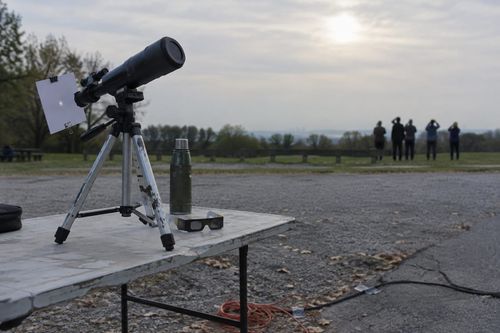
On Nov. 8, 2006, Mercury Slipped Across the Face of the Sun, and Astronomers Around the Pacific Watched the Smallest Planet Make a Rare Crossing A tiny black dot, a few hours, and a century-old method for measuring the heavens, all in one afternoon sky. On Nov. 8, 2006, the innermost planet did something it manages only about a dozen times a century: it passed directly between Earth and the Sun. From western North America across the Pacific, anyone with proper solar filters could watch a speck of Mercury inch across the solar disk. A Dot on the Sun   A transit of Mercury is easy to describe and hard to see. The planet is so small and so far away that it appears as a tiny, perfectly round black dot, far too minuscule to be seen without magnification. Looking at the Sun without proper protection is dangerous, so observers used solar-filtered telescopes or projected the Sun's image onto a screen. The 2006 crossing took several hours, and the best views were from the Pacific region and the western Americas, where the Sun was well above the horizon for at least part of the event. Backyard enthusiasts and professional observatories alike lined up their instruments, and the pinpoint silhouette drifted steadily from one edge of the Sun toward the other. Unlike a solar eclipse, nothing about the sky darkened. The Sun carried on exactly as bright as ever, with one small, steady blemish making its way across the glare. For viewers expecting spectacle, the drama was in the patience. The event also carried scientific history. Astronomers have long used planetary transits to refine measurements of the solar system, and timing Mercury's contacts with the Sun's edge has been a classic test of orbital predictions for centuries. In 2006, the Sun was also being watched from space by newer tools, including the Japanese-led Hinode observatory, launched only weeks earlier, and the long-running SOHO spacecraft. The irony was hard to miss: with spacecraft studying the Sun in extraordinary detail, one of the afternoon's most closely followed sights was a small dark dot that anyone with a filtered lens could follow by eye. Mercury's next crossing came in 2016, and then again in 2019, which made the 2006 transit a reminder that some of astronomy's best shows arrive on a schedule, and then make you wait.  

21 October 2026

Post

November 8: The Invisible Light, the Survivor, the Typhoon

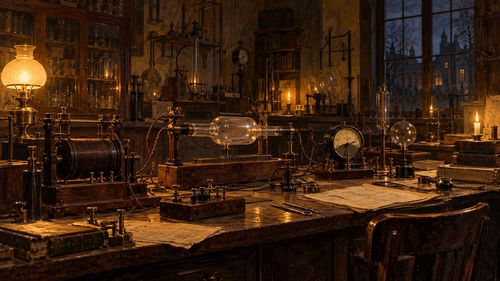
November 8: The Invisible Light, the Survivor, the Typhoon Three November 8ths defined by moments that revealed what was hidden — light through flesh and bone, a killer beneath a disguise, and the full force of what a warming ocean can build November 8 has three times asked us to look at what had been concealed. A physicist in Würzburg noticed a strange fluorescence and spent six weeks confirming what it meant — that a new kind of ray could pass through human flesh and cast the shadow of bone onto a photographic plate, making the interior of the body visible for the first time in medical history. A young woman in a Utah shopping mall recognized, with a split-second clarity that saved her life, that the man beside her was not who he claimed to be — and fought her way out of his car. And an archipelago in the Pacific received a storm of such unprecedented power that it stripped entire communities from the coastline and forced the world to reckon with what the ocean is capable of when the atmosphere above it has been warming for decades. A New Kind of Ray   On November 8, 1895, Wilhelm Conrad Röntgen was working late in his laboratory at the University of Würzburg in Bavaria, experimenting with cathode ray tubes — glass vacuum tubes that produced a beam of electrons when a current was passed through them — when he noticed something unexpected. A fluorescent screen across the room, which should not have been reacting to the cathode rays being contained within the tube, was glowing. Röntgen covered the tube with black cardboard. The screen still glowed. He moved it farther away. It still glowed. He was observing something that penetrated the cardboard and traveled across the room — something that no known ray or particle could do. He spent the next six weeks alone in his laboratory, barely eating or sleeping, confirming what he had found and ruling out every alternative explanation before announcing his discovery on December 28. Röntgen called his discovery X-rays — the X denoting an unknown quantity, a name that stuck despite his own preference for "Röntgen rays," which is what they are called in German to this day. The first X-ray image he produced was of his wife Anna Bertha's hand, showing the bones of her fingers and the ring she wore — an image she reportedly found unsettling. Röntgen was awarded the first Nobel Prize in Physics in 1901. Within a year of his December 1895 announcement, X-ray machines were being used in hospitals across Europe and North America. Within a decade, they were standard in military medicine. The discovery he made by noticing a glowing screen on November 8, 1895 has since been used billions of times to look inside the human body — to find broken bones, tumors, tuberculosis, swallowed objects, and the structural causes of pain that would otherwise have remained invisible. Medicine before X-rays and medicine after them are, in a practical sense, two different disciplines.   A late 19th-century physics laboratory — the kind of space where Wilhelm Röntgen spent six solitary weeks in 1895 confirming a discovery that would change medicine forever. Murray, Utah On the evening of November 8, 1974, eighteen-year-old Carol DaRonch was approached in the Fashion Place Mall parking lot in Murray, Utah, by a man who identified himself as a police officer and told her that her car had been broken into and she needed to come with him. DaRonch had not noticed anything wrong with her car, but she complied. The man drove her not to a police station but to a dark side street, where he stopped the car and attempted to handcuff her. In the struggle that followed — terrifying, brief, and decided by the young woman's refusal to stop fighting — DaRonch managed to open the car door and throw herself out onto the pavement. A passing couple stopped and drove her to safety. The man who had taken her was Ted Bundy, who would go on to confess to the murders of at least thirty women before his execution in 1989. Carol DaRonch's escape was not simply a matter of survival — it became the legal cornerstone of the case against Bundy. She was the witness who could identify him, whose physical evidence connected him to an attempted kidnapping charge, and whose testimony at his 1976 Utah trial resulted in the conviction that placed him in prison for the first time. Bundy escaped from custody twice before being captured again in Florida, where he was ultimately tried and convicted for murders he committed after his escapes. DaRonch testified again at proceedings related to his case and has spoken publicly about her experience, including in Netflix's 2019 documentary series about Bundy. Her name belongs in the story not as a victim but as a survivor whose courage, presence of mind, and willingness to testify helped stop someone who might otherwise have continued indefinitely. November 8, 1974 is her night — not his. A 1970s suburban shopping mall parking lot — the setting where Carol DaRonch's courage and presence of mind on November 8, 1974 made her one of the few people to escape Ted Bundy and live to testify against him. ❦ Yolanda   On November 8, 2013, Super Typhoon Haiyan — known in the Philippines as Typhoon Yolanda — made landfall on the island of Leyte with sustained winds of approximately 195 miles per hour, making it one of the most powerful tropical cyclones ever recorded at the time of landfall. The storm surge that accompanied the winds was catastrophic: walls of water up to twenty feet high swept inland across low-lying coastal communities, destroying everything in their path with a speed and force that left survivors with almost no time to reach high ground. The city of Tacloban, Leyte's largest urban center and home to more than 200,000 people, was among the worst affected — its coastal neighborhoods obliterated, its airport flooded, its streets filled with debris and the dead. The official death toll reached 6,300. More than four million people were displaced. The storm caused an estimated $2.86 billion in damage. Haiyan arrived at a moment of particular scientific awareness about the relationship between warming ocean temperatures and the intensity of tropical storms — and it demonstrated, with devastating specificity, what that relationship means at human scale. The Philippines is among the world's most typhoon-prone nations, experiencing an average of twenty tropical cyclones per year, and its geography — a sprawling archipelago of more than seven thousand islands with long, low-lying coastlines — makes it acutely vulnerable to exactly the kind of storm surge that Haiyan produced. The international humanitarian response was substantial, with more than ninety countries contributing aid. Philippine officials delivered an impassioned plea for climate action at the UN Climate Conference that opened days after the typhoon. Haiyan has been cited in every major climate report since as a concrete example of what extreme weather intensification looks like when it arrives at a populated coast.   The Philippine coastline — one of the world's most typhoon-prone landscapes, where Haiyan's storm surge demonstrated on November 8, 2013 what a warming ocean can build and what it can take.

21 October 2026

Post

Nov. 7, 2006: Democrats Seize the House

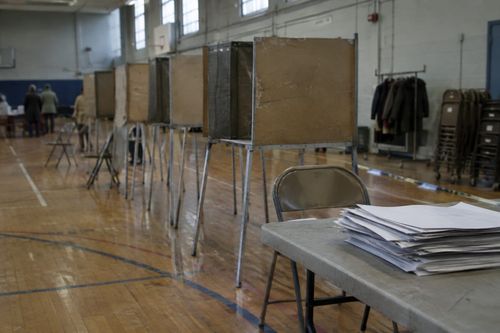
On Nov. 7, 2006, American Voters Handed Democrats the House for the First Time in 12 Years, and the Iraq War Was on the Ballot A midterm election framed as a verdict on the Iraq War ended a dozen years of Republican control of the House and put Nancy Pelosi on the path to the Speaker's gavel. Election Day 2006 fell on Nov. 7, with President George W. Bush's name on no ballot and yet at the center of nearly every race. By the time the polls closed, the midterm had become a national referendum on the war in Iraq and on the Republican Congress that had backed it, and the results would reshape Washington. The Midterm Wave   Republicans had controlled the House since the 1994 elections, and they entered the fall of 2006 on the defensive. Polls showed voters unhappy with the direction of the war, and a string of scandals on Capitol Hill had added to the party's troubles. Democrats, led in the House by Nancy Pelosi of California, campaigned on the idea that the country needed a change in direction and a check on the White House. On election night, the results rolled in across the East and Midwest, and the pattern was clear early: Republican incumbents who had seemed safe were losing seats, and Democrats picked up ground in districts that had not elected one of their candidates in years. By the end of the night, the party had taken the House, ending twelve years of Republican majorities. For a Congress that had spent much of the Bush presidency in lockstep with the executive branch, the voters had delivered a pointed change of plans, and they had done it on a day when the president himself was not running for anything. The Senate was slower to settle. Close races in Montana and Virginia kept control in doubt for days, and Democrats ultimately secured a narrow majority when Jim Webb's razor-thin win in Virginia held up after a few tense days. The political fallout moved quickly. The day after the election, Bush announced that Defense Secretary Donald Rumsfeld, the public face of the Iraq war, was resigning. Pelosi, who had been the Republicans' favorite campaign target, was now in line to become the first woman to serve as Speaker of the House, a post she would claim in January 2007. It was a fitting twist for a campaign built on running against Washington's leaders: the villain of the ads became the next person to lead the chamber, and the architect of the war's strategy was out of a job before the votes were fully counted.  

21 October 2026

Post

November 7: Magic's Announcement, the Night That Wouldn't End

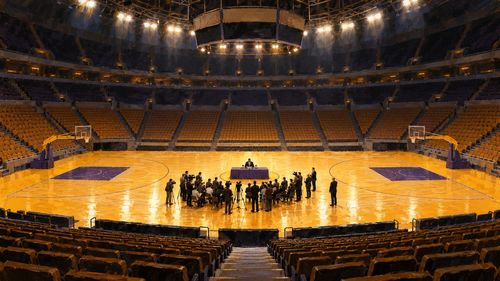
November 7: Magic's Announcement, the Night That Wouldn't End Two November 7ths defined by announcements that changed everything — a press conference that humanized a plague, and an election night that made history twice before anyone realized it wasn't over Some November 7ths ask more of us than others. In 1991, a man walked to a podium at the Forum in Inglewood, California, and said something that required enormous courage to say — and that changed, overnight, the way millions of Americans thought about a disease they had been encouraged to believe was someone else's problem. Nine years later, an election night that was supposed to deliver a verdict delivered something else entirely: a former First Lady walking into the Senate for the first time, and a presidential race that the networks called, uncalled, and called again before deciding they had no idea — a night that would stretch into thirty-six days and end in a Supreme Court chamber rather than a voting booth. The Press Conference   On November 7, 1991, Earvin "Magic" Johnson stood before reporters at the Great Western Forum in Inglewood, California, and announced that he had tested HIV-positive and would be retiring from professional basketball immediately. He was thirty-two years old, at the peak of his powers, a five-time NBA champion and three-time league MVP who had transformed the point guard position and, with his rival Larry Bird, rescued a league that had been struggling commercially in the late 1970s. The announcement was received with the particular shock of something that contradicts a fundamental assumption: HIV/AIDS had been framed, in the American public conversation of the 1980s, as a disease of gay men and intravenous drug users. Magic Johnson was neither. His diagnosis forced a reckoning with the reality that a virus does not sort by identity. Johnson's press conference did not simply inform — it transformed. Donations to AIDS research organizations surged in the days that followed. Calls to HIV testing hotlines increased dramatically. The conversation about AIDS in schools, workplaces, and homes that had been delayed for a decade by stigma and willful ignorance could no longer be avoided. Johnson himself became one of the most visible advocates for HIV awareness and safe sex education, serving briefly on President George H.W. Bush's AIDS commission before resigning in frustration over the administration's inadequate response. He returned to the NBA in 1992 for the All-Star Game and played on the United States Olympic "Dream Team" that summer. He attempted a full comeback with the Lakers in 1996 and played thirty-two games before retiring again at thirty-six. He has lived with HIV for more than three decades, his health sustained by the antiretroviral medications that the AIDS advocacy movement — in which his announcement played a galvanizing role — helped bring to wider availability. The press conference he gave on November 7, 1991 is credited by public health researchers with measurably changing American behavior around HIV prevention.   The Great Western Forum in Inglewood — where Magic Johnson's November 7, 1991 announcement forced a nation to confront what it had spent a decade choosing not to see about HIV/AIDS. Election Night, 2000 On November 7, 2000, Americans went to the polls to choose between Vice President Al Gore and Texas Governor George W. Bush — and the evening that followed became one of the most extraordinary nights in the history of American electoral politics. As results came in from across the country, it became clear that the race was historically close, with the outcome depending on Florida's twenty-five electoral votes. The networks called Florida for Gore early in the evening, then retracted the call. They called it for Bush after midnight, then retracted that call too. By the early hours of November 8, with the race still undecided and Florida too close to call, the nation went to sleep not knowing who its next president would be. It would not know for thirty-six days. What that same election night also produced, in the quieter register of a Senate race in New York, was a different kind of history. Hillary Rodham Clinton — former First Lady, Yale-trained attorney, and first-term political candidate who had moved to New York specifically to run for the seat being vacated by Daniel Patrick Moynihan — defeated Republican Rick Lazio by twelve percentage points to become the first former First Lady elected to the United States Senate. Clinton had entered the race as a celebrity candidate with no record of elected office and had faced predictable questions about her carpetbagging residency and the appropriateness of her ambitions. She won decisively. The race for the White House that night may have ended in legal chaos and a Supreme Court decision, but the race for a Senate seat in New York ended clearly, and with a result that would shape American politics for the following quarter century. The same evening that produced the most contested presidential election in modern history also produced, without quite as much fanfare, a senator who would run for president twice herself. Election night 2000 — the night the networks called Florida twice and retracted both calls, producing the most contested presidential result in modern American history and a Senate race that delivered its verdict clearly. ❦ Thirty-Six Days   The Florida recount that followed election night 2000 became a national obsession and a constitutional stress test. With Bush leading Gore by a margin that shrank with every recount — ultimately to 537 votes out of nearly six million cast in Florida — the question of which ballots to count, how to count them, and who had the authority to make those decisions wound through Florida's county canvassing boards, its state courts, its Supreme Court, and ultimately to the United States Supreme Court. Terms that had been the province of election administrators — hanging chad, butterfly ballot, undervote — entered the national vocabulary. Armies of lawyers descended on Florida. The world watched with a mixture of fascination and alarm as the most powerful democracy on earth appeared unable to determine who had won its most important election. On December 12, 2000 — thirty-six days after election night — the Supreme Court issued its 5-4 decision in Bush v. Gore, halting the Florida recount and effectively handing the presidency to George W. Bush. Al Gore, who had won the national popular vote by more than 500,000 votes, conceded the following day in a speech that called for unity and accepted the Court's ruling as final. The legal and political arguments about what happened in Florida in November and December of 2000 — about the butterfly ballot design that may have cost Gore thousands of votes in Palm Beach County, about the differing standards applied to ballots in different counties, about the Court's unprecedented intervention in an election dispute — have continued ever since. What is beyond dispute is that the night of November 7, 2000 produced an outcome that thirty-six days of lawyers, judges, and chad-examiners could not fully resolve — and that the presidency it ultimately awarded shaped the first decade of the twenty-first century.   The United States Supreme Court — where thirty-six days after election night, the 2000 presidential race found its ending in a 5-4 decision that legal scholars have debated ever since.

21 October 2026

Post

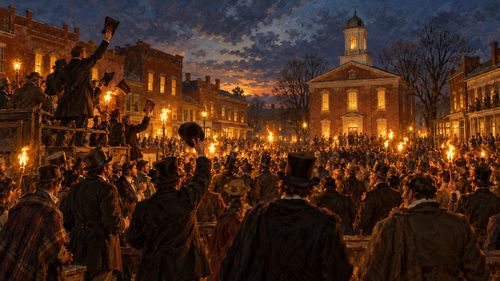
November 6: Lincoln Elected, Apartheid Condemned, a Senate First

November 6: Lincoln Elected, Apartheid Condemned, a Senate First Three November 6ths defined by elections and verdicts that forced the question of who belongs — in the American experiment, in the international community, and in the halls of the Senate The question of who belongs — who is counted, who is protected, whose dignity the law is willing to enforce — has driven more of history's turning points than any other. November 6 has asked that question three times, in three different centuries, in three very different arenas. A nation that had been arguing about slavery for decades elected a president whose position on the question made seven states decide they would rather leave before he was even inaugurated. An international body looked at a government that had built an entire legal architecture around exclusion and said, formally and on the record, that it would not accept what it saw. And a senator from Wisconsin walked into the world's most exclusive legislative chamber and made it, for the first time, a little less exclusive. The Election That Split a Nation   On November 6, 1860, Abraham Lincoln was elected the sixteenth President of the United States — and within weeks, the country he had been elected to lead began to come apart. Lincoln, a one-term Illinois congressman who had lost a Senate race to Stephen Douglas two years earlier, had won the Republican nomination in May and ran on a platform that opposed the expansion of slavery into new territories while stopping short of calling for its immediate abolition where it existed. It was enough. Southern states had made clear that Lincoln's election would be treated as cause for secession, and they were as good as their word: South Carolina voted to leave the Union in December 1860, followed by six more states before Lincoln was inaugurated in March 1861. The election that Lincoln won on November 6 set in motion the Civil War that would cost more than 600,000 lives. Lincoln had won the electoral college with 180 votes but received less than forty percent of the popular vote — his name did not even appear on the ballot in ten Southern states. The result was the consequence of a Democratic Party that had split along sectional lines, running two separate candidates, and a Constitutional Union party that further divided the anti-Lincoln vote. His minority popular vote did not diminish the legitimacy of his victory, but it illustrated the depth of the division he was inheriting. What Lincoln would do with that inheritance — the Emancipation Proclamation, the prosecution of the war to its conclusion, the Gettysburg Address, the Second Inaugural — became the measure by which American presidents have been judged ever since. The man elected on November 6, 1860, is consistently ranked first among them.   Springfield, Illinois on election night 1860 — where Abraham Lincoln learned he had won a presidency that would immediately begin pulling the nation it governed apart. The World Says No On November 6, 1962, the United Nations General Assembly passed Resolution 1761, calling on member states to impose diplomatic, economic, and transport sanctions against South Africa in response to the country's apartheid system — the comprehensive legal regime of racial segregation that the National Party government had been constructing since 1948. The resolution condemned apartheid as a violation of the UN Charter and the Universal Declaration of Human Rights, and created a Special Committee Against Apartheid to monitor the situation and coordinate international pressure. It was the first significant international institutional action against the South African government's racial policies, and it arrived at a moment when the domestic anti-apartheid movement — whose leaders included Nelson Mandela, then on trial and facing life imprisonment — was being subjected to increasingly brutal suppression. The resolution did not end apartheid. The sanctions it called for were not immediately implemented by the major Western powers, many of which had significant economic interests in South Africa and were reluctant to act on principle at the cost of profit. The United States and Britain abstained from the vote. It would take more than two decades of sustained international pressure, escalating sanctions, and the internal resistance of the South African people before the apartheid government began to negotiate its own dismantlement in the early 1990s. What the 1962 resolution established was the international framework — the formal declaration that apartheid was a global concern rather than a domestic matter — that made those eventual sanctions morally and legally coherent. Nelson Mandela was released from prison in 1990 and elected president of a democratic South Africa in 1994. The road from November 6, 1962 to that outcome was long and the human cost was enormous. The resolution was the first step on it. The United Nations General Assembly — where on November 6, 1962, the international community formally declared that apartheid was the world's business, not South Africa's alone. ❦ Wisconsin's Senator   On November 6, 2012, Tammy Baldwin won the Wisconsin Senate race against former governor Tommy Thompson, becoming the first openly gay person elected to the United States Senate. Baldwin had previously served seven terms in the House of Representatives, where she had been one of the first openly gay members of Congress and had built a legislative record focused on healthcare, workers' rights, and veterans' issues. Her Senate victory came on the same night that voters in three states — Maine, Maryland, and Washington — approved same-sex marriage by popular referendum for the first time, making November 6, 2012 one of the most significant single days in the history of LGBTQ civil rights in America. Baldwin won by nearly six percentage points in a state that had twice elected her Republican opponent to statewide office. Baldwin's election to the Senate reflected a shift in American public opinion on LGBTQ equality that had been building for a decade and would accelerate dramatically in the years that followed — culminating in the Supreme Court's 2015 ruling in Obergefell v. Hodges that established a constitutional right to same-sex marriage nationwide. She has been reelected twice since 2012 and has continued to focus her Senate work on economic issues, healthcare access, and the concerns of working-class Wisconsin voters alongside her advocacy for LGBTQ rights. The barrier she broke on November 6, 2012 was real, but her Senate career has been defined less by the historic nature of her election than by the work she has done in the chamber she entered — which is, perhaps, exactly as it should be.   The United States Capitol — the building Tammy Baldwin entered on November 6, 2012, as the first openly gay person elected to the Senate in American history.

21 October 2026

Post

Nov. 5, 2008: Obama Wins the Presidency

Nov. 5, 2008: The Morning After Barack Obama Was Elected the 44th President of the United States After a long campaign and a night of returns, America woke up to a president-elect no earlier election had produced. On the morning of Nov. 5, 2008, the United States woke to a new political reality. The night before, Barack Obama, a first-term senator from Illinois, had won the presidency over Arizona Senator John McCain, becoming the first Black president-elect in the nation's history. The result had been called by the networks shortly after the West Coast polls closed at 11 p.m. Eastern. The Long Night   Obama's victory came after a campaign that began in Springfield, Illinois, in February 2007 and outlasted a bruising Democratic primary against Hillary Clinton. By the end, he had carried states that Democrats had struggled to win for years, including Virginia, Indiana and North Carolina, and he won Ohio and Florida. He finished with 365 electoral votes to McCain's 173, well past the 270 needed. The popular vote ran roughly 53 percent to 46 percent. Turnout was among the highest in decades, and the contest unfolded against a financial crisis that had dominated the final weeks of the race. McCain conceded in Phoenix, telling supporters that Americans had spoken and acknowledging the significance of the result for the country's history of race. The man who had been a little-known state legislator little more than a decade earlier now held the most powerful elected office in the world, a rise that few election forecasters would have predicted at the start. Obama delivered his victory speech before a vast crowd in Chicago's Grant Park, a city park that had also been a stage for turbulent protests during the 1968 Democratic National Convention. He opened by saying that if anyone still doubted that America is a place where all things are possible, tonight was their answer. He also cautioned that the road ahead would be long, and that the climb would be steep. Crowds gathered in cities across the country and abroad, and newspapers printed extra editions the next morning that sold out quickly in many places. Obama was inaugurated on Jan. 20, 2009, inheriting a recession and two wars. The celebration, in other words, lasted about as long as the night itself, and the work began almost at once.  

21 October 2026

Post

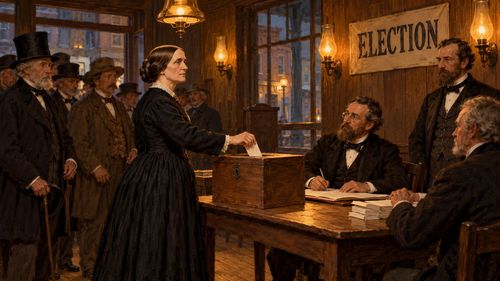
November 5: The Illegal Vote, the Third Term, the Order to Strike

November 5: The Illegal Vote, the Third Term, the Order to Strike Three November 5ths defined by decisions that broke the rules — a woman who voted when the law said she couldn't, a president who ran when tradition said he shouldn't, and a military command that set in motion something the world would not survive unchanged Some rules exist to protect institutions. Others exist to protect the people who benefit from keeping others out. November 5 has witnessed both kinds being broken — by a woman who walked into a barbershop polling place in Rochester and cast a ballot she believed the Constitution already entitled her to cast, by a president who looked at Europe falling to fascism and decided that this was not the moment to honor a tradition, and by a military command that authorized a strike against an American naval base and set in motion a war that would cost fifty million lives. Three November 5ths. Three rule-breaking decisions. Three very different kinds of consequence. Rochester, 1872   On November 5, 1872, Susan B. Anthony walked into a barbershop on West Street in Rochester, New York — which served, as many businesses did in that era, as a polling place — and cast a ballot in the presidential election between Ulysses S. Grant and Horace Greeley. She was fifty-two years old, she had spent more than twenty years campaigning for women's suffrage, and she had convinced the election inspectors to register her two weeks earlier by arguing that the Fourteenth Amendment's guarantee of citizenship rights applied to women as much as men. Fourteen other women voted with her that day. Two weeks later, a deputy US marshal appeared at her Rochester home and placed her under arrest for "knowingly, wrongfully, and unlawfully" voting in a federal election. The trial that followed, in June 1873, became a national event — not least because the judge, Ward Hunt, had written his verdict before the trial began and refused to allow Anthony to testify on her own behalf or to submit the case to the jury, simply reading his prepared guilty verdict from the bench. He fined her $100. Anthony refused to pay it and never did. She also used every public moment the trial afforded her — the sentencing, the press coverage, the speaking tours she conducted while awaiting and during the proceedings — to advance the argument that the Constitution already guaranteed her the right she had exercised. It did not yet, legally. The Nineteenth Amendment that finally secured women's right to vote would not be ratified until 1920, fourteen years after Anthony's death. She had voted in 1872 knowing that the law might not protect her. She was right. She voted anyway.   A 19th-century American polling place — the kind of modest storefront space where Susan B. Anthony cast her illegal ballot on November 5, 1872, and where the long argument for women's suffrage took a decisive public turn. Four More Years On November 5, 1940, Franklin D. Roosevelt won the presidential election by a commanding margin, defeating Republican Wendell Willkie with 449 electoral votes to 82 and capturing fifty-five percent of the popular vote. The victory was remarkable not only for its scale but for what it required Roosevelt to break: the two-term tradition established by George Washington and honored, as a matter of democratic custom rather than constitutional requirement, by every president for 144 years. Roosevelt had decided to seek a third term as Nazi Germany consumed Western Europe and Britain stood alone against Hitler's forces — reasoning that changing the nation's leadership at the moment of maximum global peril was a risk the country could not afford to take. His Republican opponents called it a power grab. His supporters called it a necessity. The voters, by a margin of five million, called it an election. The tradition Roosevelt broke had been strong enough to feel, to many Americans, like a constitutional prohibition — but it was not one. The Twenty-Second Amendment, which formally limited presidents to two terms, was not ratified until 1951, six years after Roosevelt's death, enacted specifically in response to his four consecutive victories. Roosevelt would go on to win a fourth term in 1944, making him the only president in American history to be elected more than twice. He died in office on April 12, 1945, three weeks before Germany's surrender. The third term he won on November 5, 1940 — the one that broke Washington's tradition — would be followed by the wartime presidency that defined both his legacy and the twentieth century. An American living room on election night, 1940 — where families gathered around their radios to learn that Franklin Roosevelt had broken a 144-year tradition and won a third term. ❦ Tora, Tora, Tora   On November 5, 1941, Japanese Imperial Headquarters issued the final operational orders for the attack on Pearl Harbor — the decision that committed Japan to war with the United States at a moment when both nations were still formally engaged in diplomatic negotiations. The orders authorized the plan developed by Admiral Isoroku Yamamoto: a surprise air strike by carrier-based aircraft against the U.S. Pacific Fleet at anchor in Pearl Harbor, Hawaii, timed for early December and designed to cripple American naval power in the Pacific in a single blow. The strike was predicated on a calculated gamble — that destroying the American fleet before the United States could mobilize would give Japan time to consolidate control over Southeast Asian oil fields, rubber plantations, and other resources, and to establish a defensive perimeter strong enough to make reconquest too costly to attempt. The attack that followed on December 7, 1941 — thirty-two days after the orders were signed — killed 2,403 Americans, wounded nearly 1,200 more, and destroyed or damaged eighteen naval vessels and 188 aircraft. It brought the United States into World War II. Yamamoto, who had studied in the United States and understood American industrial capacity better than most of his colleagues, had opposed going to war and had argued against the Pearl Harbor plan on strategic grounds. He understood what the orders of November 5 had actually committed Japan to: not a crippling blow and a negotiated settlement, but a war against a nation whose productive power would eventually be brought to bear with overwhelming force. He is reported to have said, after the attack succeeded, that Japan had awakened a sleeping giant and filled it with a terrible resolve. Whether he said it or not, he knew it was true.   Pearl Harbor, Hawaii — the target of the orders signed on November 5, 1941, and the place where the world changed thirty-two days later.

21 October 2026

Quiz

Cultured

Museum-lover? Art aficionado? Put your knowledge to the test!...

21 October 2026

Quiz

Civics Class

Hope you paid attention in civics class - it's your time to shine!...

21 October 2026

Quiz

Back in My Day

We walked uphill to school - both ways! How well do you know nostalgia?...

21 October 2026

Quiz

Couch Potato

See if your binge-watching has paid off!...

21 October 2026

Quiz

Armchair Quarterback

From the Olympics to the Gridiron - how well do you know your stuff?...

21 October 2026

Quiz

Smarty Pants

Do you know your beakers from your bunsen burners?...

21 October 2026

Quiz

Name That Era

How well do you know music history?...

21 October 2026

Quiz

How Well Do You Know American History?

Test your smarts with this history quiz!...
Terms and ConditionsDo Not Sell or Share My Personal InformationPrivacy PolicyPrivacy NoticeAccessibility NoticeUnsubscribe
Copyright © 2026 Day In History