September 28: A Scandal Breaks, a Shore Is Reached, and a Rocket Finally Makes It
September 28 is a day for arrivals that changed what came after. In 1920, a Chicago grand jury handed down indictments against eight members of the White Sox baseball team, and what had been a rumor became an official accusation: that eight men had accepted money to lose the World Series on purpose, and that the national pastime had been for sale. In 1542, a Spanish navigator named Juan Rodríguez Cabrillo dropped anchor off what is now San Diego, becoming the first European to set foot on the Pacific coast of what would become the United States — opening a coastline to European ambition that the continent's geography had kept hidden from the Atlantic approach. And in 2008, after three failed attempts, a SpaceX Falcon 1 rocket reached orbit, making the company the first privately owned enterprise to put a liquid-fueled rocket into space — the opening move of an era in which the business of reaching orbit was no longer exclusively the province of governments. Three September twenty-eighths. Three moments when something that had been closed, or hidden, or merely attempted, became real.
Say It Ain't So
On September 28, 1920, a Cook County grand jury indicted eight members of the Chicago White Sox — pitchers Eddie Cicotte and Claude Williams, outfielders Shoeless Joe Jackson and Happy Felsch, first baseman Chick Gandil, shortstop Swede Risberg, third baseman Buck Weaver, and utility player Fred McMullin — on charges that they had conspired with gamblers to intentionally lose the 1919 World Series to the Cincinnati Reds in exchange for $100,000. The conspiracy, which had been whispered about since the Series itself, had been an open secret in certain gambling circles for months; a grand jury investigation had been convened in the summer of 1920, and several of the players had given confessions before the September 28 indictments made the affair public. The scandal — quickly dubbed the "Black Sox" affair — devastated public confidence in a sport that had been presenting itself as the purest expression of American competitive virtue, and produced a crisis of legitimacy that the baseball establishment recognized it could not manage without fundamental structural change.
The aftermath of the indictments handed down on September 28, 1920, reshaped professional baseball. The eight players were acquitted at trial in 1921 — in part because their signed confessions had disappeared from the courthouse, under circumstances that have never been explained — but baseball's newly appointed Commissioner, Kenesaw Mountain Landis, banned all eight from the game for life, regardless of the acquittal. The ban has never been lifted; Shoeless Joe Jackson, whose .375 batting average in the 1919 Series suggested he had not thrown games as enthusiastically as some of his co-conspirators, remains excluded from the Hall of Fame more than a century after the indictments. The figure of Landis — an autocratic federal judge who accepted the commissioner role on condition of near-absolute authority — and the permanent ban he imposed established a precedent for how professional sports would treat integrity violations that has shaped baseball governance ever since. The apocryphal story of a boy approaching Jackson outside the courthouse and pleading "Say it ain't so, Joe" may or may not have happened. It has endured as the emotional epitaph of the scandal because it captured, more precisely than the indictment, what had actually been lost.

San Diego Bay, 1542
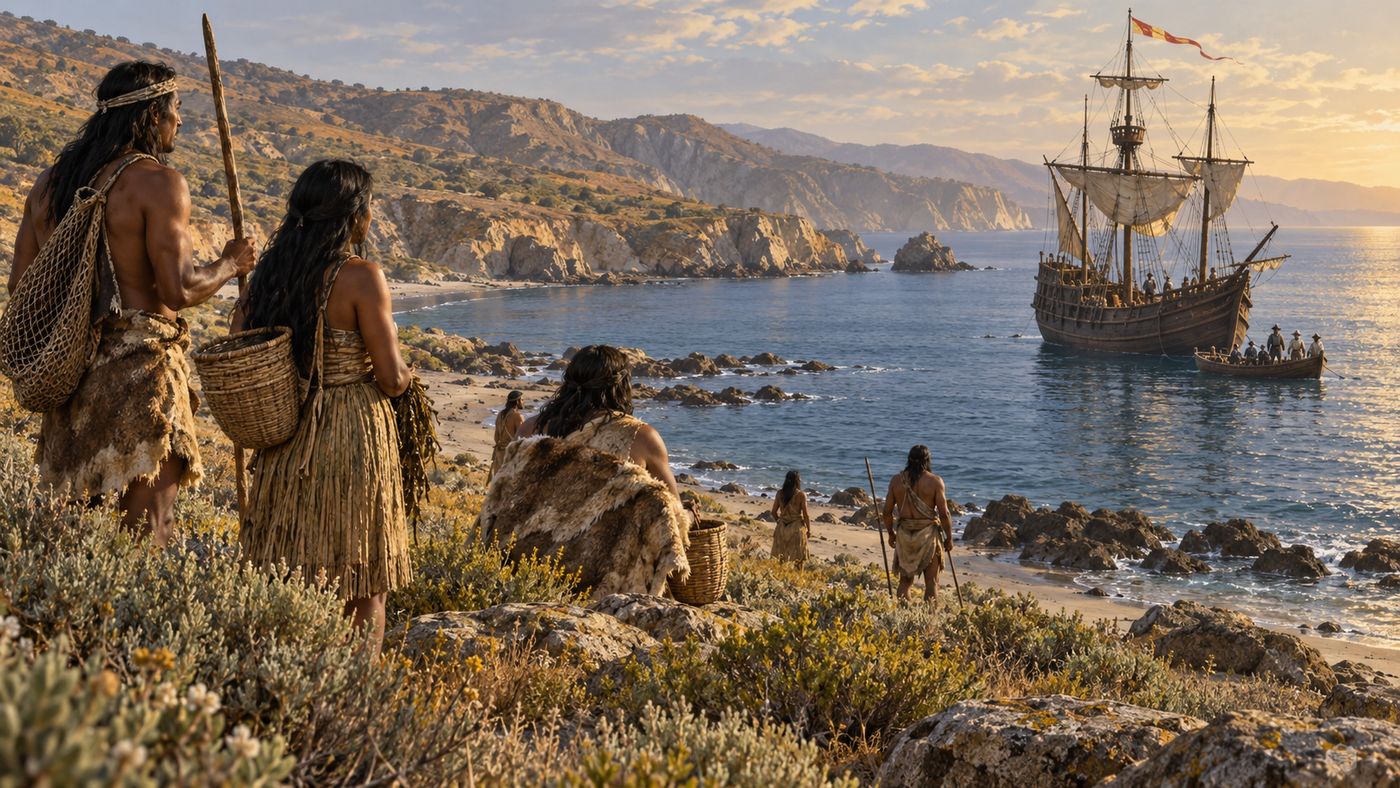
On September 28, 1542, Juan Rodríguez Cabrillo — a Portuguese-born navigator sailing under the flag of Spain — anchored in what is now San Diego Bay and became the first European to set foot on the Pacific coast of North America north of Baja California. Cabrillo had departed from the port of Navidad in western Mexico in June 1542 with two small ships — the San Salvador and the Victoria — under commission from the Viceroy of New Spain to explore the coast to the north in search of the mythical Strait of Anián, a supposed Northwest Passage connecting the Pacific and Atlantic, and any wealthy kingdoms that might be accessible from the coast. He found neither, but he documented the California coastline from San Diego to well north of present-day San Francisco, observing and making first contact with the Kumeyaay people near San Diego and numerous other Indigenous communities along his route.
The expedition that anchored in San Diego Bay on September 28, 1542, established Spain's claim to the California coast and opened a region that would not see sustained European settlement for more than two centuries — the first permanent Spanish missions in California were not established until 1769. Cabrillo himself died during the voyage, in January 1543, from complications of a broken limb suffered during a skirmish; his second in command, Bartolomé Ferrer, continued the expedition north before returning to Mexico. Cabrillo's logs and records were largely lost, and most of what is known about the expedition comes from a brief summary account. He is commemorated by the Cabrillo National Monument at the tip of Point Loma in San Diego — the site from which, in 1542, he first observed the bay that he named San Miguel, and that was later renamed San Diego by subsequent Spanish navigators. The coast he reached on September 28, 1542, was not settled, exploited, or built upon for generations; but the knowledge that it existed, and its approximate location and character, entered the European geographical record and shaped the ambitions that eventually produced the California that followed.
Falcon 1
On September 28, 2008, SpaceX's Falcon 1 rocket lifted off from Omelek Island in the Marshall Islands and successfully reached Earth orbit — the fourth launch attempt for the vehicle, after three consecutive failures that had nearly bankrupted the company and exhausted the patience of its investors. SpaceX had been founded in 2002 by Elon Musk, who had invested approximately $100 million of his own money in the company after selling his stake in PayPal, with the stated goal of reducing the cost of space access and ultimately enabling human settlement of Mars. The three previous Falcon 1 launches — in 2006, 2007, and earlier in 2008 — had each failed for different technical reasons, costing the company its payloads and an enormous amount of money it could not easily replace. The September 28 launch succeeded. The Falcon 1 became the first privately developed, liquid-fueled rocket to reach orbit — a milestone that had previously been achieved only by national space programs with government funding and decades of institutional development.
The successful Falcon 1 launch of September 28, 2008, was the proof of concept that sustained SpaceX through the development of the Falcon 9, the Dragon spacecraft, the Falcon Heavy, and the Starship program that followed. The company went on to win NASA contracts for cargo delivery to the International Space Station, for crewed missions to the ISS that ended American dependence on Russian Soyuz launches for crew transport, and for a range of commercial launch contracts that made SpaceX the dominant launch provider in the world by payload mass delivered to orbit. The reusable first-stage booster technology that SpaceX developed and demonstrated — landing rocket boosters vertically for reuse rather than discarding them in the ocean — transformed the economics of space launch in ways that have forced the entire industry, including the legacy aerospace contractors who had dominated government launch contracts for decades, to adapt or lose relevance. The rocket that finally reached orbit on September 28, 2008, after three failures, was a small vehicle carrying a modest payload. What it demonstrated about what private enterprise could do in space was not small at all.