What the Flag Carries
Today is Flag Day — the anniversary of the June 14, 1777 resolution that gave the United States its banner. This year it arrives in the middle of a World Cup, which means the Stars and Stripes is flying this weekend alongside the flags of 47 other nations in American cities from Los Angeles to Miami to Kansas City: the red and green of Portugal, the blue and white of Argentina, the golden eagle of Mexico, the Springbok colors of South Africa. No single summer in recent memory has put quite so many flags in quite so many American windows at quite the same time. It is, in its way, a reminder of what flags actually are — not just symbols of nations, but vessels for the things people cannot otherwise say.
From Fort McHenry to the Surface of the Moon
The American flag has been present at the defining moments of the national story in ways that no other object has matched. It flew over Fort McHenry through the British bombardment of September 1814 — a fifteen-stripe version sewn by Baltimore seamstress Mary Pickersgill, thirty by forty-two feet, large enough to be seen from the harbor — and its survival through the night inspired Francis Scott Key to write what became the national anthem. It was carried into Civil War battles by soldiers who understood that losing the regimental colors to the enemy was among the greatest dishonors a unit could suffer; men died protecting pieces of cloth because the cloth meant something beyond itself. It was raised at Iwo Jima in February 1945 in a photograph so iconic that its composition — six men, a pole, a volcanic hillside — became the model for the Marine Corps War Memorial in Washington. And on July 20, 1969, Neil Armstrong and Buzz Aldrin planted it in the lunar soil of the Sea of Tranquility, 238,855 miles from the nation that had sewn it. Five more flags followed on subsequent Apollo missions. All six are believed to still be standing, bleached white by decades of solar radiation — which, depending on how you feel about things, is either poignant or perfect.
But the flag's power has never been a simple or settled thing. The same object that is folded with military precision at a veteran's funeral and presented to a grieving family — thirteen folds, a specific ritual, a wordless acknowledgment of sacrifice — has also been burned in protest, worn as clothing in defiance of the Flag Code, and carried by demonstrators on opposite sides of nearly every major social argument in American history. The Supreme Court ruled in 1989, in Texas v. Johnson, that burning the flag is protected speech under the First Amendment — a decision that itself ignited a fierce national argument about what the flag means and who gets to define it. That argument has never fully resolved, and perhaps it never should. A flag that everyone agreed on completely would be a flag belonging to a country that had stopped arguing — and an America that had stopped arguing would not be America.
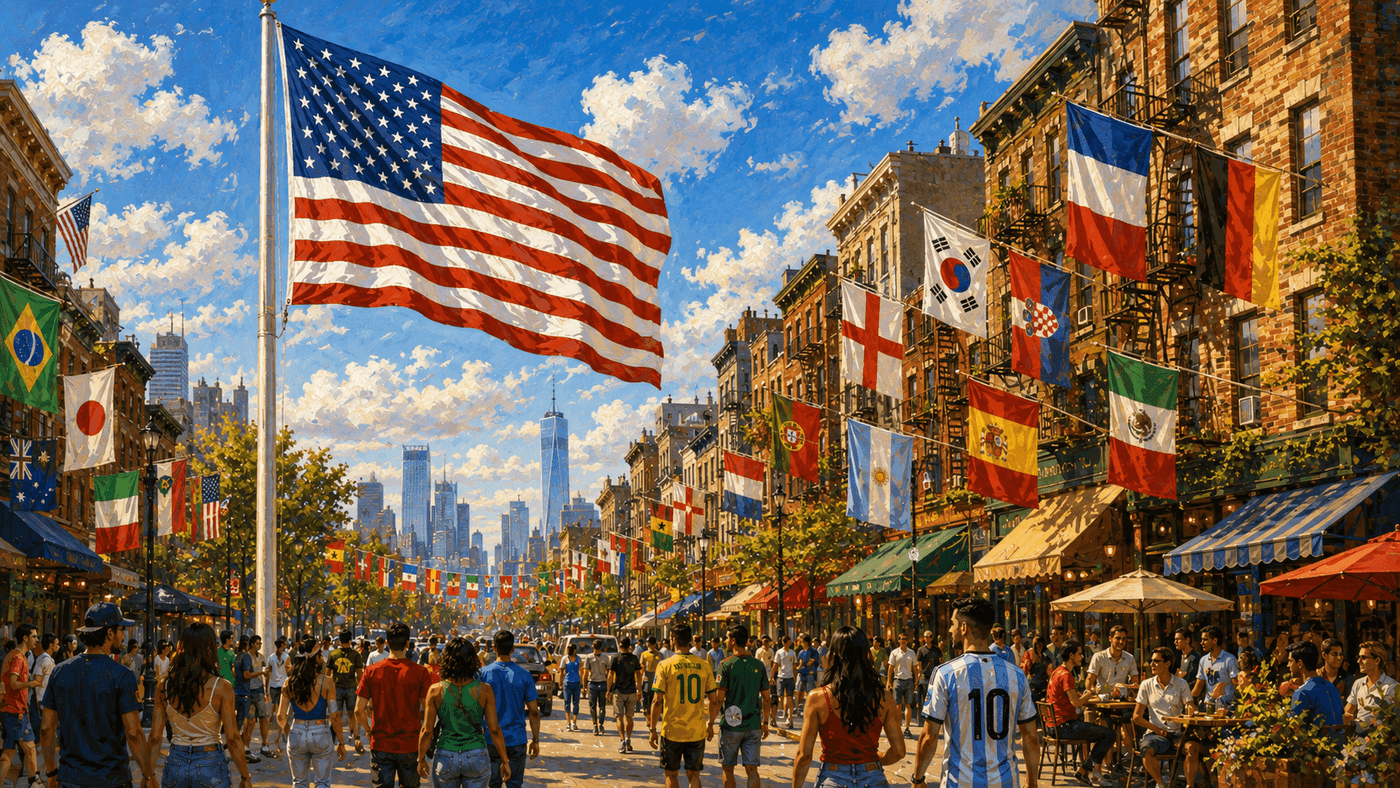
This Flag Day, with the World Cup in full swing and the country's 250th birthday just three weeks away on July 4th, the flags outside American homes carry more than the usual symbolic weight. Fans from 48 nations are watching their own colors fly in American cities this summer, and many of them are seeing something they didn't expect: a country that hangs its own flag with fierce pride while cheerfully flying everyone else's beside it. That, too, is something the founders set in motion on June 14, 1777 — a country whose symbol has always been in the act of becoming something it hasn't quite finished being yet.