The Architect Who Died Before His Dream
On the afternoon of June 7, 1926, Antoni Gaudí — the most celebrated architect in Spain, the man who had devoted the final four decades of his life to a single unfinished basilica in Barcelona — walked out of his workshop at the Sagrada Família as he did every evening, headed for confession at a nearby church. Near the crossing of Gran Via and Carrer de Bailèn, he was struck by a tram. He fell to the street, badly injured. No one stopped to help. His clothes were worn and simple, his appearance unkempt from years of monastic devotion to his work. Passersby took him for a beggar. He was carried to a hospital for the poor, where he lay unidentified for nearly a day. When the Sagrada Família's chaplain finally recognized him, it was too late. Antoni Gaudí died on June 10, 1926, at the age of 73. Today, one hundred years to the day, Pope Leo XIV stands before the tower Gaudí never lived to see and blesses it in his name.
A Cathedral 144 Years in the Making
The first stone of the Sagrada Família was laid in Barcelona on March 19, 1882 — before the Brooklyn Bridge was finished, before the Eiffel Tower existed, before the automobile had been invented. Gaudí took over as its lead architect the following year and immediately transformed what had been planned as a conventional Gothic revival church into something the world had never seen: a forest of stone spires, organic facades crawling with sculpted life, towers reaching toward heaven in shapes borrowed from nature rather than from any architectural tradition before him. Gaudí understood from the beginning that he would not live to finish it. "My client is not in a hurry," he reportedly said, referring to God. He was buried in the basilica's crypt when he died, and construction continued around his grave for nearly another century.
The Tower of Jesus Christ — the central spire, the tallest and most symbolically vital of the basilica's eighteen planned towers — was completed in February of this year, its exterior finished at 172.5 meters (566 feet), making the Sagrada Família the tallest church in the world. Gaudí designed it to stand just short of Barcelona's Montjuïc hill, which he refused to surpass out of a conviction that no human creation should exceed the work of God. Today, in a ceremony of extraordinary historical weight, Pope Leo XIV celebrates Mass inside the basilica and formally blesses and inaugurates the tower — an event the Vatican called one of the most significant moments in the basilica's history. Three popes have visited the Sagrada Família in modern history. Pope John Paul II prayed at its Nativity Façade in 1982. Pope Benedict XVI consecrated it as a basilica in 2010, when it was still missing its central spire. Today is different: the tower Gaudí designed is complete, and the man Rome has called "God's architect" is being honored, at last, in the cathedral he gave his life to build.
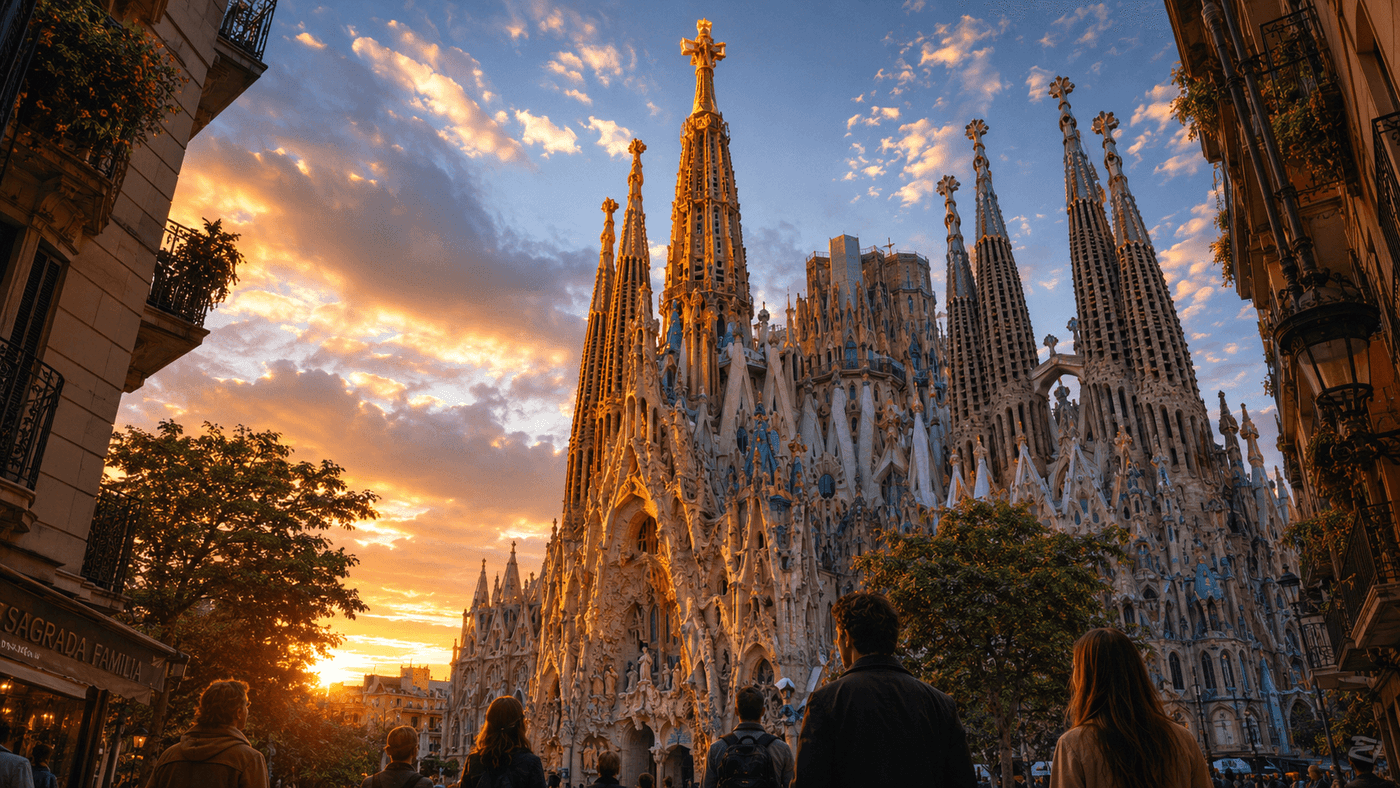
The full basilica will not be complete for another decade; Gaudí's vision is vast, and the work continues. But what rises above Barcelona today — lit tonight by a light show projected across the new tower and the city sky — is already one of the most extraordinary things human hands have ever built. A devout Catholic who gave away nearly everything he owned in his later years, who spent his final days walking between his workshop and his church, who died dressed as a pauper on a street he had walked a thousand times before: Gaudí always said the Sagrada Família was not his project. It was a gift he was merely entrusted to deliver. One hundred years after his death, that gift is being unwrapped.