We Were Looking in the Wrong Place All Along
For more than a century, the story of human origins has been told from East Africa. The famous fossil sites of the Great Rift Valley — Olduvai Gorge in Tanzania, the Afar region of Ethiopia, the shores of Lake Turkana in Kenya — have produced the bones of our most celebrated ancestors: Lucy, the Turkana Boy, Ardi, the fossils of Homo habilis and Homo erectus and Australopithecus and dozens of other species that trace the long, branching path from early primates to modern humans. The field of paleoanthropology has been built, in large part, on what the eastern edge of Africa has yielded. Earlier this year, a team of researchers from Mansoura University in Egypt and the University of Southern California published a study in Science that quietly suggested the field may have been looking in the wrong place — or at least, not looking everywhere it should. The fossil they found was not from East Africa. It was from a forgotten site in northern Egypt. And the 18-million-year-old creature it belonged to may be closer to the ancestor of all living apes — including humans — than anything found in the East African record of the same age.
Five Years of Searching — and a Lower Jaw in the Sand
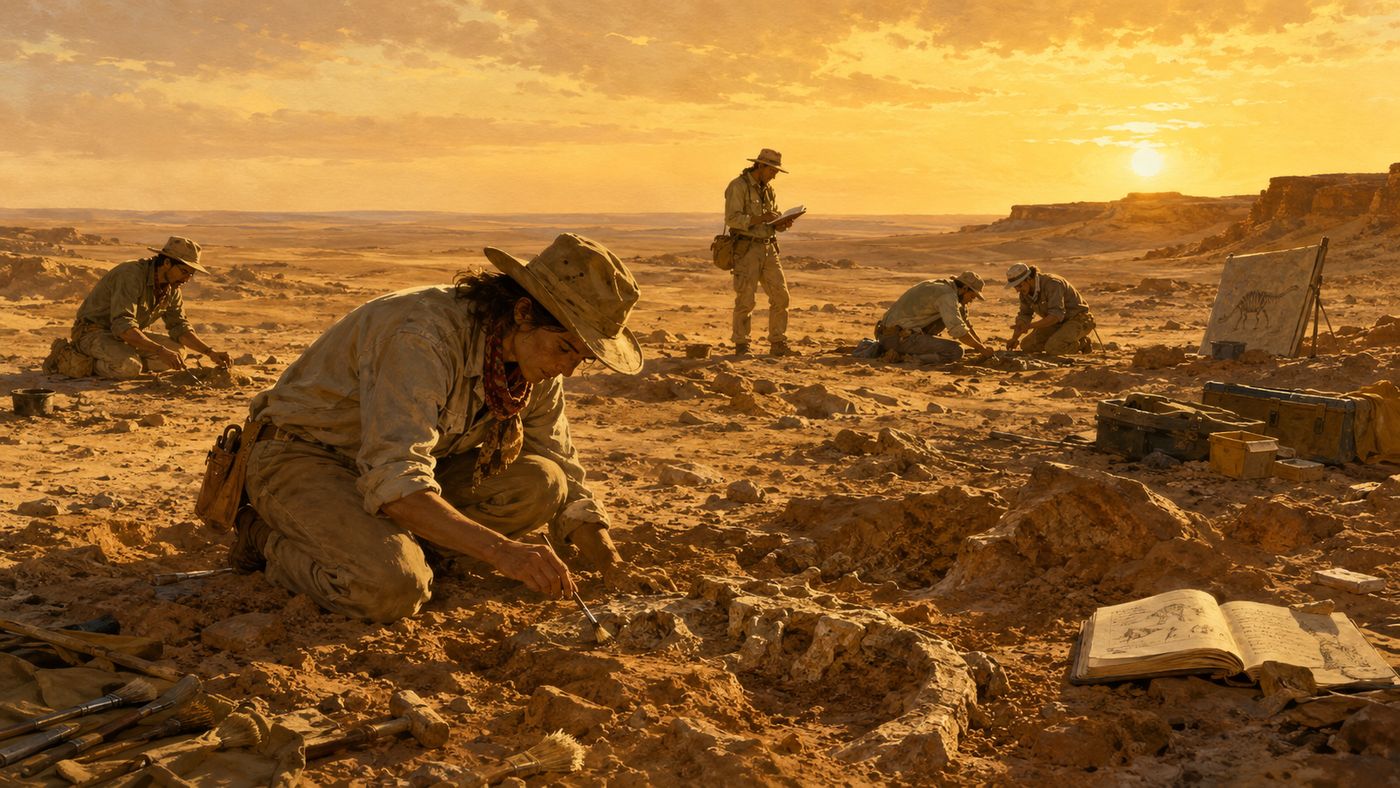
The creature is called Masripithecus moghraensis — its genus name derived from "Masr," the Arabic word for Egypt. It lived approximately 17 to 18 million years ago, during the Early Miocene, in a landscape that was then a lush, forested floodplain in what is now the Wadi Moghra region of northern Egypt, near the Qattara Depression. Researchers from Mansoura University's Vertebrate Paleontology Center spent five years searching the site during field expeditions in 2023 and 2024, guided by a specific hypothesis: that when you study the early ape family tree carefully, there is a missing piece — a gap between the oldest apes, which evolved in Africa more than 25 million years ago, and the emergence of the group that eventually gave rise to all living apes and humans. Senior author Hesham Sallam put it plainly: "We spent five years searching for this kind of fossil because, when we look closely at the early ape family tree, it becomes clear that something is missing — and North Africa holds that missing piece." What they found was a lower jaw and several worn teeth. Those fragments, analyzed against a global database of known fossil apes and compared using modern phylogenetic methods, placed Masripithecus closer to the ancestor of all living apes than any known East African species of the same age — making it the first definitive fossil ape from North Africa and the most consequential find in the region's paleontological history.
The implications are significant enough that David Alba and Júlia Arias-Martorell, two paleontologists who were not involved in the study, wrote a related Perspective piece in Science directly stating that the findings "confirm that paleontologists might have been looking for crown-hominoid ancestors in the wrong place." The logic is straightforward but striking: if the ancestor of all living apes was present in North Africa 17 to 18 million years ago — closer to the geographic crossroads between Africa, Europe, and Asia than East Africa's fossil sites — then the dispersal of apes into Europe and Asia during the Miocene, which has long puzzled scientists, becomes considerably easier to explain. The Tethys Sea that once separated Africa from Eurasia had largely receded by this period, leaving land bridges through what is now the Middle East. North Africa was not a dead end for early apes. It may have been the launching pad. "Discovering a fossil ape in this region is both significant and somewhat surprising," said study first author Shorouq Al-Ashqar of Mansoura University. "But it also highlights how incomplete our picture has been."
What makes the discovery particularly exciting to paleontologists is not just what Masripithecus itself tells us — but what it implies about what remains to be found. North Africa's fossil record from the Miocene is sparse not because apes weren't there, but because the region has received far less systematic paleontological attention than East Africa, Europe, or Asia. Previous excavations at Wadi Moghra had yielded the fossils of monkeys and other mammals, but no apes — leading to an assumption that apes simply weren't present in the region at this time. Masripithecus overturns that assumption entirely. Researchers expect that continued fieldwork across northern Africa and the Arabian Peninsula will uncover additional species that fill in the remaining gaps. The story of how modern apes — and eventually humans — evolved and spread across the planet is not finished being told. It is, as the team from Mansoura demonstrated after five years of searching in Egypt, being rewritten from the ground up, one fossil at a time.