The Day We Found the First Breath
Forty-eight light-years from Earth, a rocky planet about 1.7 times the size of our own orbits a red dwarf star once every 24.7 days. The planet is called LHS 1140 b. It sits squarely in its star's habitable zone — the region where temperatures could allow liquid water to exist on a surface. Scientists have known about it since 2017. What they did not know, until a paper published last week in the journal Science, is that LHS 1140 b has an atmosphere — a thin envelope of gas clinging to its surface, detectable because helium is slowly leaking from its upper layers into space. It is the first atmosphere ever detected on a rocky, Earth-like planet in the habitable zone of another star. "An atmosphere is essential for a planet to support life as we know it," said lead author Collin Cherubim of Harvard University. "This is the first time anyone has found an atmosphere on a rocky planet in the habitable zone of another star." The search for life beyond our solar system has just crossed its most significant threshold in a generation.
Why an Atmosphere Changes Everything
To understand why the discovery of LHS 1140 b's atmosphere matters so profoundly, it helps to understand why atmospheres are so hard to keep. Rocky planets — the kind capable of supporting life as we know it — are constantly bombarded by radiation from their host stars. That radiation strips gas away from a planet's surface over millions of years, eroding the very atmospheric layer that makes surface life possible. Most rocky planets discovered so far in or near habitable zones appear to have lost their atmospheres entirely — blasted clean by stellar wind. The fact that LHS 1140 b has retained one, despite orbiting a red dwarf star — a class of star known for intense early flare activity that is particularly hostile to atmospheric retention — is itself extraordinary. It suggests the planet is either geologically active enough to replenish its atmosphere from volcanic outgassing, or that it has some other mechanism that has allowed it to hold on. Cherubim and his colleagues used the WINERED spectrograph, mounted on a telescope at the Las Campanas Observatory in Chile, to detect helium in the planet's upper atmosphere directly — the first direct atmospheric detection of any rocky exoplanet, achieved by measuring the characteristic spectral fingerprint of helium as the planet transited its star. The team's theoretical models also suggest the planet may have a surface ocean or be covered in ice — both consistent with conditions that could support life.
The history of humanity's search for life beyond Earth is a history of thresholds — each one eliminating a previous assumption and opening a new class of questions. The Copernican revolution removed Earth from the center of the universe and raised, for the first time, the possibility that other worlds existed. The discovery of exoplanets — planets orbiting other stars — began in earnest in 1992 with the detection of planets around a pulsar, and accelerated enormously with NASA's Kepler Space Telescope, which from 2009 to 2018 identified more than 2,600 confirmed exoplanets and revealed that planets are not rare exceptions but a routine feature of the galaxy. The James Webb Space Telescope, launched in 2021, brought for the first time the spectroscopic capability to analyze the atmospheric chemistry of some of those planets in detail — and has been used extensively to study rocky planets including those in the TRAPPIST-1 system, most of which appear to lack significant atmospheres. LHS 1140 b is now the exception: a rocky world in the habitable zone that has held onto its air. "This has been a model validation," Cherubim said, "and hopefully it's just the first of many more observations to come."
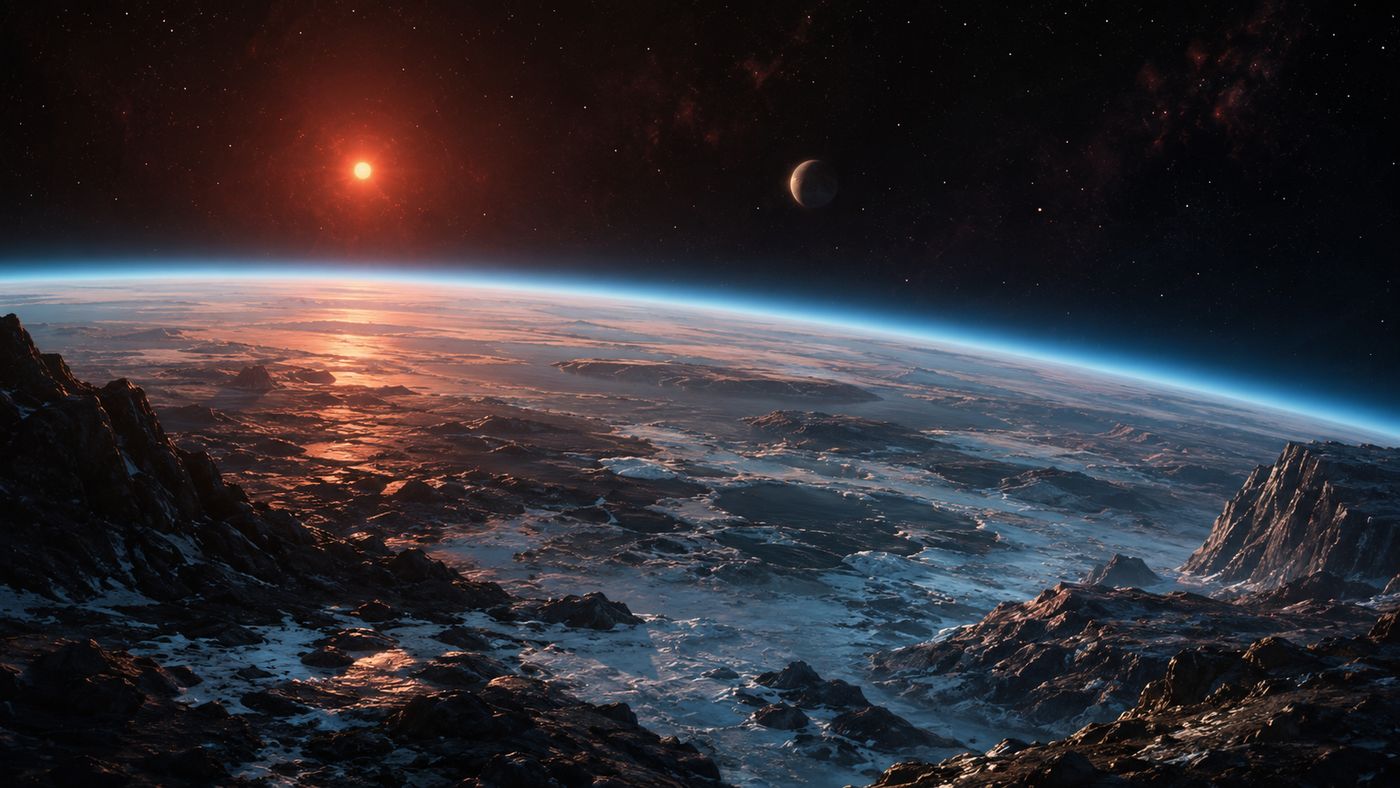
What the discovery does not yet tell us is whether LHS 1140 b's atmosphere contains the specific gases — oxygen, methane, carbon dioxide in particular combinations — that would indicate biological activity. Helium itself is not a biosignature; it is a noble gas present throughout the universe, inert and uninvolved in chemistry. What helium's presence tells us is that the planet has an atmosphere at all — that the next layer of questions can now be asked. Cherubim's team plans further observations aimed at characterizing the full chemical composition of the atmosphere, and eventually determining whether surface oceans exist. Those observations will likely require the next generation of extremely large ground-based telescopes, several of which are currently under construction. The search that has preoccupied astronomers, philosophers, and ordinary people for as long as humans have looked up at the night sky — are we alone? — has not been answered. But on July 16, 2026, in a paper published in Science, it moved one enormous step closer to the moment when an answer becomes possible. A rocky world 48 light-years away has air. Everything else follows from that.