The Law That Heard What Parents Were Saying
On Tuesday, both chambers of the French Parliament voted to ban children under 15 from using social media — making France the first country in the European Union to pass a blanket ban on the platforms and the second country in the world after Australia, which enacted a similar law for under-16s in 2024. The bill is a flagship initiative of President Emmanuel Macron's second term, who has repeatedly cited social media as a contributing factor to violence, mental health crises, and declining academic performance among French youth. It also bans mobile phones in high schools — extending a ban on phones that has existed in French primary and middle schools since 2018. Platforms including TikTok, Instagram, Snapchat, Facebook, Reddit, and X will be required to implement age verification tools; the law does not immediately translate into an outright ban but rather a phased enforcement framework. What it does immediately is send a signal: a major Western democracy has decided that unrestricted children's access to social media is a policy failure, and it is prepared to act on that conclusion.
Every New Medium, the Same Argument
Every new communications medium in modern history has triggered a version of this same societal argument. Television, when it entered American homes in the late 1940s and early 1950s, was immediately met with parental alarm: children were spending too many hours in front of the set, their imaginations were dulling, violence on screen was corrupting their values. The U.S. Senate held hearings in 1954 on the influence of comic books on juvenile delinquency. Video games prompted congressional hearings in 1993 that led to the creation of the ESRB rating system. The internet itself prompted the Communications Decency Act of 1996, which attempted to restrict indecent online content accessible to minors — most of it was struck down by the Supreme Court a year later as unconstitutional. Each time, the concern was real, the evidence was debated, and the regulatory response was slower and less effective than the technology's spread. What is different about the social media moment — what France's law and Australia's law and the global surge of similar proposals reflect — is the scale and specificity of the evidence that has now accumulated. This is not a moral panic. It is a public health response.
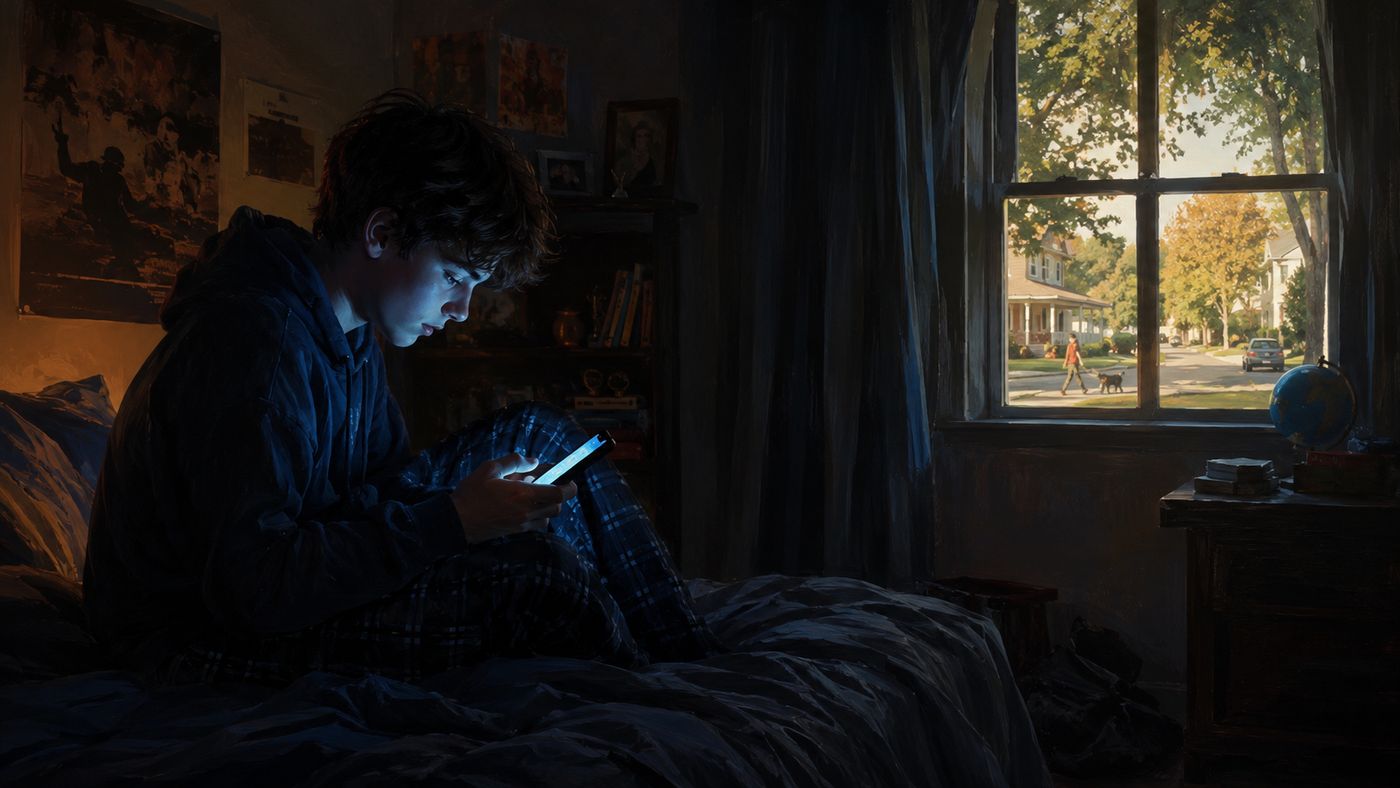
The data on adolescent mental health since the widespread adoption of smartphones and social media — beginning approximately in 2012, when smartphone ownership among teenagers crossed 50 percent in the United States — is among the most striking in modern epidemiology. Rates of depression, anxiety, loneliness, and self-harm among teenage girls rose sharply and simultaneously across multiple countries over the following decade, with the sharpest increases correlating with social media use. Jean Twenge's research at San Diego State University, Jonathan Haidt's work at NYU, and a series of large-scale studies in the UK, Australia, and France have all pointed toward the same conclusion: the social comparison, the algorithmic amplification of distressing content, the disruption to sleep, and the displacement of in-person social interaction have made adolescence measurably harder for a generation that did not choose the tools that were handed to them. France's 2023 law requiring parental consent for under-15s to create accounts existed on paper but was largely unenforceable. Tuesday's law attempts to put the enforcement mechanism on the platforms rather than the parents — requiring TikTok and Instagram and Snapchat to verify ages, with penalties for failure. Spain has announced similar intentions. The EU's Digital Services Act, which required last-minute amendments to the French bill to avoid conflict, sets a broader framework that may eventually produce continent-wide standards.
The questions that remain are the hard ones. Age verification at scale is technically difficult and privacy-invasive — any system robust enough to actually verify a child's age will also collect significant personal data from adults. Determined teenagers have found workarounds to every parental control system ever built. The platforms themselves are structurally incentivized to minimize enforcement costs. And the research, while compelling in its patterns, is still contested on causality: whether social media causes mental health decline or whether adolescents who are already struggling are more drawn to social media remains genuinely debated. What is not debated is that France's Parliament has made a decision and that other governments are watching closely. Macron, who must step down as president in April 2027, has framed the social media ban as one of the defining domestic achievements of his tenure — a legacy item in a term that has been otherwise turbulent. Whether the law works will take years to determine. That it passed, unanimously in spirit if not in letter, across a fractious French parliament, is itself a statement about where the political consensus on children and screens has arrived in 2026. A generation of parents has been saying something was wrong. Yesterday, at least one government decided to listen.