August 7: The Man on the Wire, the Heart of Purple, and the Bull Moose
August 7 is a day for audacity. In 1974, a French acrobat stretched a wire between the two tallest buildings in the Western Hemisphere, walked out onto it without permission, and spent forty-five minutes doing things 1,350 feet above the streets of Manhattan that no rational cost-benefit analysis could justify — except that they were beautiful, and the crowd below knew it. One hundred and ninety-two years earlier, on a very different kind of stage, George Washington quietly established the first military decoration in American history — a purple cloth heart that would eventually become one of the most recognized honors in the world. And in 1912, a former president who had already served two terms stood before a convention of insurgent reformers in Chicago and accepted a nomination that would split the Republican Party, deny his successor the presidency, and help elect a Democrat for the first time in sixteen years. Three August sevenths. Three acts of nerve, each one reshaping something that had seemed settled.
1,350 Feet
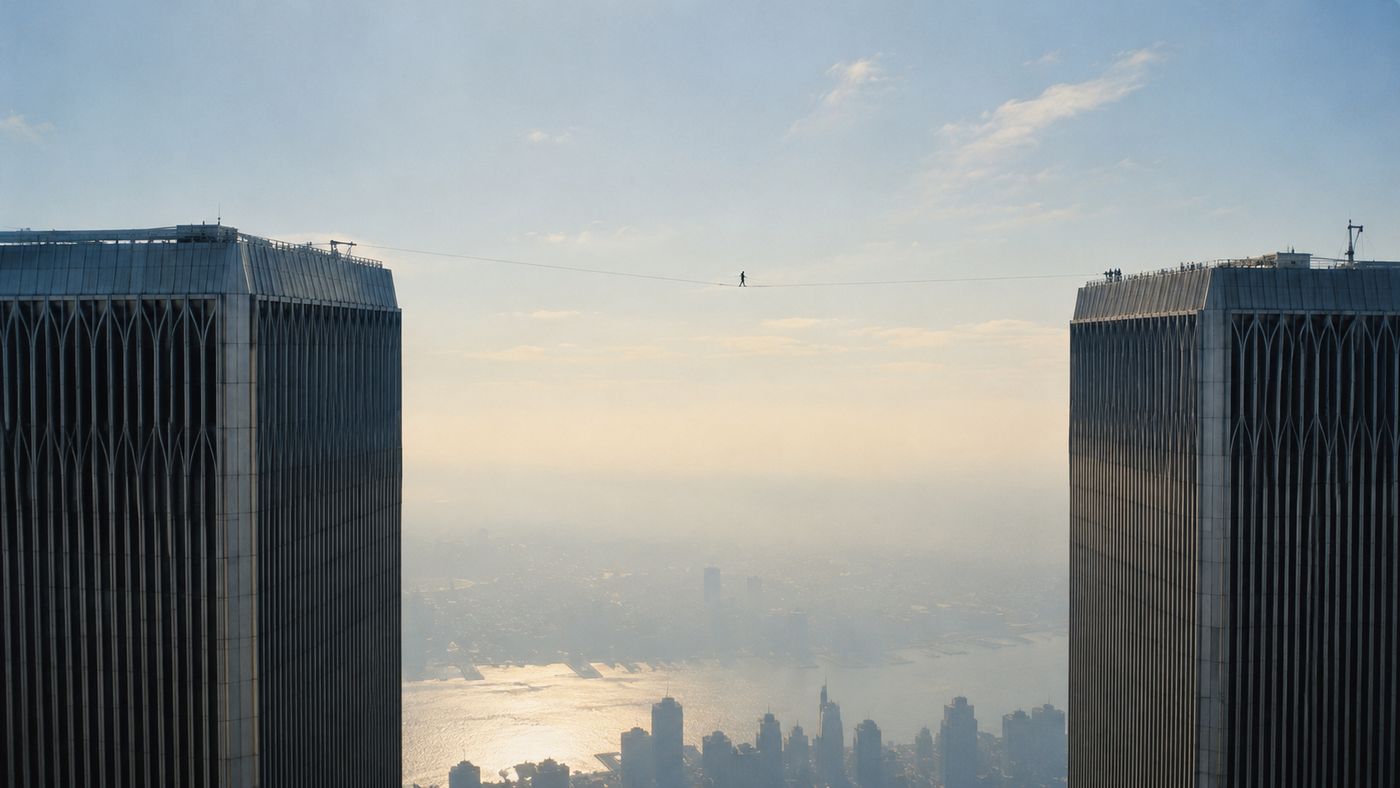
On the morning of August 7, 1974, Philippe Petit — a twenty-four-year-old French street performer and high-wire artist — stepped off the edge of the South Tower of the World Trade Center onto a three-quarter-inch steel cable that he and a small team of accomplices had illegally rigged between the two towers the night before, and began walking. The towers were 1,350 feet above the street and 140 feet apart. What followed lasted forty-five minutes: Petit crossed the wire eight times, lay down on it, performed a salute to a seagull that flew past, and danced while police officers on both towers commanded him through bullhorns to come in immediately. He surrendered only when he was ready. He was arrested, charged with criminal trespass and disorderly conduct, and ordered as part of his sentence to perform a free wire walk in Central Park for children. He complied. The charges were otherwise dropped.
Petit had first seen a drawing of the planned World Trade Center towers in a dentist's office in Paris in 1968, when he was nineteen — six years before they were completed — and had immediately conceived the idea of walking between them. The preparation took those six years: he made covert reconnaissance trips to the towers during construction, practiced on other structures including Notre-Dame de Paris and the Sydney Harbour Bridge, and assembled a team that spent two nights smuggling equipment to the roof. When a police officer on the tower roof ordered him to come in and Petit stepped back out onto the wire instead, the officer later said he could not bring himself to watch — it was too beautiful. Thousands of people on the streets of lower Manhattan stopped and looked up that August morning, and for forty-five minutes, the towers that many New Yorkers had resented for their scale and their intrusion on the skyline became the stage for something that made people glad they existed. The man who walked between them on August 7, 1974, called it "the artistic crime of the century." The prosecutor who arraigned him declined to disagree.
The Badge of Merit
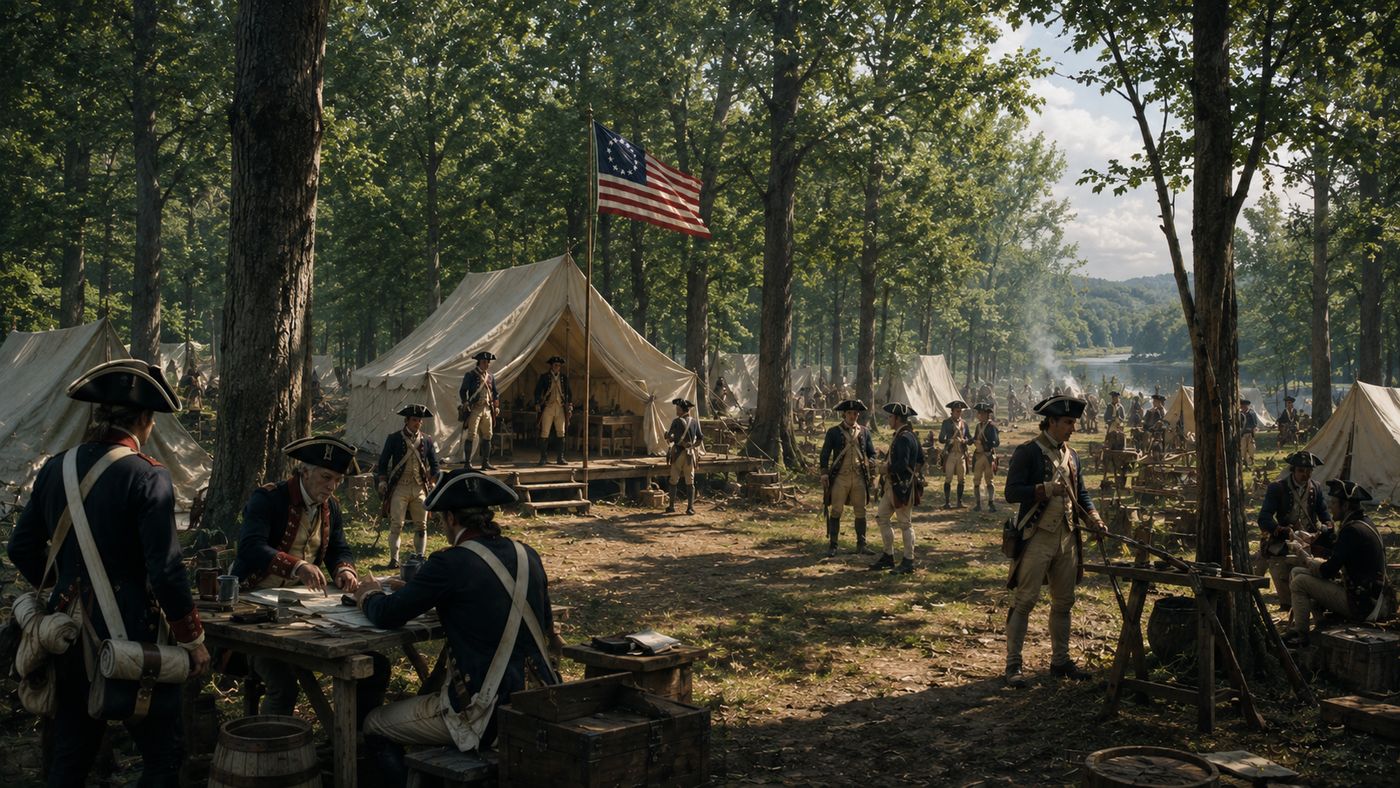
On August 7, 1782, General George Washington issued an order from his Continental Army headquarters at Newburgh, New York, establishing the Badge of Military Merit — America's first formal military decoration and the direct ancestor of the Purple Heart. The badge, Washington specified, would recognize "any singularly meritorious action" performed by soldiers in the Continental Army, and would consist of a heart-shaped piece of purple silk embroidered with the word "Merit" in silver, worn on the left breast of the uniform. The award was notable for being available to enlisted men and non-commissioned officers — not just officers — at a time when most military honors were reserved for those of rank. Washington intended it as a democratic recognition that valor was not the exclusive property of gentlemen.
Only three men are known to have received the Badge of Military Merit during the Revolutionary War, all of them sergeants. The decoration fell into disuse after the Revolution and was not formally revived until 1932, when General Douglas MacArthur, then Army Chief of Staff, reestablished it as the Purple Heart on the bicentennial of Washington's birth — this time specifically to honor those wounded or killed in action, rather than general acts of merit. The Purple Heart has since been awarded to more than 1.8 million American service members. It remains the oldest American military decoration in continuous use — the direct descendant of the purple silk heart that Washington ordered in a Newburgh headquarters on August 7, 1782, for soldiers who had done something worthy of recognition, regardless of their rank or station.
We Stand at Armageddon
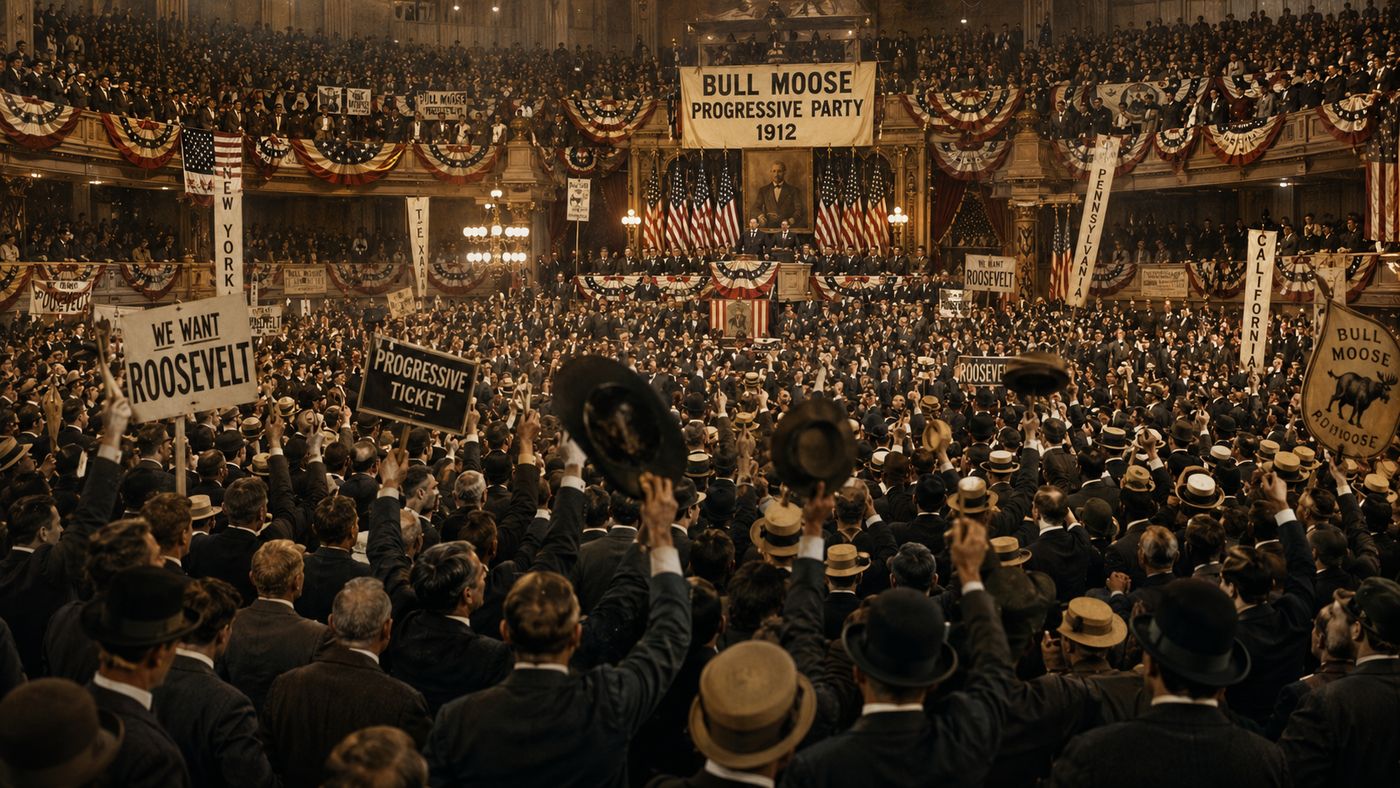
On August 7, 1912, Theodore Roosevelt stood before a convention of Progressive Party delegates in Chicago and accepted their presidential nomination, launching one of the most consequential third-party campaigns in American political history. Roosevelt had left the presidency in 1909 after declining to seek a third term, handpicked his successor William Howard Taft, traveled to Africa on a safari, and returned to find that Taft had governed in ways that Roosevelt considered a betrayal of the progressive reforms he had championed. He had challenged Taft for the Republican nomination in 1912, won most of the primary contests, and been denied the nomination by the party machinery that controlled the convention. Rather than accept the result, he left the Republican Party and accepted the nomination of the newly formed Progressive Party — declaring himself fit as a bull moose and telling delegates that they stood at Armageddon and battled for the Lord.
The Bull Moose campaign that Roosevelt launched on August 7, 1912, produced the strongest third-party performance in presidential election history. Roosevelt finished second, ahead of the sitting Republican president Taft, who finished third — the only time in American history that a sitting president has finished third in a presidential election. The split between Roosevelt and Taft handed the election to Democrat Woodrow Wilson, who won with less than 42 percent of the popular vote in a four-way race. The Progressive Party platform that Roosevelt ran on — advocating for women's suffrage, the eight-hour workday, workers' compensation, direct election of senators, and a national health service — represented the most comprehensive progressive agenda any major presidential candidate had offered to that point, and several of its planks were eventually enacted over the following decades. Roosevelt survived an assassination attempt during the campaign — shot in the chest while delivering a speech in Milwaukee, he completed the address before seeking medical treatment — and lost the election. The Bull Moose Party dissolved within a few years. The reforms it championed did not.