August 16: A King Falls, Gold Is Found, and a Man Runs Faster Than Anyone Ever Has
August 16 has held moments of extraordinary human significance across three centuries. In 1977, a forty-two-year-old man was found unresponsive in a Memphis bathroom and the world learned what it was like to lose someone who had functioned, for a quarter century, as the primary embodiment of a new kind of music and a new kind of American possibility. Eighty-one years earlier, on a creek in the Canadian subarctic, a glint in the water set in motion one of the most dramatic mass migrations in North American history — 100,000 people making their way to one of the most remote and hostile environments on the continent in pursuit of gold. And in 2009, in a Berlin stadium, a Jamaican sprinter ran a hundred meters in 9.58 seconds and stopped in his tracks, celebrating while his competitors were still running, in a performance so dominant it seemed to exist in a different category from the rest of the field. Three August sixteenths. Three encounters with the extreme edge of what is possible.
Graceland, 1977
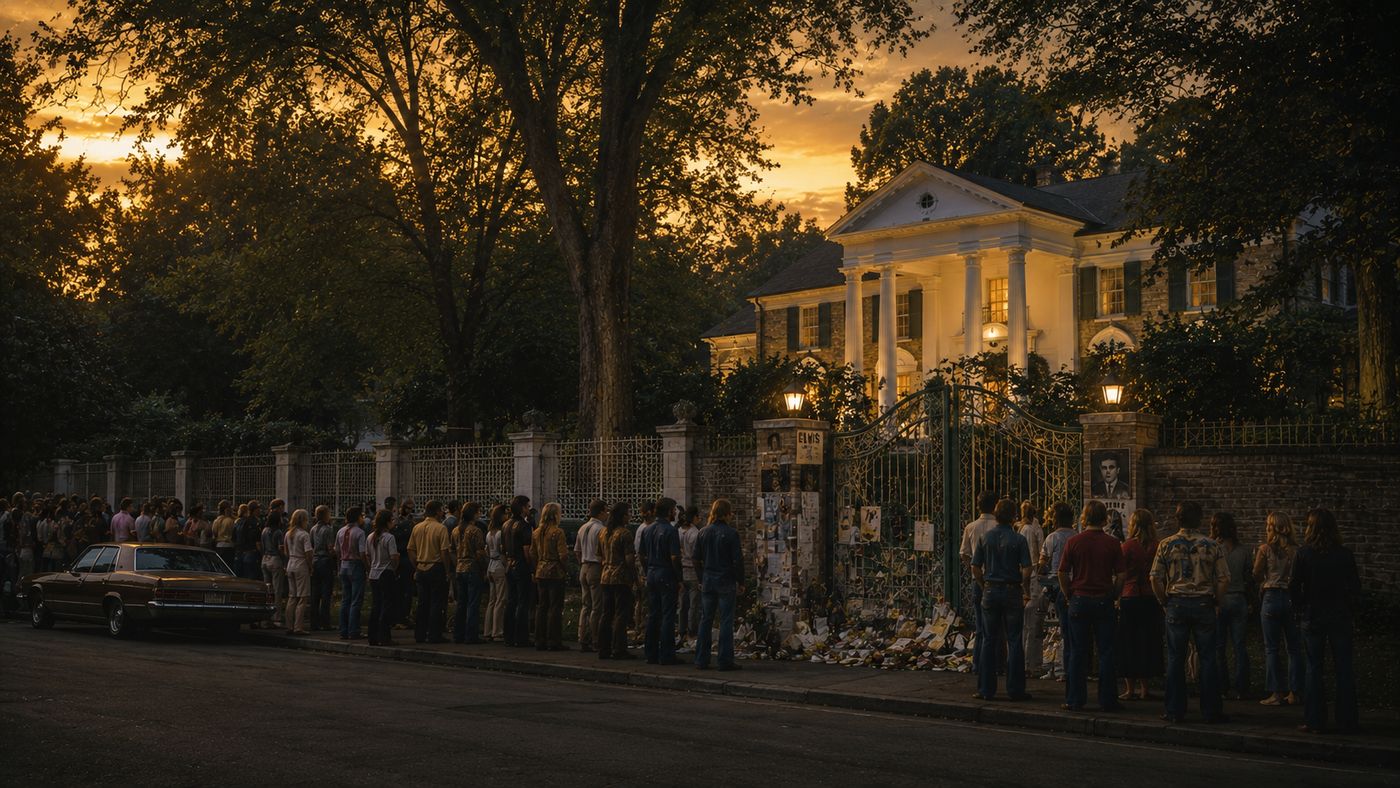
On the afternoon of August 16, 1977, Ginger Alden found Elvis Presley unresponsive on the floor of his bathroom at Graceland, his Memphis mansion, and called for emergency help. He was transported to Baptist Memorial Hospital and pronounced dead at 3:30 p.m. He was forty-two years old. The official cause of death was cardiac arrhythmia, though the autopsy also found fourteen prescription drugs in his system — evidence of the pharmaceutical dependency that had characterized the final years of his life and that his inner circle had largely protected from public knowledge. The news broke that afternoon and spread with the speed of something the world was not prepared to receive. Fans gathered outside Graceland by the thousands. Radio stations played his music continuously. Politicians, artists, and heads of state issued statements of mourning for a man who had, twenty-three years earlier, walked into Sun Studio in Memphis with a few dollars and emerged with a sound that had never existed before.
Elvis Presley's death on August 16, 1977, ended the career of a figure whose significance to American popular culture was without close parallel. He had not invented rock and roll — that credit belongs, as it always has, to the Black artists whose music he absorbed and through whom he learned to perform, including Big Mama Thornton, whose "Hound Dog" he covered to enormous commercial success, as we covered in the August 13 post — but he had been the person through whom that music reached a white mainstream audience with sufficient force to transform American popular culture permanently. His twenty-three-year career had encompassed not just music but film, television, and a performance persona of such extravagance that it remained uniquely his own even as it was imitated by thousands. The decline of his final years — the weight gain, the prescription drug dependency, the increasingly erratic performances — was the decline of a man who had been a public phenomenon since the age of nineteen and who had never developed the tools to manage what that had cost him. The Graceland that visitors tour today is a shrine to the peak, not the end. August 16, 1977, was the end.
Bonanza Creek
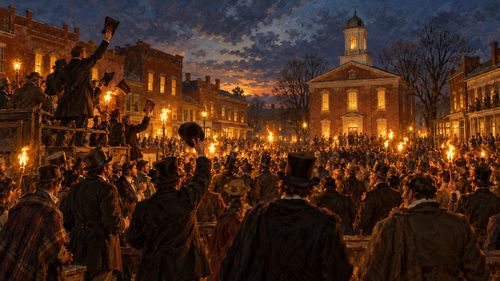
On August 16, 1896, George Washington Carmack and his party — including his Indigenous wife Kate Carmack and her relatives Skookum Jim Mason and Tagish Charlie — discovered gold in Bonanza Creek, a small tributary of the Klondike River in Canada's Yukon Territory. The discovery was made during a fishing expedition, and the gold they found — nuggets and flakes in sufficient quantity to fill a spent shotgun cartridge — was rich enough to justify staking claims immediately. Word of the find spread through the Yukon's small prospecting community with remarkable speed, and the creeks of the Klondike River basin were staked by experienced miners within weeks. The news, however, did not reach the broader world until the summer of 1897, when ships carrying Klondike miners and their gold arrived in Seattle and San Francisco, and the photographs of men staggering down gangplanks under the weight of gold-filled bags ignited a mass frenzy.
The Klondike Gold Rush that followed the discovery of August 16, 1896, drew an estimated 100,000 prospectors from the United States, Canada, Europe, and beyond to one of the most remote and hostile environments in North America. The overland routes required crossing mountain passes in conditions of extreme cold and altitude; the river routes were long and treacherous; and the gold fields, when the stampeders arrived, were already largely staked by the experienced miners who had gotten there first. The majority of those who came to the Klondike never found significant gold. The boom towns that rose from nothing — Dawson City, most famously — were extraordinary temporary civilizations: libraries, theaters, dance halls, and saloons in a land where permafrost lay inches below the surface. The gold rush lasted approximately three years before declining yields and the lure of new strikes elsewhere dispersed the population. Kate Carmack, whose role in the original discovery has been debated by historians, received no share of the wealth her find produced — a dispossession rooted in the same colonial frameworks that had shaped every previous encounter between Indigenous peoples and the gold-seeking forces of the industrial world.

9.58
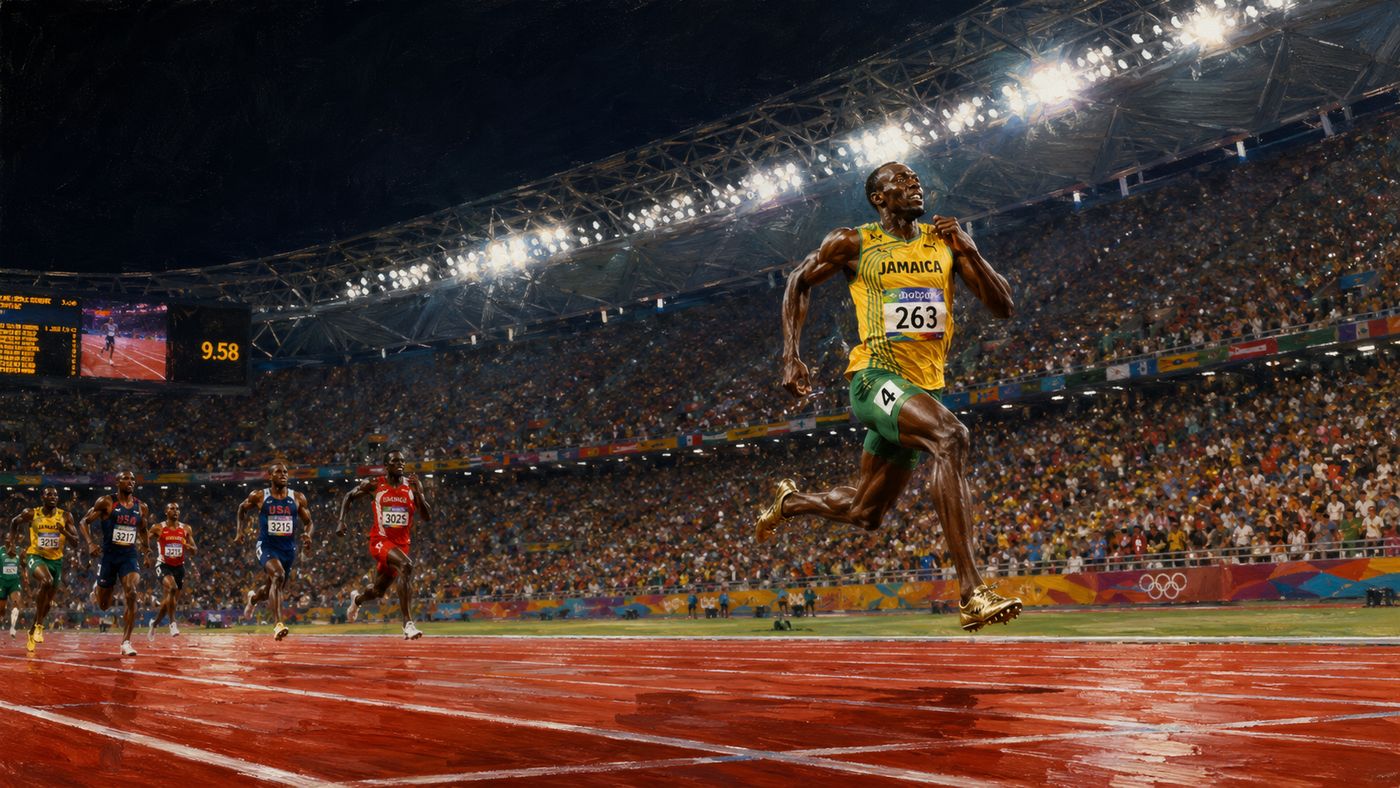
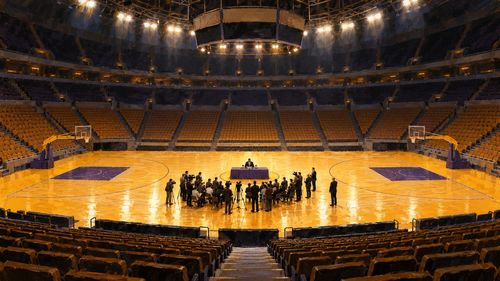
On August 16, 2009, Usain Bolt of Jamaica ran 100 meters in 9.58 seconds at the World Athletics Championships in Berlin, setting a world record that stands to this day and that many sports scientists believe may represent the outer boundary of what human physiology can achieve over that distance. Bolt had already set the world record at the Beijing Olympics the previous summer with a time of 9.69 seconds — a run during which he had famously begun celebrating and slowed perceptibly before the finish line. His Berlin run was different: fully committed from start to finish, with a top speed estimated at 27.8 miles per hour, it produced a time that improved on his already-extraordinary Beijing mark by 0.11 seconds — a margin so large that the sprinting world, accustomed to records falling by hundredths or even thousandths of a second, struggled to contextualize it. His competitors finished the race while Bolt was already turning to acknowledge the crowd.
The performance on August 16, 2009, was the centerpiece of a career that made Usain Bolt the most dominant sprinter in the history of the sport. He won the 100 meters, 200 meters, and 4x100 meter relay at three consecutive Olympic Games — 2008, 2012, and 2016 — a feat of sustained excellence across multiple events that no sprinter had previously achieved. His combination of height — at six feet five inches he was considered by many coaches too tall to be a great sprinter, a theory he comprehensively disproved — raw speed, and an almost theatrical competitive composure made his races some of the most anticipated events in athletics. He retired after the 2017 World Championships, where injury prevented a clean finish to his career, and has not been replaced as a dominant figure in the sport. His 9.58 second world record remains intact as of this writing, a number that has stood longer than any of his predecessors' records survived. The 9.58 he ran in Berlin on August 16, 2009, may simply be the fastest a human being will ever run 100 meters. Or it may not. The only way to know is to wait.