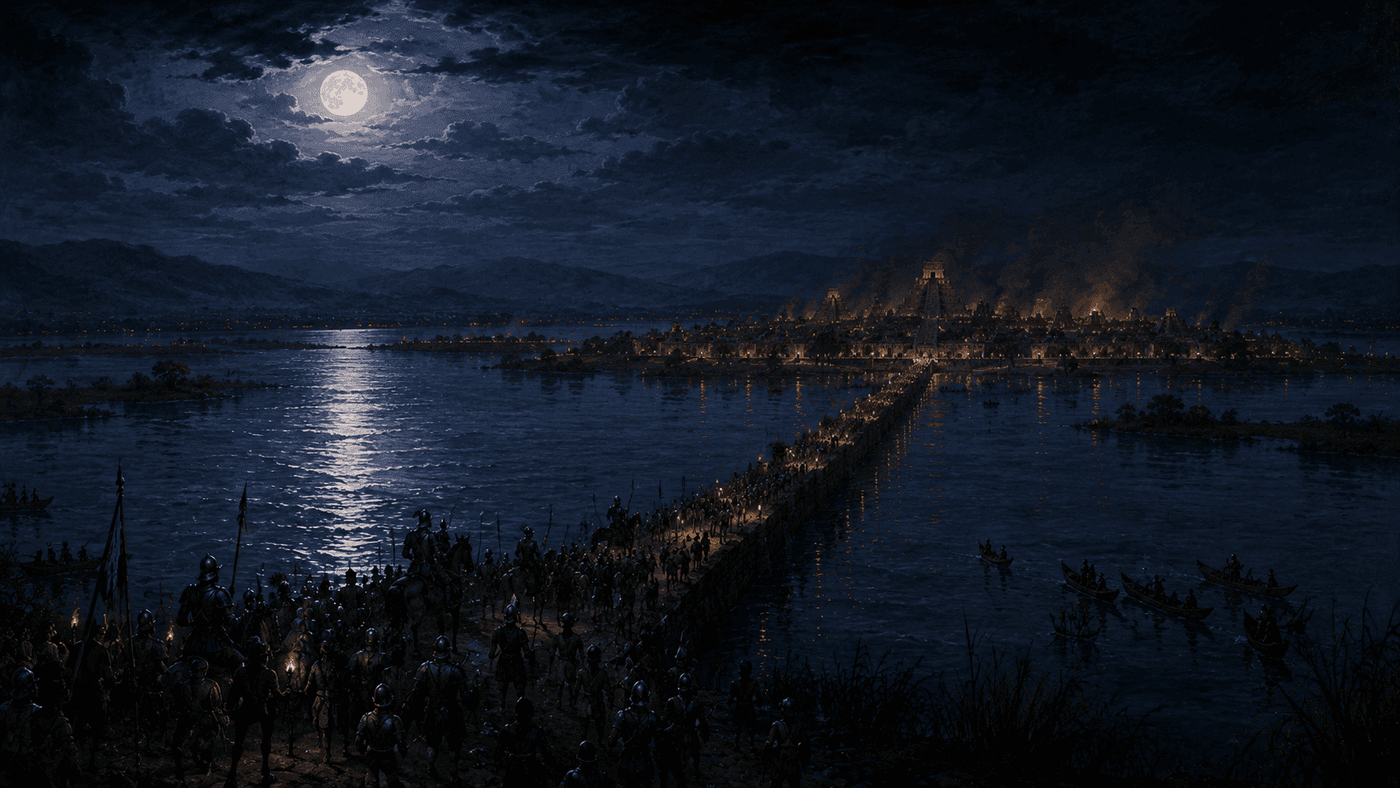
June 30: A Leap, a Legend, and a Sad Night
June 30 is a day that asks what we do with the stories we inherit. In 2015, a dancer took the stage at one of the world's most storied ballet companies and claimed a title that should have been possible long before — a moment of personal triumph set against an institution's long history of exclusion. In 1936, a novelist published a book about a South she had grown up in, a South already becoming mythology, and in doing so created one of the most beloved and most contested works in American literature. And in 1520, on a moonlit causeway above a lake in central Mexico, a conquistador's ambition met its most catastrophic consequence — a night of ruin whose echoes shaped the entire subsequent history of the Americas. Three stories about the past's grip on the present, and the different ways people have chosen to face it.
Principal
On June 30, 2015, American Ballet Theatre announced that Misty Copeland had been promoted to principal dancer — the highest rank in a ballet company — making her the first African American woman to hold that position in ABT's seventy-five-year history. The announcement came during the company's annual gala at the Metropolitan Opera House in New York, and the standing ovation that followed said something about how long the moment had been in coming. Copeland's path to that stage had been extraordinary in every sense: she had not begun serious ballet training until she was thirteen — late by the demanding standards of the art form — and had come up against resistance at nearly every turn, from teachers who questioned whether her body type suited classical ballet to an institution whose corps de ballet had historically reflected almost no racial diversity at all. She had become a soloist at ABT in 2001 and spent the next fourteen years working toward the promotion that arrived on June 30.
Copeland's promotion resonated far beyond the world of classical dance. She had already become a public figure of unusual reach — a bestselling memoirist, a fitness ambassador, and a visible advocate for diversity in the arts — and her elevation to principal brought ballet into conversations it had rarely entered. For young Black girls who had been told, implicitly or explicitly, that the world of pointe shoes and tutus was not for them, Copeland's presence at the top of ABT's roster was a direct counter-argument. She has spoken often about the letters she receives from young dancers of color who say that seeing her on stage changed what they believed was possible for themselves. The leap she made on June 30, 2015, was not just technical — it was the kind that clears a path for everyone who comes after.

Tomorrow Is Another Day
On June 30, 1936, Macmillan published Gone With the Wind by Margaret Mitchell — a first novel, nearly a decade in the writing, by a former Atlanta journalist who had spent much of that decade insisting she wasn't working on anything. The book sold one million copies in its first year, won the Pulitzer Prize in 1937, and became the basis for the 1939 film that remains one of the highest-grossing movies in history when adjusted for inflation. Mitchell had grown up hearing stories of the Civil War and Reconstruction from Atlanta relatives who had lived through both, and the novel she built from those inherited memories was nothing less than a total world — 1,037 pages of character, landscape, violence, and longing centered on the red clay of north Georgia and the woman who refused to let it defeat her. Scarlett O'Hara entered the cultural bloodstream and has never entirely left it.
Gone With the Wind is among the most contested works in American literature — beloved by generations of readers and criticized, with increasing force, for its romanticization of the antebellum South and its deeply problematic portrayal of slavery and Black characters. Mitchell wrote the Confederacy as a lost civilization worth mourning, and that framing shaped how millions of readers understood the Civil War for decades. The novel and film together did more than almost any other cultural work to propagate the "Lost Cause" mythology — the idea that the Confederacy fought for honor rather than the preservation of slavery. That legacy has made Gone With the Wind a flashpoint in ongoing arguments about history, memory, and whose stories get told as epic. Mitchell died in 1949, having published nothing else. The book she left behind has been arguing with America ever since.

La Noche Triste
On the night of June 30, 1520, Hernán Cortés and his Spanish forces — together with thousands of Tlaxcalan allies who had thrown their lot in with the conquistadors against the Aztec Empire — attempted a desperate nighttime retreat from Tenochtitlan, the island capital of the Mexica across the causeways of Lake Texcoco. The escape was catastrophic. Aztec warriors, alerted to the Spanish withdrawal, attacked from canoes in the darkness. Soldiers weighed down by looted gold sank into the lake. The portable bridge the Spanish had constructed to cross the gaps in the causeway became jammed and could not be moved. Estimates of the dead vary, but hundreds of Spanish soldiers and thousands of indigenous allies were killed before the survivors reached the shore. Cortés himself, according to the accounts of his chroniclers, wept beneath a tree on the far bank — giving La Noche Triste, the Sad Night, its name.
La Noche Triste did not end the conquest — it merely interrupted it. Cortés regrouped, rebuilt his alliances with peoples who had suffered under Aztec dominance, and returned the following year with a larger force. By August 1521, Tenochtitlan had fallen, and the Aztec Empire with it. The city that rose on its ruins became Mexico City, capital of New Spain and eventually of the modern Mexican nation. The night of June 30, 1520, sits at a hinge in the history of the Americas — the moment when the conquest's outcome was most genuinely in doubt, when the Mexica came closest to driving the Spanish from their island city and preserving what remained of their world. They very nearly succeeded. The weight of what followed — the epidemics, the subjugation, the destruction of an entire civilization — makes La Noche Triste something more than a military episode. It is the last night before the world that had existed for centuries in central Mexico began, irreversibly, to end.