June 26: Gum, an Airlift, and a Wedding
History has a fondness for hiding its turning points in plain sight. On June 26, a cashier in a small Ohio grocery store picked up a pack of chewing gum, ran it across a glass plate, and heard a beep that would eventually reshape the global economy. Twenty-six years before that, on the other side of the world, cargo planes began threading through Soviet-controlled airspace to keep two million West Berliners alive — a logistical gamble that became the defining act of Cold War defiance. And forty-one years after the gum, nine Supreme Court justices handed down a ruling that made marriage equality the law of the land in all fifty states, closing a chapter of exclusion that had lasted the entire history of the republic. Three June days. Three moments that arrived quietly and left the world permanently altered.
The Beep Heard Round the World
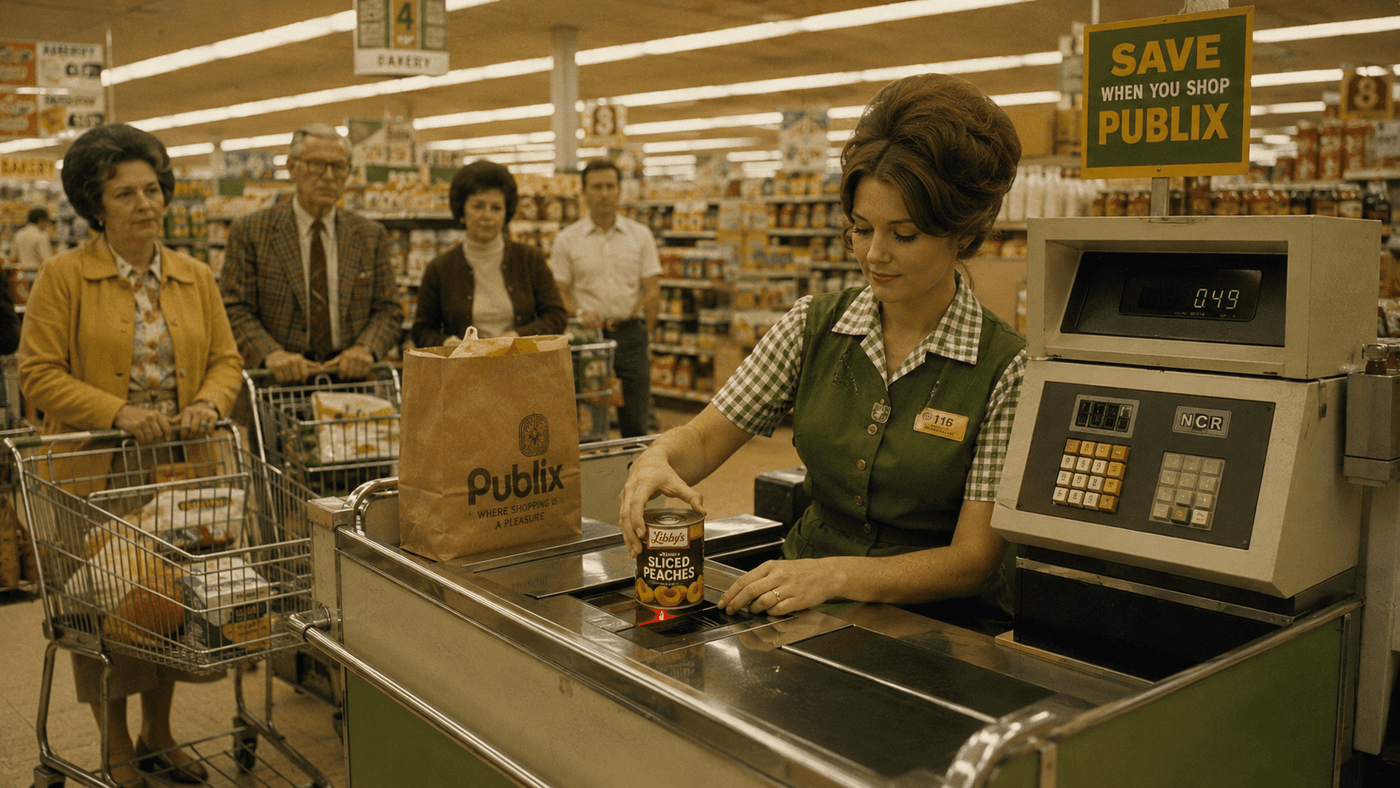
On June 26, 1974, at 8:01 in the morning, a cashier named Sharon Buchanan at Marsh's Supermarket in Troy, Ohio, picked up a ten-pack of Wrigley's Juicy Fruit chewing gum and passed it across a scanner connected to a cash register. The scanner read the zebra-striped Universal Product Code printed on the package, registered a price of 67 cents, and printed it on the receipt. It was the first time a barcode had been used in a live commercial transaction, and almost nobody noticed. The Marsh's store manager and a small delegation from the grocery industry were present for the occasion, but there were no cameras, no press releases, and no particular fanfare. The chewing gum was purchased. The receipt was printed. The revolution began.
The Universal Product Code had been in development since the late 1960s, when the grocery industry began searching for a way to speed up checkout lines and automate inventory management. A consortium of manufacturers and retailers adopted the UPC standard in 1973, and Marsh's Supermarket volunteered to host the first live test. The technology's adoption was initially slow — installing the scanning equipment was expensive, and many retailers were skeptical. By the mid-1980s, however, barcodes had spread through retail, manufacturing, shipping, and healthcare, fundamentally transforming supply chain management worldwide. Today, roughly six billion barcodes are scanned every day across the globe. The system that began with a pack of Juicy Fruit now underlies virtually every commercial transaction involving a physical product — from the shelves of a corner store to the logistics networks of the largest companies on earth. That original pack of gum is preserved at the Smithsonian Institution's National Museum of American History.
The Bridge of Air
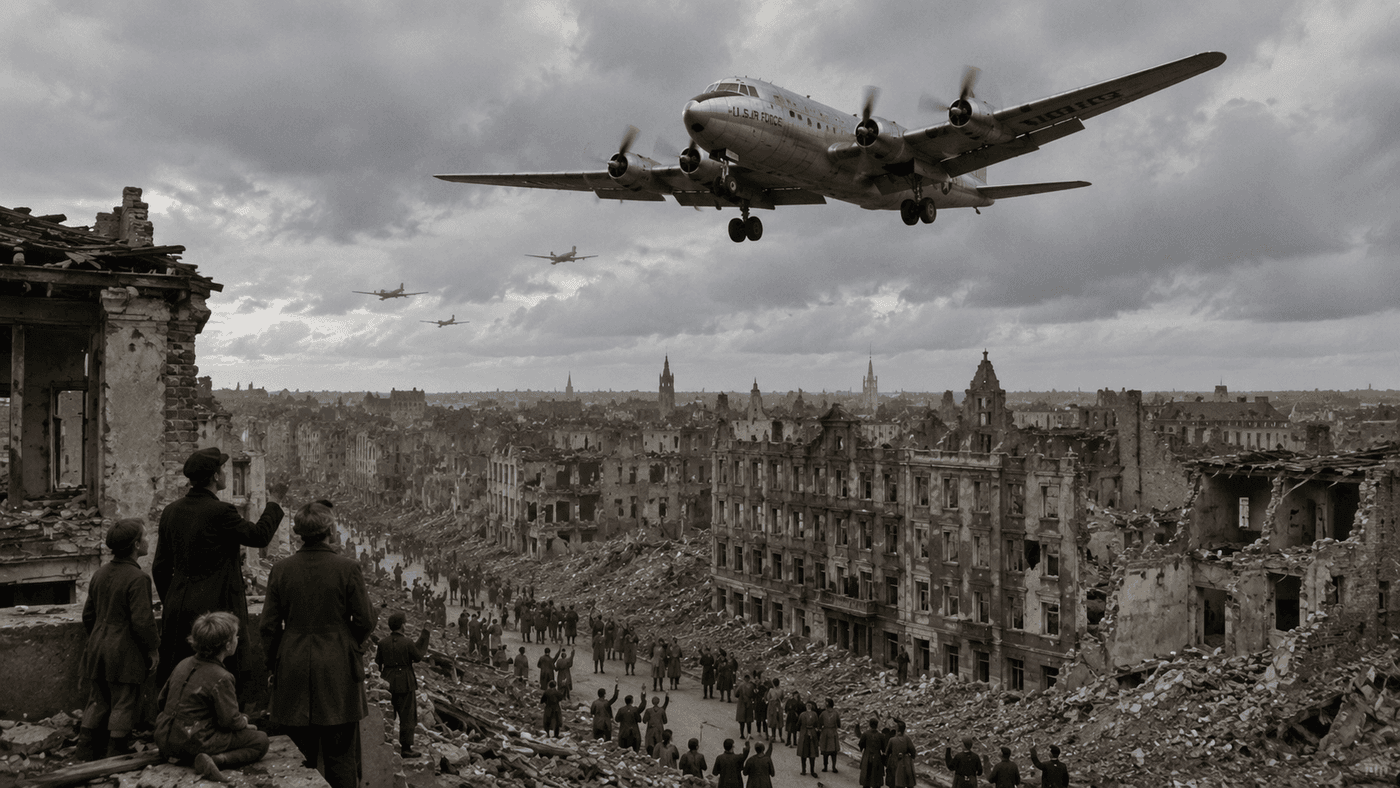
On June 26, 1948, the first American cargo planes touched down at Tempelhof Airport in West Berlin, inaugurating what would become one of the most audacious logistical operations in Cold War history. Three days earlier, the Soviet Union had sealed all land and water routes into the western sectors of the divided city, cutting off more than two million residents from food, fuel, and medicine in a bid to force the Western Allies out of Berlin entirely. Rather than abandon the city or attempt to break the blockade by force — either of which risked open war — the United States and Britain chose a third option: they would supply an entire city by air. Military planners estimated it would be impossible. They were wrong.
At its peak, the Berlin Airlift was delivering a plane to one of West Berlin's three airports every forty-five seconds, around the clock. Pilots flew up to three missions a day through narrow air corridors in all weather conditions. They carried coal, flour, dried milk, medicine, and, famously, candy — American pilot Gail Halvorsen began dropping chocolate bars and raisins attached to handkerchief parachutes for the children gathered below, earning him the nickname "Candy Bomber" and generating a wave of goodwill that no propaganda campaign could have manufactured. The Soviets lifted the blockade on May 12, 1949, after eleven months, having failed to dislodge the Western presence in Berlin. The airlift continued for several months afterward as a precaution. In total, Allied aircraft flew more than 200,000 sorties and delivered over two million tons of supplies. It was a victory of patience, logistics, and stubborn principle — and it established, clearly and publicly, that the Western Allies would not be moved.
Love Wins
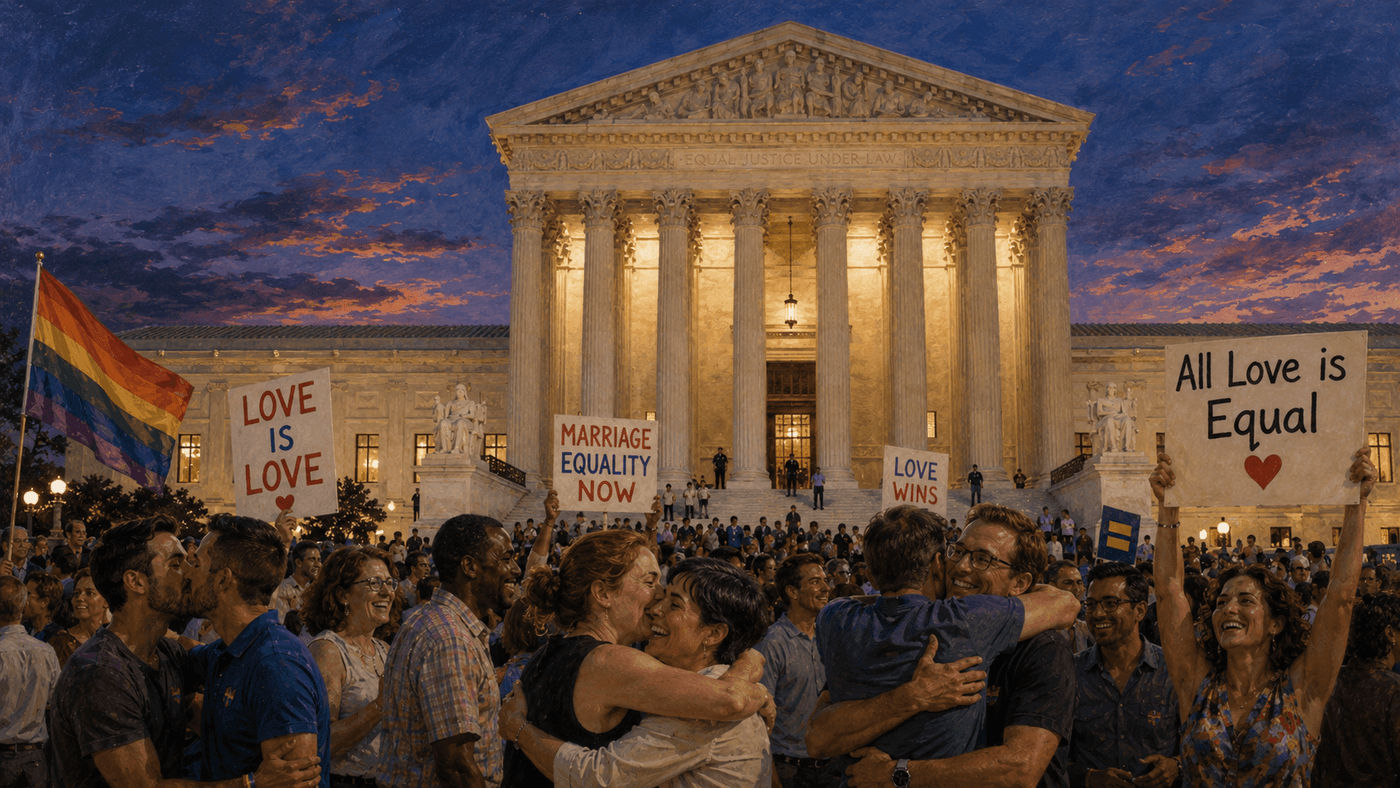
On June 26, 2015, the Supreme Court of the United States issued its ruling in Obergefell v. Hodges, holding five to four that the Fourteenth Amendment requires all states to license and recognize marriages between same-sex couples. The case had been brought by Jim Obergefell, an Ohio man who had married his partner John Arthur — who was terminally ill — in Maryland, a state where same-sex marriage was legal, but found that Ohio refused to recognize the union or list Obergefell as the surviving spouse on Arthur's death certificate. What Obergefell wanted was something modest and human: to be listed on his husband's death certificate. What the Court gave him, and millions of others, was the constitutional right to marry in every state in the country. Justice Anthony Kennedy, writing for the majority, concluded that the right to marry is fundamental, and that excluding same-sex couples from it demeans their dignity.
The ruling landed on a Friday morning, and within hours, same-sex couples who had been waiting — in some cases for decades — were lining up at county clerks' offices across the country. The White House was lit in rainbow colors that night. For LGBTQ+ Americans and their families, it was a moment of legal recognition that many had believed they would never see in their lifetimes — a formal acknowledgment, by the highest court in the land, that their relationships were equal under the law. The decision was the culmination of a movement that had been building since the Stonewall uprising of 1969, accelerating through the AIDS crisis, the culture wars of the 1990s, and the state-by-state battles of the 2000s. It did not end the fight for LGBTQ+ equality — battles over employment, housing, healthcare, and transgender rights continued — but it marked, unmistakably, a before and an after in the story of who America's promises include.