July 1: A Nation Born, a Rating Made, a Flag Lowered
July 1 has a talent for quiet transformation. In 1867, four British colonies signed a document and became a country — not with revolution or war, but with deliberation and ink, giving birth to Canada on a summer morning that most of the world barely noticed. One hundred and seventeen years later, Hollywood decided it needed a new box to put its movies in, and a two-character addition to a rating system reshaped how an entire industry would tell stories for generations. And in 1997, the world watched a ceremony in Hong Kong that compressed 156 years of colonial history into a single rainy evening — a flag going down, another going up, and an era ending in real time on television screens across the globe. Three July firsts. Three moments when something was formally declared that had already, in some sense, been becoming true for years.
Dominion
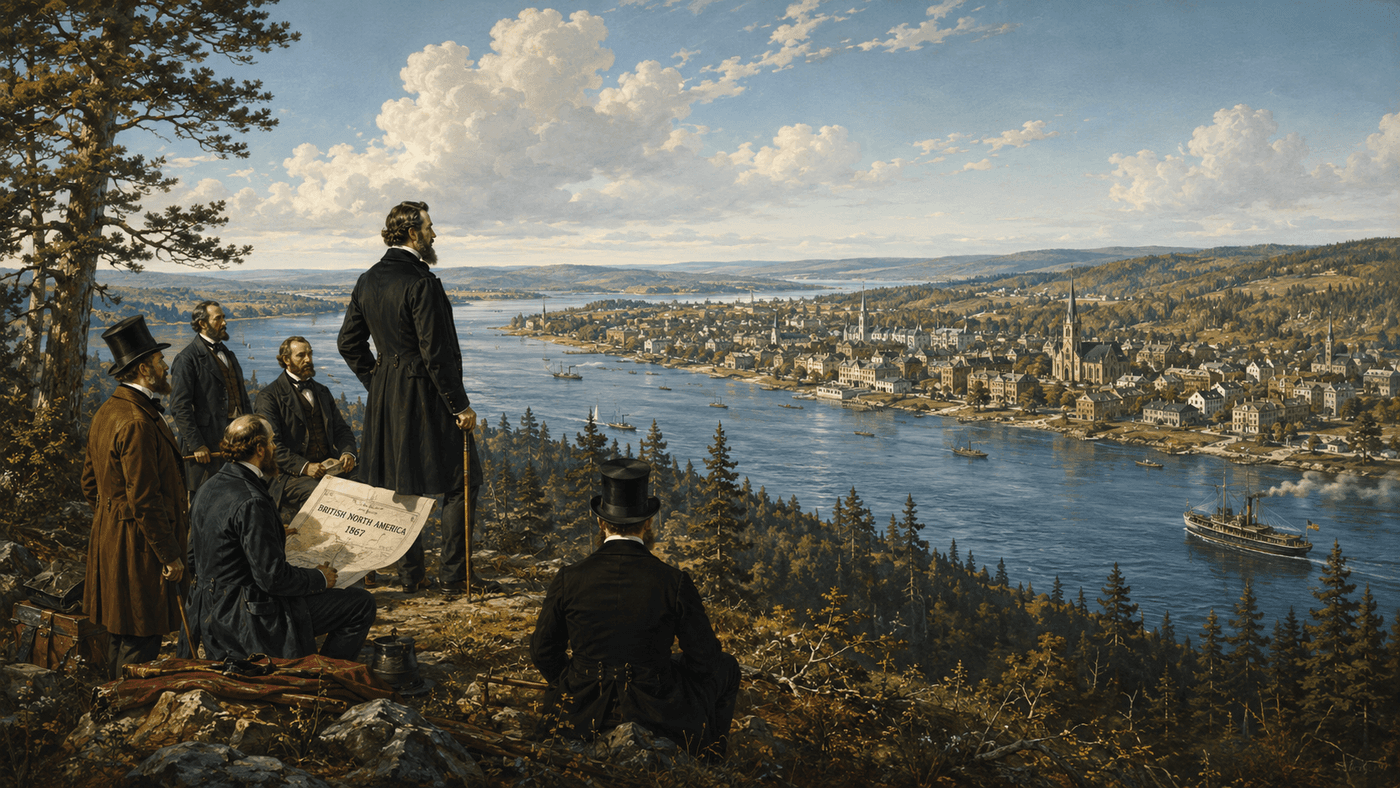
On July 1, 1867, the British North America Act came into force, uniting the Province of Canada — divided into the new provinces of Ontario and Quebec — with New Brunswick and Nova Scotia into a single self-governing Dominion called Canada. It was a nation born not from revolution but from negotiation: years of political deadlock, economic anxiety, and anxiety about American expansionism following the Civil War had convinced British colonial politicians that union offered a more viable future than fragmentation. The Fathers of Confederation, as they came to be known, hammered out the terms at a series of conferences in Charlottetown and Quebec City in 1864, and the British Parliament enacted their agreement into law. On July 1, 1867, Canada woke up as something new — not fully independent, still under the sovereignty of the British Crown, but possessed of its own parliament, its own prime minister, and its own constitutional framework.
The country that came into being that July morning shared the longest undefended border in the world with the United States — a relationship that has defined both nations ever since. Canada's path to full independence was gradual: the Statute of Westminster in 1931 granted legislative autonomy, and the Constitution Act of 1982 completed the process by patriating the constitution from Britain and adding the Canadian Charter of Rights and Freedoms. The nation that began with four provinces and a population of roughly 3.5 million now encompasses ten provinces and three territories, stretches from the Atlantic to the Pacific to the Arctic, and is home to more than 40 million people. July 1 is celebrated as Canada Day — a national holiday that, unlike its American counterpart four days later, tends toward fireworks and civic pride rather than the revolutionary fervor its origins didn't quite involve. Canada is, in many ways, the great argument that nations can be made through patience rather than war.
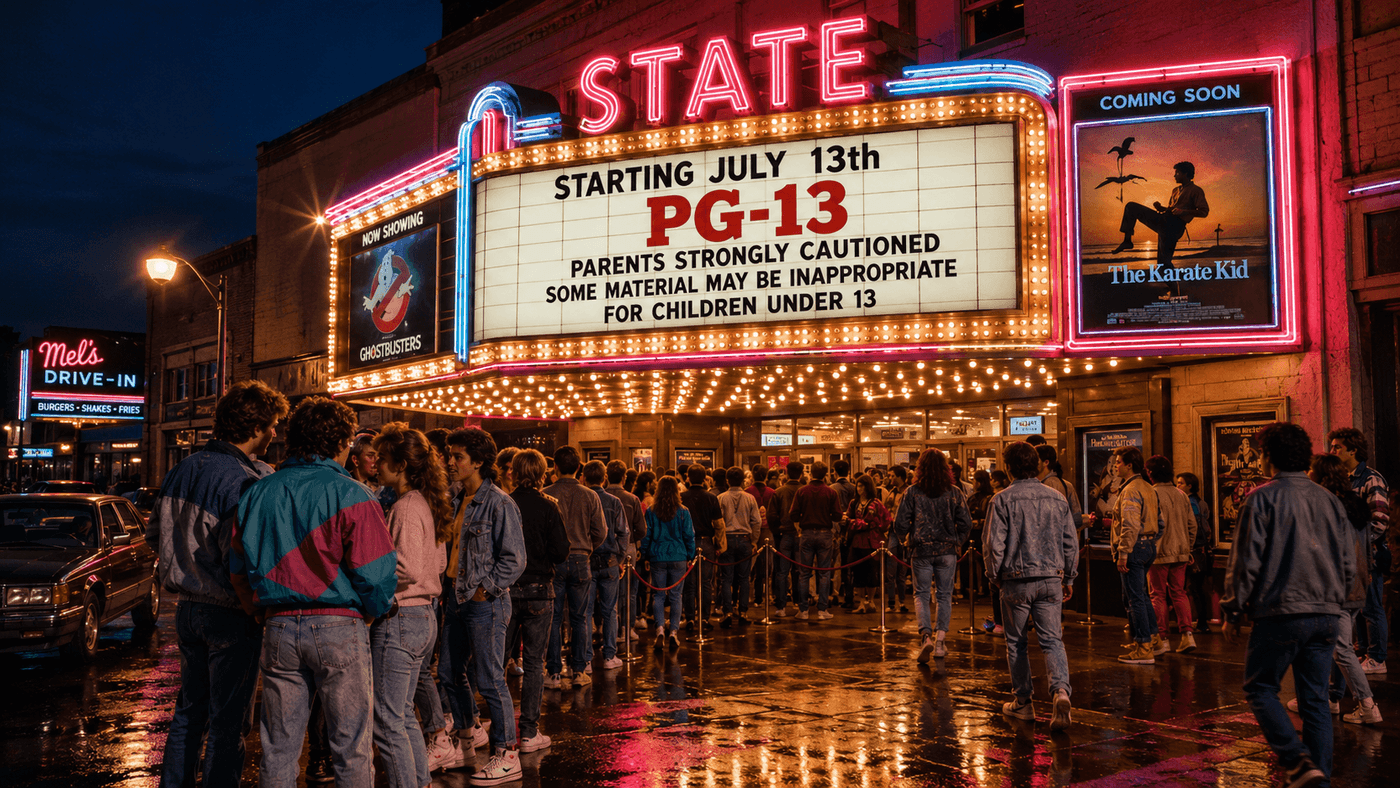
PG-13
On July 1, 1984, the Motion Picture Association of America officially introduced the PG-13 rating — a new classification slotted between the existing PG and R designations, intended to flag films containing material that parents might find inappropriate for children under thirteen. The catalyst was a pair of films from the summer of 1984 that had generated significant parental complaint: Steven Spielberg's Indiana Jones and the Temple of Doom and Joe Dante's Gremlins, both of which were PG but contained scenes of violence and horror that many found jarring for younger audiences. Spielberg himself, notably, had suggested the new rating to MPAA president Jack Valenti. The first film to officially carry the PG-13 designation was Red Dawn, John Milius's Cold War action film, which opened in August 1984.
The PG-13 rating's introduction had consequences that reshaped the economics and storytelling of Hollywood far beyond what its creators likely intended. The rating carved out a middle ground that proved enormously commercially attractive: broad enough to reach large audiences, flexible enough to accommodate significant action, violence, and mature themes, but without the box-office ceiling that an R rating imposed on marketing to younger viewers. Over the decades, the PG-13 designation became the sweet spot for blockbuster filmmaking — the rating of superhero films, franchise tentpoles, and virtually every major summer release aimed at the widest possible audience. Critics have argued that the rating's elasticity has gradually allowed Hollywood to push content toward the edge of R while retaining the more profitable classification. Whether or not that critique is fair, the two characters added to the rating system on July 1, 1984, remain among the most commercially significant in the history of American cinema.
The Last Night of British Hong Kong
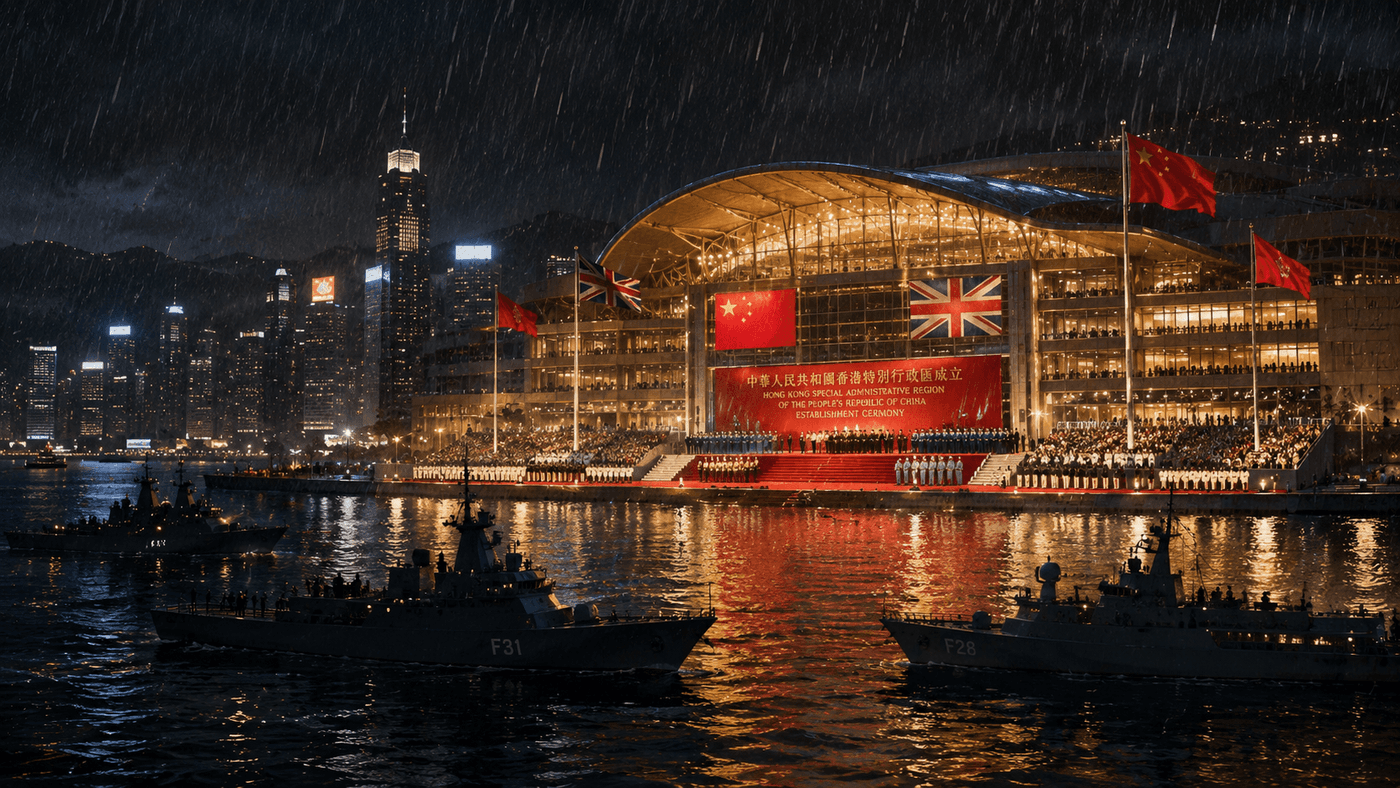
At the stroke of midnight on July 1, 1997, the Union Jack was lowered at the Hong Kong Convention and Exhibition Centre, and the flag of the People's Republic of China rose in its place. One hundred and fifty-six years of British colonial rule in Hong Kong came to an end in a ceremony attended by British Prime Minister Tony Blair, Prince Charles — representing the Crown — and Chinese President Jiang Zemin. The handover had been arranged by the 1984 Sino-British Joint Declaration, which established that Hong Kong would be returned to China under a framework called "one country, two systems," guaranteeing the territory's existing legal and economic structures for fifty years. As the ceremony concluded in the rain, HMS Britannia — the royal yacht — carried Prince Charles and the last British governor, Chris Patten, out of Victoria Harbour. It was the end of an era, watched live by millions around the world.
Hong Kong's handover was one of the most consequential geopolitical events of the post-Cold War era, with ramifications that have only grown more visible in the decades since. The territory's unique status as a global financial center and a bastion of civil liberties within Chinese sovereignty made it a subject of intense international attention — and anxiety. In 2019, mass protests erupted in response to a proposed extradition bill that many Hong Kongers saw as an erosion of their promised autonomy, drawing crowds of millions into the streets. Beijing's response, including the imposition of a sweeping National Security Law in 2020, dramatically curtailed the freedoms that the "one country, two systems" framework had been designed to protect. The fifty-year guarantee expires in 2047. For the United States, which had deep trade and diplomatic ties to Hong Kong, the territory's changing status has become a flashpoint in the broader contest between American and Chinese visions of global order — a contest that was already taking shape on the rainy night the flags changed in 1997.