Science

Recent Content

Dec. 31, 2004: Taipei 101 Opens as World's Tallest

Dec. 31, 2004: Taipei 101 Opens as World's Tallest

Read more
December 31: Rockin' Eve Debuts, Times Square Ball Drops

December 31: Rockin' Eve Debuts, Times Square Ball Drops

Read more
Dec. 30, 2011: The Day Samoa Skipped

Dec. 30, 2011: The Day Samoa Skipped

Read more
December 30: Hello, Goodbye Hits No. 1, Packers Win

December 30: Hello, Goodbye Hits No. 1, Packers Win

Read more
Dec. 29, 2013: Schumacher's Skiing Accident

Dec. 29, 2013: Schumacher's Skiing Accident

Read more
logo
  • Introduction

  • Lessons From The Past

  • Cultural Awareness and Diversity

  • Appreciation for Progress

  • Understanding Political and Social Dynamics

  • Preserving Cultural Heritage

  • Conclusion

Dec. 27, 2004: The Magnetar Flare That Hit Earth

On Dec. 27, 2004, a Dead Star 50,000 Light-Years Away Flashed So Brightly That It Briefly Disturbed Earth's Upper Atmosphere

A neutron star's brief convulsion swamped spacecraft detectors across the solar system and gave astronomers one of the most extreme events they had ever recorded.

The day after Christmas 2004, the world was absorbed by the Indian Ocean tsunami. On Dec. 27, a very different disaster reached Earth. It was not a threat but a flash of gamma rays and X-rays from the magnetar SGR 1806-20, a collapsed star on the far side of the Milky Way. The burst lasted a fraction of a second, yet it was powerful enough to register on instruments throughout the inner solar system.

The Flash

A magnetar is a neutron star with a magnetic field vastly stronger than anything else known in the universe, and SGR 1806-20 is one of the few identified in our galaxy. It sits roughly 50,000 light-years away, spins about once every 7.5 seconds, and is a repeating source of gamma-ray bursts. On Dec. 27, 2004, it produced what astronomers call a giant flare. In a spike lasting only a tenth of a second or so, the star released as much energy as the Sun emits in at least 100,000 years. The light then faded into a pulsating tail that lasted several minutes, flickering in time with the star's spin. Spacecraft built to watch the high-energy sky, including NASA's Swift and Wind and the European Space Agency's Integral, recorded the event. Many detectors were overwhelmed by the initial spike. The signal had crossed half the galaxy and arrived stronger than almost anything astronomers had designed their equipment to measure. The light had left the star about 50,000 years earlier, before there were any cities to rattle.

The flare did more than blind detectors. Researchers later reported that the burst briefly ionized part of Earth's upper atmosphere, altering the behavior of low-frequency radio signals, an effect seen before only with solar flares. Scientists announced the findings in early 2005, and the event became a landmark in the study of magnetars. It showed that the stars could unleash far more energy than previously thought, and it prompted debate over how often such flares occur. A later analysis suggested that some short gamma-ray bursts seen in other galaxies might be giant flares from distant magnetars. The event also had an odd timing: it arrived while the public's attention was on the tsunami, a catastrophe unrelated to it. For all its power, the flare left no mark that anyone on the ground could see or feel. Its only trace was in the data.

[#~image_alt_1~#]

More History

25 December 2026

Post

Dec. 25, 2021: Webb Telescope Launches

Dec. 25, 2021: On Christmas Morning, the James Webb Space Telescope Rode an Ariane 5 Rocket Into the Sky After decades of planning and delays, the most complex space observatory ever built left Earth on a holiday, with its fate hanging on hundreds of moving parts. On Dec. 25, 2021, while much of the world unwrapped presents, a rocket stood on a pad in Kourou, French Guiana, carrying the largest and most intricate telescope ever launched into space. The James Webb Space Telescope, a joint project of NASA, the European Space Agency and the Canadian Space Agency, lifted off at 7:20 a.m. EST (12:20 UTC) on an Ariane 5, beginning a journey meant to reveal the earliest galaxies. The Christmas Launch   The date was not the original plan. Webb's launch had been pushed back repeatedly over the years, and in December 2021 it slipped again, from Dec. 18 to Dec. 25, after a sudden clamp-band release incident during payload preparations and then unfavorable weather. The project's price tag had grown to roughly $10 billion, and its designers had built it around a mirror 6.5 meters wide, made of 18 gold-coated hexagonal segments that had to fold up to fit inside the rocket's nose cone. A tennis-court-sized sunshield of five thin layers would then have to unfurl in space to keep the instruments frigid. NASA described the observatory as having hundreds of single points of failure, steps that had to work with no chance of a repair mission. The telescope that had spent years behind schedule finally left on the one morning when the world was least likely to be watching the countdown. The rocket did its part with unusual precision. Arianespace's Ariane 5 placed Webb on a trajectory so accurate that the observatory used less fuel for course corrections than planned, and NASA said that left enough propellant to operate for about 20 years, double the original goal. Webb's solar array unfolded within minutes of separation, and in the following weeks the sunshield tensioned and the mirror segments opened one by one. On Jan. 24, 2022, Webb arrived at its working position near the Sun-Earth L2 point, about a million miles from home. It began science operations that summer, and its first full-color images were released on July 12, 2022. A project that had been so long in the making showed its first results as a stunning picture of the distant, ancient universe, from a spacecraft launched on Christmas Day.  
Read More

23 December 2026

Post

Dec. 23, 2003: First U.S. Mad Cow Case Found

On Dec. 23, 2003, the USDA announced the first case of mad cow disease in the United States, and a Washington dairy cow upended the global beef trade Two days before Christmas, one Holstein cow turned a quiet holiday week into a test of American food safety and trade. Dec. 23, 2003, was supposed to be a slow news day before the holidays. Instead, Agriculture Secretary Ann Veneman stepped to a podium in Washington, D.C., with news officials had long insisted was unlikely: a dairy cow in Washington state had tested positive for bovine spongiform encephalopathy, better known as mad cow disease. It was the first confirmed case on American soil. One Cow, Many Borders   The animal was a Holstein dairy cow that had been slaughtered earlier that month at a plant in Washington state. It had been unable to walk, which is why it was sampled for testing, and a USDA lab in Ames, Iowa, flagged the result. Veneman told reporters that the meat from the cow had gone into the food supply, but that the brain, spinal cord and other tissues associated with the disease had been removed. Officials stressed that the risk to consumers was extremely low. The disease had been tied in Britain to a fatal human illness, variant Creutzfeldt-Jakob disease, which gave the announcement a weight far beyond a single farm. American officials had spent years describing the country's safeguards as strong, and for a few hours before Christmas, that claim was put to its first real public test. The cow, it turned out, had been sampled precisely because the system was designed to look for it. The economic shock came fast. Within days, more than 30 countries restricted imports of American beef, including Japan and South Korea, two of the industry's most valuable customers, in a trade worth roughly $3 billion a year. Investigators later traced the cow to Canada, which reframed the story as a North American problem rather than a purely domestic one. The USDA soon announced new safeguards, including a ban on using so-called downer cattle for human food, a rule that would have kept this very cow out of the supply. The episode ended with an odd kind of reassurance: the nation's first case arrived on the same day it was caught, and a Christmas week scare produced the tightening of rules that had, until then, been declared sufficient.  
Read More

13 December 2026

Post

Dec. 13, 2012: Chang'e 2 Flies Past Asteroid Toutatis

On December 13, 2012, a Chinese Moon Probe on an Unplanned Second Career Flew Past the Asteroid Toutatis Chang'e 2 had already finished its lunar job, so China sent it deep into space to photograph one of the solar system's most awkward-looking rocks. On Dec. 13, 2012, a spacecraft built to orbit the Moon passed within a few kilometers of an asteroid. Chang'e 2 was a Chinese lunar probe that had launched in 2010. By the time it reached Toutatis, it was more than seven million kilometers from home and well past the end of its original assignment. The flyby made China the fourth space program, after the United States, Europe and Japan, to photograph an asteroid up close. The Bonus Mission   Chang'e 2 launched in October 2010 as a scouting vehicle for China's lunar program, and it mapped the Moon's surface in fine detail from a low orbit. Once that work was done in 2011, its engineers could have let it idle. Instead they sent it toward Lagrange point L2, a gravitationally balanced spot far beyond the Moon on the side of Earth facing away from the Sun. From there the craft was steered toward Toutatis, an asteroid that swings through the inner solar system on a roughly four-year orbit and passes close to Earth's own path. Toutatis is a known tumbler, spinning around more than one axis at once, which makes it hard to study from a distance. A probe designed for lunar mapping had ended up being China's first deep-space asteroid scout, and nobody had put that on the original mission plan. Chinese space officials announced that the encounter took place on Dec. 13, 2012, and the probe's camera returned a series of images as it passed. They showed Toutatis as an elongated, lumpy body more than four kilometers long, with a pronounced neck-like narrowing and a surface strewn with boulders and craters. The pictures let scientists compare long-held radar-based models of the asteroid with direct views, and they offered clues that it may be made of two joined pieces. Chang'e 2 then flew on, becoming a spacecraft with no destination left on its itinerary, still sending signals from deeper and deeper in space. The probe built to study the neighbor next door ended up with a snapshot of a stranger passing through.  
Read More

11 December 2026

Post

Dec. 11, 2020: FDA Authorizes Pfizer Vaccine

On December 11, 2020, the FDA Authorized the First COVID-19 Vaccine for Emergency Use in the United States Less than a year after the virus was first identified, a late-Friday regulatory decision opened the door to the biggest vaccination effort the country had ever attempted. On Friday, Dec. 11, 2020, the U.S. Food and Drug Administration issued an emergency use authorization for the vaccine developed by Pfizer and BioNTech, making it the first COVID-19 vaccine cleared for use in the United States. The decision came on a winter evening when the country was recording some of its highest daily death tolls of the pandemic. The Green Light   The authorization followed a meeting of the FDA's outside advisory committee the previous day, where independent experts voted 17 to 4, with one abstention, to back the vaccine for people 16 and older. The agency's review rested on a large clinical trial that found the two-dose regimen to be about 95 percent effective at preventing symptomatic COVID-19. Acting Commissioner Stephen Hahn signed off, and the agency described the action as the first emergency use authorization of a COVID-19 vaccine. The vaccine, made with messenger RNA technology that had never before been used in an approved vaccine, had moved from genetic sequence to regulatory clearance at a pace without precedent. Earlier vaccines had typically taken a decade or more to develop. The shots still needed to travel, however, and they had to be kept at ultra-cold temperatures, a logistical puzzle that required specialized freezers and carefully planned shipping long before the paperwork was complete. Distribution began almost immediately. Shipments left Pfizer's Kalamazoo, Michigan, facility over the weekend, and the first vaccinations in the United States were administered on Monday, Dec. 14, to health care workers. Within days, the agency's attention turned to a second candidate from Moderna, which received its own authorization on Dec. 18. The speed of the effort drew scrutiny as well as celebration, with regulators and public health officials stressing that the review had not skipped its safety steps. For a country that had spent months waiting for any sign of an exit, the announcement was a quiet piece of paper with enormous consequences. Yet the authorization was only the beginning of a long campaign, since the hardest part, persuading hundreds of millions of people to roll up their sleeves, still lay ahead.  
Read More

08 December 2026

Post

Dec. 8, 2020: Margaret Keenan's First Pfizer Shot

On Dec. 8, 2020, a 90-year-old grandmother in Coventry rolled up her sleeve and became the first person in the world to receive a fully tested COVID-19 vaccine outside a clinical trial Britain called it V-Day, and its first patient was a retired jewelry shop assistant who was a week shy of her 91st birthday. The first dose of the Pfizer-BioNTech vaccine given outside a trial went into the arm of Margaret Keenan at University Hospital in Coventry, England, on the morning of Dec. 8, 2020. The jab came less than a year after the virus had first been identified, and days after British regulators authorized the shot. The National Health Service had spent weeks preparing for the moment, and it arrived with cameras waiting. V-Day in Coventry   Keenan, a former jewelry shop assistant, was among the first patients in line as the NHS began its mass vaccination program at hospital hubs across the United Kingdom. Nurse May Parsons administered the injection, and the moment was broadcast around the world. Britain had become the first Western country to authorize a fully tested COVID-19 vaccine, and it moved quickly to put doses into patients, prioritizing older adults and care home residents, who were the most vulnerable to the disease. Keenan, who was just a week away from turning 91, was among the first to be called. After the shot, she described it as the best early birthday present she could have wished for, a line that was quoted in headlines around the world. For a pandemic that had kept families apart for most of a year, one small needle stick in a Midlands hospital carried more weight than its few seconds suggested. The second person vaccinated that day was William Shakespeare, an 81-year-old from Warwickshire, a coincidence of names that British newspapers could scarcely resist. Within hours, the story had shifted from a scientific milestone into something close to a national ritual, with hospitals sharing images of the first patients and health officials urging the public to keep following restrictions while the rollout began. The shots themselves required two doses and carefully controlled ultra-cold storage, a logistical challenge that had dominated planning for weeks. Yet the images that endured were not of freezers or spreadsheets. They were of an older woman in a hospital gown and a patterned T-shirt, smiling beneath a mask, at the start of the long task of ending a global emergency.  
Read More

03 December 2026

Post

Dec. 3, 2018: Hayabusa2 Closes In on Ryugu

Dec. 3, 2018: Japan's Hayabusa2 Probe Takes Its Place Beside the Asteroid Ryugu to Begin a Hunt for Buried Secrets of the Solar System After more than three years of travel, a small Japanese spacecraft arrived at a rubble-pile asteroid to ask where Earth's water and organic ingredients came from. On Dec. 3, 2018, the Japan Aerospace Exploration Agency's Hayabusa2 spacecraft was in position at the asteroid Ryugu, a dark, spinning object roughly half a mile wide that orbits the Sun far from any ordinary neighborhood. It had launched in December 2014. The goal was to touch the surface, collect material, and bring it home. The Rendezvous   Hayabusa2 was the successor to the original Hayabusa, which returned a tiny amount of dust from the asteroid Itokawa in 2010 after a famously troubled journey. This time JAXA aimed at a carbon-rich asteroid, a type thought to preserve material from the early solar system, including possible clues about water and organic compounds. The spacecraft had reached Ryugu's vicinity in June 2018, using ion engines to match the asteroid's path and to hover at a distance of about twelve miles. In the months that followed, its cameras revealed a surface far rockier than scientists had expected, strewn with boulders and lacking the smooth, sandy patches mission planners had hoped might make a safe landing zone. Controllers would have to rethink their choices. The mission team had picked a target the shape of a spinning top, then found it covered in obstacles. The work of the following year went on to include small hopping rovers released onto the surface, a copper impactor that blasted an artificial crater, and two touchdowns to gather samples, including material from beneath the surface. Hayabusa2 left Ryugu in November 2019 and in December 2020 dropped a capsule over the Australian outback. The capsule held about 5.4 grams of dark grains, far more than the mission's target of 0.1 gram. Analysis later found organic molecules and amino acids in the samples. A probe built to fetch a pinch of dust returned with a heavy payload, from a rock that had spent billions of years drifting through the dark.  
Read More

02 December 2026

Post

Dec. 2, 2020: UK Approves the Pfizer Vaccine

Dec. 2, 2020: The United Kingdom Becomes the First Western Nation to Authorize a COVID-19 Vaccine With a regulatory green light for the Pfizer-BioNTech shot, Britain turned a year of lockdowns and loss toward a new kind of waiting: the wait for a needle. On Dec. 2, 2020, the UK's medicines regulator, the MHRA, granted temporary authorization to the vaccine developed by Pfizer and BioNTech. It was the first time a Western country had approved a fully tested COVID-19 vaccine for public use, and it came barely eleven months after the virus first appeared in the news. The Green Light   The decision followed a rolling review of data from the companies' large Phase 3 trial, which had reported roughly 95 percent efficacy against symptomatic COVID-19. The regulator's approval allowed the shot to be supplied under temporary authorization, and Prime Minister Boris Johnson announced the news on social media, calling it incredible. The vaccine was built on messenger RNA, a technology that had never before been used in an approved vaccine for the public. Researchers had spent years refining it in relative obscurity, and now it had gone from laboratory promise to government approval in a stretch of months that vaccine specialists once would have considered impossible. The approval also set off an unusual bit of international jostling. Other countries, whose regulators were still deep in their own reviews, now had to explain why a rival had reached the finish line first. For a pandemic that had made borders, schedules and ordinary life feel unmovable, the speed of the paperwork was, in its own way, a small shock. The first people in Britain to be vaccinated would not have to wait long. On Dec. 8, Margaret Keenan, a 90-year-old woman in Coventry, became the first person in the world to receive the Pfizer-BioNTech shot outside a clinical trial, in a hospital that had been turned into one of the country's first vaccination hubs. The U.S. Food and Drug Administration followed with its own emergency use authorization on Dec. 11, and other nations soon joined in. The approval did not end the pandemic; cases and deaths kept climbing through the winter, and supplies were limited at first. But it changed the shape of the story. After months in which the most hopeful news was a downward curve on a chart, the headline now involved something people could actually roll up a sleeve for. The most anticipated science of the year arrived not with fanfare, but with a regulatory notice.  
Read More

28 November 2026

Post

Nov. 28, 2018: The CRISPR Babies Announcement

On Nov. 28, 2018, a Chinese scientist walked onto a Hong Kong stage to defend the birth of the world's first gene-edited babies He Jiankui's public account of the CRISPR twins drew gasps, condemnation and a reckoning over who gets to rewrite the human genome. Scientific revolutions usually arrive in peer-reviewed journals. This one arrived in the news first. By Nov. 28, 2018, reports had already claimed that a researcher in Shenzhen had edited the DNA of human embryos and that two girls had been born from them. That afternoon, the man behind the claim had to explain himself to a roomful of his peers. The Hong Kong Stage   The venue was the Second International Summit on Human Genome Editing at the University of Hong Kong, where He Jiankui, then an associate professor at the Southern University of Science and Technology in Shenzhen, was scheduled to speak. He told the audience that he had used the CRISPR tool to alter a gene called CCR5 in embryos, with the aim of making children resistant to HIV infection. He said the work had produced twin girls, known publicly by the pseudonyms Lulu and Nana, and that a second pregnancy might also be underway. The claim had not been published or independently verified. His university said he had been on unpaid leave since February 2018 and that it had not known about the project. Many scientists in the room had spent years debating whether such an experiment should ever be attempted. They were now hearing that someone had already done it, and that the news had broken before any journal had a chance to weigh in. The reaction was swift. The summit's organizing committee said the next day that the work was irresponsible and failed to conform to international norms, and criticized the lack of transparency around it. Researchers pointed out that the embryos were healthy and that proven ways to protect children from HIV already existed. Chinese authorities opened an investigation, and in December 2019 a court in Shenzhen sentenced He to three years in prison and fined him three million yuan. The technology he used had been celebrated for its precision, but the episode showed that the harder problem was never the cutting. It was deciding, in advance and in public, who gets to hold the scissors.  
Read More

26 November 2026

Post

Nov. 26, 2011: Curiosity Launches to Mars

On Nov. 26, 2011, NASA Launched a Car-Sized Rover Called Curiosity Toward Mars on a Mission Meant to Last Two Years A one-ton robot left Florida on an Atlas V rocket with a simple question: could Mars ever have supported life? The morning after Thanksgiving weekend began, an Atlas V rocket stood on Space Launch Complex 41 at Cape Canaveral, Florida. On Nov. 26, 2011, it lifted off carrying NASA's Mars Science Laboratory, a spacecraft built around a rover the size of a small car. The rover had been named Curiosity by a sixth-grade student, Clara Ma, in a national student contest. Its destination was 354 million miles away. The Long Cruise   The Atlas V launched at 10:02 a.m. Eastern time and sent the spacecraft on a roughly eight-month cruise to Mars. Curiosity was far larger than the rovers that came before it. It weighed about 900 kilograms, or nearly a ton, and carried ten science instruments, including a laser that could vaporize rock from a distance and a chemistry lab built to analyze soil and powdered stone. NASA put the mission's cost at about $2.5 billion. Its goal was less to find life than to find out whether Mars ever offered the conditions for it. The rover was bound for Gale Crater, where a mountain of layered rock rose from the crater floor like a geological history book. Engineers had picked it partly because the layers promised a record of how the planet changed over time. Getting there, however, required a landing method nobody had tried: the rover would be lowered to the surface on cables from a hovering rocket-powered platform. The launch was the easy part, and everyone involved knew it. The gamble paid off on Aug. 6, 2012, UTC, when Curiosity touched down inside Gale Crater after the so-called seven minutes of terror, the descent that had to be completed without any help from Earth. Within months, it found evidence of an ancient streambed, and later analysis of mudstone showed that the crater once held a lake with chemistry that could have supported microbial life. The prime mission was set at one Martian year, about 687 Earth days. Curiosity passed that mark long ago and was still climbing Mount Sharp more than a decade later, working through terrain no engineer had seen when the rocket left the pad. A rover that left Earth to answer one question has spent years producing new ones, which is how a two-year plan turned into a career.  
Read More

21 November 2026

Post

Nov. 21, 2006: Seven Powers Sign the ITER Fusion Pact

On Nov. 21, 2006, Seven Governments Gathered in Paris and Signed an Agreement to Build a Miniature Sun The ITER pact joined rivals and allies in one of the most ambitious science projects ever attempted: a machine meant to prove fusion power can work. Treaty signings are usually about borders, trade or weapons. On Nov. 21, 2006, in the Élysée Palace in Paris, the signatures went onto something stranger: a joint agreement to build an experimental reactor meant to mimic the process that powers the Sun. The European Union, the United States, Russia, Japan, China, India and South Korea put their names to the ITER agreement, committing to a shared machine that none of them wanted to build alone. A Star in France   The idea behind ITER is simple to state and brutally hard to achieve. Fusion joins light atomic nuclei and releases energy, but only when fuel is heated to extreme temperatures and held in place long enough for the reaction to sustain itself. ITER's design, a doughnut-shaped tokamak that uses powerful magnets to confine superheated plasma, aims to produce roughly ten times the thermal power it takes to heat the fuel. The goal was never to put electricity on the grid. It was to demonstrate that the physics scales up. The site had been settled the year before: Cadarache, in southern France, won out over a rival bid from Japan after a long diplomatic contest. The 2006 signing turned that compromise into a legal framework, with each partner agreeing to contribute components and funding. The partners had spent years haggling over who would host the machine, and now they had to agree on who would pay for it. The agreement created a new international organization to oversee construction, and its design relied on an unusual arrangement: most contributions would arrive as finished hardware rather than cash, with parts built in factories across several continents and shipped to France. That structure kept every government invested in the outcome, but it also made coordination a constant challenge. Schedules slipped and cost estimates grew in the years that followed, and the first-plasma date announced around the time of the signing was later pushed back repeatedly. Still, the partners kept building. A project conceived partly as a Cold War-era gesture of scientific cooperation outlasted the political tensions that have strained relations among its members since. The machine meant to hold a star has proven slower to assemble than the diplomacy that launched it, and in some ways more stubborn.  
Read More

29 October 2026

Post

Oct. 29, 2004: Cassini's First Close Titan Flyby

On October 29, 2004, NASA's Cassini Spacecraft Made Its First Close Flyby of Saturn's Mysterious Moon Titan Peering beneath an orange haze that had hidden a world for centuries, Cassini revealed a landscape unlike anything else in the solar system. On October 29, 2004, the Cassini spacecraft swept to within about 745 miles of Titan, Saturn's largest moon, in the first of dozens of close encounters that would define its 13-year mission. For decades, Titan's thick nitrogen-methane atmosphere had hidden its surface from every telescope and passing probe, turning the moon into one of the solar system's great blank spots. Cassini's instruments, built to pierce that orange shroud, were about to change that. Behind the Haze   Cassini's radar and imaging instruments cut through Titan's dense atmosphere in ways visible light cameras never could, returning the sharpest views of the moon's surface humanity had ever seen. Scientists spotted bright and dark regions suggesting complex geology, along with hints of the methane lakes and dune fields that later missions would confirm in detail. Mission scientists at NASA's Jet Propulsion Laboratory described the data as immediately reshaping assumptions about Titan's surface, which some had expected to be smooth or ocean-covered. Instead, the flyby revealed a moon carved by processes eerily similar to Earth's own, just built from entirely different chemistry. It was a reminder that familiar shapes don't require familiar materials. The October 29 pass was a prelude to Cassini's most dramatic achievement regarding Titan: the release of the European Space Agency's Huygens probe, which would land on the moon's surface just months later in January 2005. That descent, made possible by the orbital groundwork laid during early flybys like this one, delivered the first images ever taken from the surface of a world in the outer solar system. Cassini would go on to make more than 120 targeted Titan flybys before its mission ended with a deliberate plunge into Saturn in 2017. The moon it helped reveal, with its rivers and seas of liquid methane, remains one of the strongest candidates for exotic life beyond Earth, a possibility this single flyby helped bring into focus.  
Read More

23 October 2026

Post

Oct. 23, 2001: Apple Unveils the iPod

On October 23, 2001, Steve Jobs Introduced the World to the iPod A small white device with a click wheel promised to put a thousand songs in your pocket—and quietly began rewriting the rules of the music business. On October 23, 2001, in a modest auditorium at Apple's Cupertino headquarters, Steve Jobs pulled a small white rectangle from his pocket and told the assembled press that Apple was introducing a breakthrough digital device. The company was still years from the iPhone, still recovering from the dot-com bust, and best known for candy-colored iMacs. What Jobs held up that day looked unassuming, almost toy-like, but it carried a claim that sounded almost absurd for its time. 1,000 Songs   The device was the iPod, a 6.5-ounce gadget with a 5GB hard drive that Apple promised could hold "1,000 songs in your pocket." It used a mechanical scroll wheel for navigation, connected via FireWire for what was then blazing-fast transfers, and carried a price tag of $399 — steep enough that some technology writers dismissed it as a niche product for Mac loyalists. Compared to the clunky MP3 players already on the market, most of which held a fraction of the songs and ran on double-A batteries, the iPod felt like it had arrived from another decade entirely. Jobs, dressed in his familiar black turtleneck, framed it not as a gadget but as a lifestyle shift, a way of carrying an entire music collection without carrying anything heavy at all. Skeptics wondered aloud whether Apple, a computer company, had any business making a music player — a question that would soon answer itself in the most emphatic terms possible. The first iPod shipped a few weeks later, compatible only with Macs, which limited its reach in a market still dominated by Windows PCs. But the device's design language — minimalist, white, built around Apple's new iTunes software — set a template the company would refine for years. Within two years, Windows compatibility and the iTunes Music Store would turn the iPod into a cultural fixture, its white earbuds becoming a visible symbol of the early 2000s. The record labels that once shrugged off digital music would soon find themselves negotiating with the company that had made downloading songs feel effortless, a shift that began with one modest press event and a device nobody outside Cupertino was sure the world actually needed.  
Read More

22 October 2026

Post

Oct. 22, 2008: The First Android Phone Debuts

On October 22, 2008, the T-Mobile G1 Went on Sale, Introducing the World to Android A slide-out keyboard and a search-engine giant's operating system quietly launched the smartphone war's second act. On October 22, 2008, shoppers filing into T-Mobile stores across the United States could walk out with a chunky, slide-out-keyboard handset called the G1 — the first phone ever to run Google's new Android operating system. Built by HTC and priced at $179 with a two-year contract, it arrived just over a year after Apple's iPhone had redefined what a phone could be, and few outside the tech press understood they were watching the opening move of a rivalry that would reshape the entire industry. The Underdog Debut   The G1 was, by most measures, an awkward machine. It had a trackball, a physical keyboard that popped out from beneath the screen, and no multi-touch pinch-to-zoom, a deliberate step around Apple's patents. Reviewers at the time noted its clunky software and middling battery life, and Google itself was cautious about the launch, treating Android less as a finished product than as an open invitation to manufacturers and developers who felt boxed out of Apple's tightly controlled ecosystem. T-Mobile sold out its initial stock within days, driven less by the hardware than by curiosity about what Google intended to build. What followed was not immediate dominance but a slow accumulation of scale. Android's open-source licensing meant that Samsung, Motorola, LG, and eventually manufacturers worldwide could adopt it for free, and within three years Android phones outsold iPhones globally. The G1 itself was discontinued within two years, a footnote next to the operating system it introduced, which today runs on the majority of smartphones on Earth — proof that the clumsiest first draft can still write the ending.  
Read More

18 October 2026

Post

Oct. 18, 2019: First All-Female Spacewalk

On October 18, 2019, Christina Koch and Jessica Meir Stepped Into History Outside the ISS A scheduling quirk months earlier had delayed this moment, but on this day two women finally floated alone into the vacuum of space together. On October 18, 2019, NASA astronauts Christina Koch and Jessica Meir opened the hatch of the International Space Station and drifted out into open space, becoming the first all-female team to conduct a spacewalk in the six-decade history of extravehicular activity. Their task was technical — replacing a failed power controller — but the moment carried a weight far beyond hardware. The Long Way Up   The spacewalk almost happened months earlier, in March 2019, when Koch and fellow astronaut Anne McClain were slated to go out together. NASA scrubbed that plan after discovering there weren't enough medium-sized spacesuit torsos aboard the station to fit both women, a logistical gap that drew sharp public criticism about how spaceflight infrastructure had been designed. Koch went out instead with a male colleague, and the milestone waited. By October, the suit situation was resolved, and Meir, on her first spaceflight, joined Koch for a seven-hour, seventeen-minute excursion. They successfully swapped the faulty battery charge-discharge unit, restoring full power capacity to the station's solar array circuit. The fix worked precisely as engineers had hoped, a quietly competent end to a walk that the whole world had been watching for reasons that had nothing to do with batteries. Inside the station, NASA astronaut Jessica Meir spoke with President Donald Trump and NASA administrator Jim Bridenstine during the walk, fielding a call that framed the moment as a national milestone rather than a routine repair. Koch would go on to spend 328 days in space, setting a record for the longest single spaceflight by a woman, while Meir's own path back to Earth carried the quiet distinction of having been part of the first spacewalk performed entirely by women. NASA had conducted more than 200 spacewalks since 1965 before this one finally matched its astronaut corps to its long-overdue moment, a gap closed not by grand ceremony but by two women fixing a battery a few hundred miles above the planet that had kept them waiting.  
Read More

16 October 2026

Post

Oct. 16, 2003: China's First Astronaut Returns

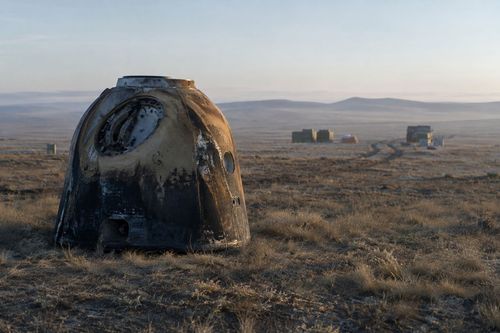
On October 16, 2003, Yang Liwei Touched Down and Made China a Spacefaring Nation After 21 hours circling the Earth, a 38-year-old fighter pilot turned taikonaut landed on the Mongolian steppe and rewrote the map of human spaceflight. On the morning of October 16, 2003, a scorched capsule descended over the grasslands of Inner Mongolia, carrying Yang Liwei back to Earth after roughly 21 hours in orbit aboard Shenzhou 5. His safe landing capped a mission that had launched the day before from the Jiuquan Satellite Launch Center, making China only the third nation — after the Soviet Union and the United States — to independently send a human into space. The Long Descent   Yang, a former People's Liberation Army Air Force pilot selected from a pool of more than a thousand candidates, had spent the flight orbiting the planet fourteen times in a spacecraft built with heavy Soviet-era design influence but engineered and assembled domestically. State television broadcast the launch live, an unusual move for a government typically cautious about publicizing failures, and it paid off: the mission went almost exactly to plan. When the reentry module separated and parachuted down near Siziwang Banner, recovery teams found Yang conscious, mobile, and reportedly in good spirits, later saying he saw no need to feel nervous during the flight. The successful landing turned a national gamble into a broadcast triumph. The flight instantly became a cornerstone of Chinese national identity, celebrated with parades, commemorative stamps, and Yang's near-instant elevation to celebrity status and military honors. It also announced, to a world still processing the post-Cold War space landscape, that a third power now had the capability to launch and recover humans on its own terms. Within a decade, China would build on the Shenzhou 5 blueprint to construct a modular space station, but the moment of Yang stepping out of that capsule under his own power remained the symbolic starting gun — a quiet field in Mongolia serving as the unlikely stage for a new era in space history.  
Read More
Terms and ConditionsDo Not Sell or Share My Personal InformationPrivacy PolicyPrivacy NoticeAccessibility NoticeUnsubscribe
Copyright © 2026 Day In History