September 16: The Mayflower Sails, a New Nation Rises in the Pacific, and Frasier Takes Seattle
September 16 is a day for departures that became arrivals, and for the gap between them — the sixty-six days of autumn Atlantic crossing, the decades of administered territory becoming a republic, the spin-off that turned out to be better than the original. In 1620, 102 passengers boarded a ship in Plymouth Harbor that would take them across an ocean to a coast most of them had never seen, founding a colony whose mythology would outlast its reality by four centuries and counting. In 1975, a territory administered by Australia since the end of the First World War completed its transition to independence, becoming one of the most linguistically diverse nations on earth. And in 1993, a character who had spent eleven years drinking at a Boston bar moved to Seattle, got a radio show, and proceeded to win more Emmy Awards than any comedy in television history. Three September sixteenths. Three new beginnings, each one built from a departure.
The Mayflower
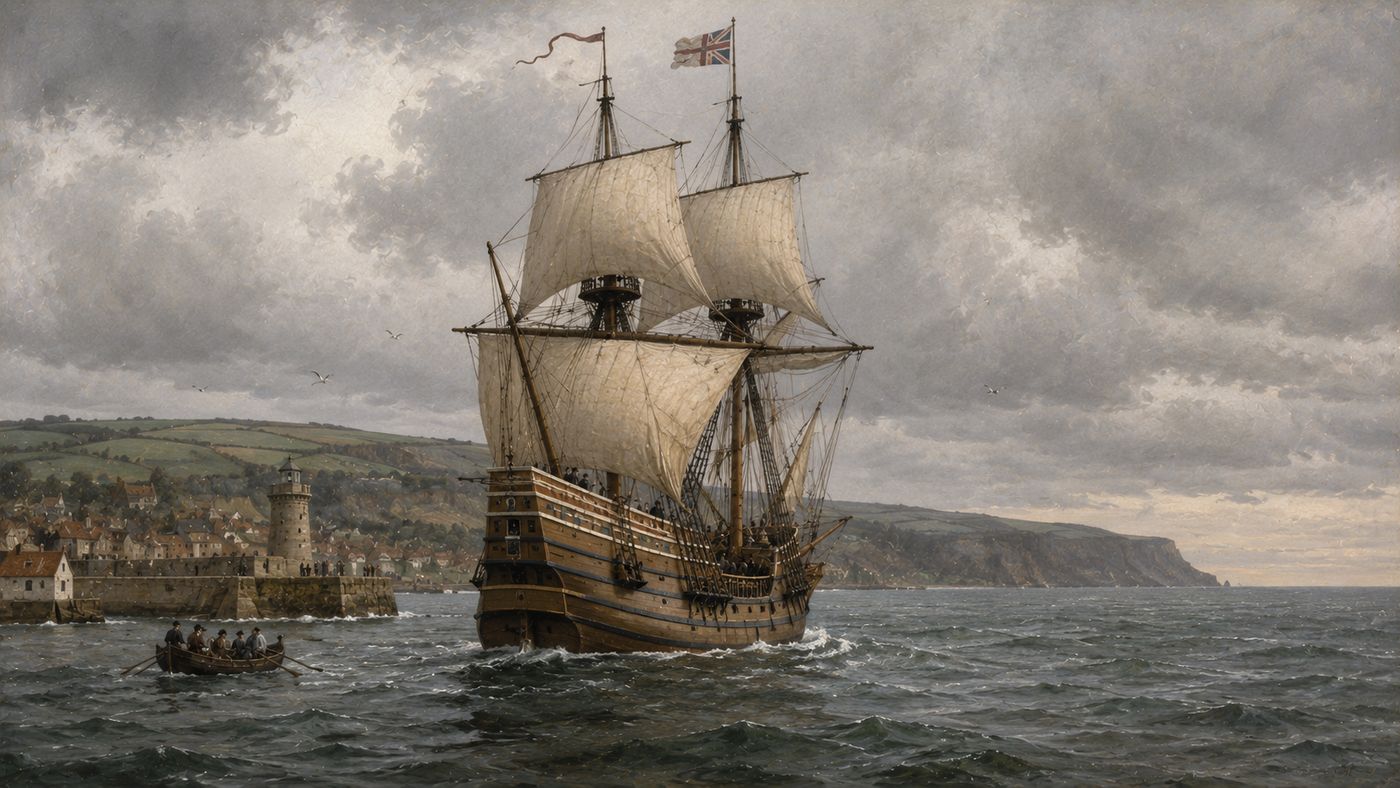
On September 16, 1620, the Mayflower departed from Plymouth, England, carrying 102 passengers on a crossing of the North Atlantic that would last sixty-six days and arrive at Cape Cod in November — far north of the Virginia territory where the passengers had been authorized to settle. The passengers included approximately forty-one Separatists — members of an English Puritan congregation who had been living in Leiden in the Dutch Republic for more than a decade and who sought to establish a community where they could practice their faith without persecution — and a larger group of non-Separatist colonists, servants, and hired workers whom the Separatists called "Strangers." The Mayflower had actually sailed twice: an earlier departure with a second ship, the Speedwell, had been abandoned when the Speedwell proved unseaworthy, requiring passengers and cargo to be redistributed onto the Mayflower alone before the September 16 departure. The crossing was difficult — storms battered the vessel throughout, a passenger died at sea, and a baby was born — but the ship arrived intact in November.
The founding of Plymouth Colony that followed the Mayflower's arrival has been one of the most mythologized events in American history. The Mayflower Compact — signed aboard ship before landing, because the colonists were outside the bounds of their Virginia authorization and needed some form of self-governance — is cited as an early expression of democratic self-government; the "Pilgrims" (a name applied retrospectively) have been constructed as founding ancestors of American liberty and religious freedom. The actual history is more complicated: the colonists arrived in a landscape that had recently been devastated by epidemic disease that had killed much of the indigenous Wampanoag population, whom they encountered; the survival of the first winter depended heavily on aid from the Wampanoag, whose diplomatic and agricultural knowledge made the difference between survival and extinction. The Thanksgiving celebration that has been attached to the Plymouth story — however accurately — was a harvest feast shared between colonists and Wampanoag in 1621, which does not represent the full arc of a relationship that deteriorated into King Philip's War (as we covered in our June 24 post) within fifty years. The ship that departed on September 16, 1620, set in motion one of the most consequential and most mythologized chapters in American history.
Independence Day
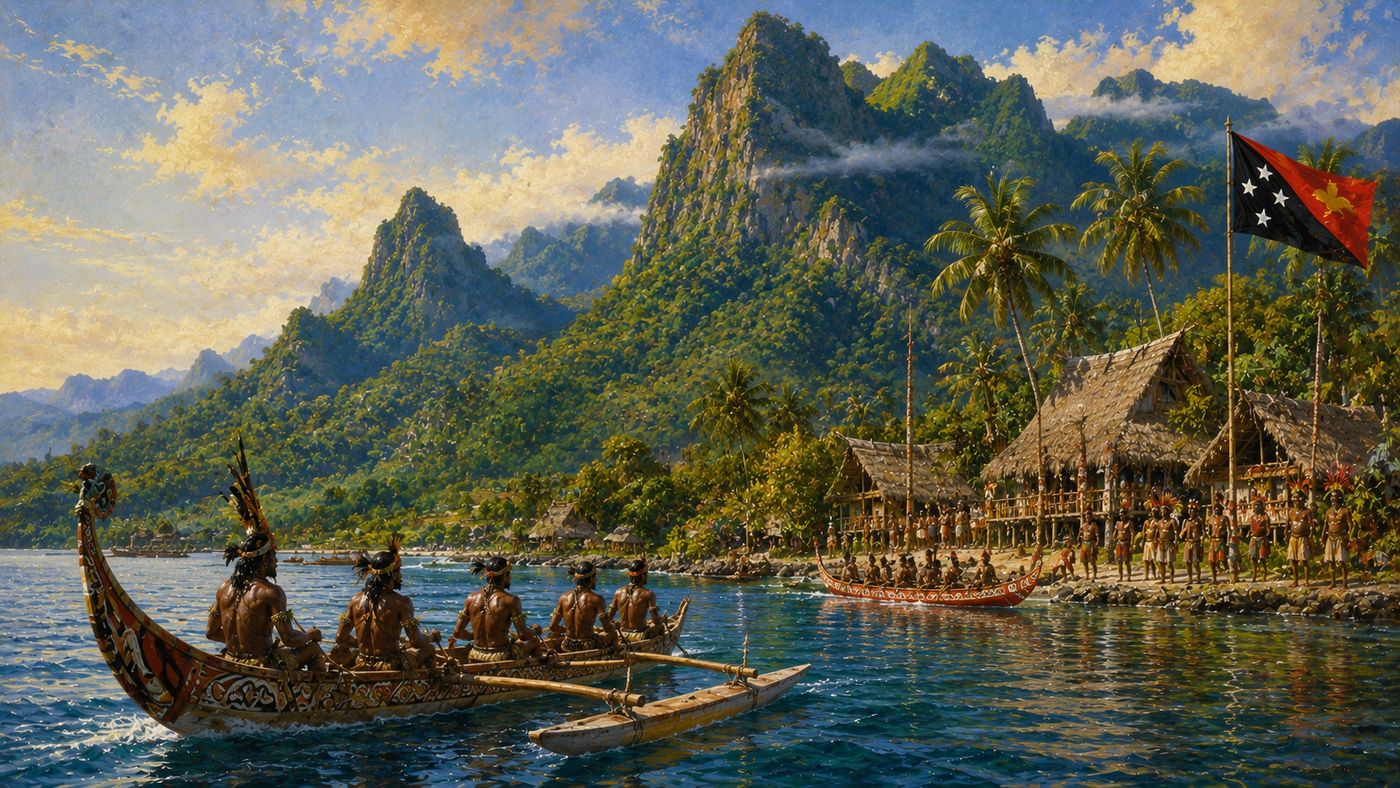
On September 16, 1975, Papua New Guinea formally achieved independence from Australia, becoming a sovereign nation and a member of the Commonwealth of Nations. The territory had been under some form of European administration since the late nineteenth century — the German Empire had controlled the northeastern portion, while Britain and then Australia administered the southeastern portion — and had been fully under Australian administration since 1914, when Australian forces occupied German New Guinea at the outbreak of the First World War. Australia had administered the combined territory as a United Nations Trust Territory following the Second World War, with a mandate to prepare it for independence. The process was carefully managed: a House of Assembly had been established in 1964, self-government had been granted in December 1973, and full independence came on September 16, 1975, with Michael Somare as the country's first Prime Minister — a position he held for multiple terms across several decades and that established him as the defining figure in Papua New Guinean politics.
The nation that achieved independence on September 16, 1975, is one of the most remarkable in the world for the sheer scale of its cultural and linguistic diversity. Papua New Guinea is home to approximately 840 living languages — roughly twelve percent of the world's total — spoken by a population of under ten million people across a mountainous tropical island terrain that has kept communities isolated and culturally distinct over millennia. It contains environments ranging from lowland rainforest to alpine grassland, and traditional societies ranging from coastal fishing communities to highland agricultural groups with little historical contact with one another. Governing this diversity as a unified national state has been the central challenge of Papua New Guinean politics ever since independence — challenged by tribal conflict, resource curse dynamics from mining revenues, and the persistent difficulty of building national institutions across geography and cultural difference that made the colonial project difficult and make the national project no simpler. The country that became independent on September 16, 1975, remains one of the world's most extraordinary cultural environments and one of its most complex governance challenges, fifty years on.
I'm Listening
On September 16, 1993, Frasier premiered on NBC — a spin-off of Cheers starring Kelsey Grammer as the pompous, cultured, emotionally complicated psychiatrist Dr. Frasier Crane, who had spent eleven years as a recurring character at a Boston bar and who now relocated to Seattle, took a job as a radio call-in therapist, and moved in with his working-class retired cop father Martin (John Mahoney) and Martin's physical therapist Daphne (Jane Leeves). The show was created by David Angell, Peter Casey, and David Lee, and was received with considerable skepticism before its premiere: spin-offs rarely worked, the character had been a supporting player for a decade, and the combination of highbrow cultural reference and sitcom structure seemed precarious. The first episode was watched by 21.9 million viewers. The show found its voice almost immediately and never really lost it.
Frasier ran for eleven seasons, concluding in 2004, and won the Emmy Award for Outstanding Comedy Series five consecutive years from 1994 to 1998 — a record that has never been matched. Its total of thirty-seven Emmy Awards makes it the most honored comedy series in television history. What made it distinctive was its commitment to a specific kind of comic intelligence: the show was genuinely interested in ideas, in the gap between pretension and reality, in the texture of class and aspiration and self-deception in American professional life, and in the mechanics of misunderstanding and embarrassment as comic engines. It was also, at its best, a show about fathers and sons — the relationship between the snobbish Frasier and the unpretentious Martin, played by John Mahoney with extraordinary warmth and restraint, provided the emotional center that the show's wit required to land. A revival, Frasier (2023), has attempted to continue the story without most of the original cast. The original that debuted on September 16, 1993, has proven a difficult act to follow.