September 14: A President Dies, a Calendar Changes, and a Capital Falls
September 14 is a day for consequences — for the moment when something that began elsewhere arrives at its full meaning. In 1901, a president shot eight days earlier finally succumbed to infection and gangrene, and the most consequential accidental presidency in American history began when Theodore Roosevelt was sworn in at forty-two, the youngest president the republic had ever had. In 1752, the British Empire adopted the Gregorian calendar, requiring eleven days to simply vanish from September — producing confusion, protest, and the enduring myth that English crowds rioted in the streets demanding their days back. And in 1847, an American army that had marched from the Gulf coast of Mexico to its capital won the battle that ended a war and transferred roughly half of Mexico's territory to the United States, shaping the geography of North America to this day. Three September fourteenths. Three arrivals at outcomes that had been building elsewhere — in a Buffalo hospital, in the halls of Parliament, and in the valleys between Veracruz and Mexico City.
The Youngest President
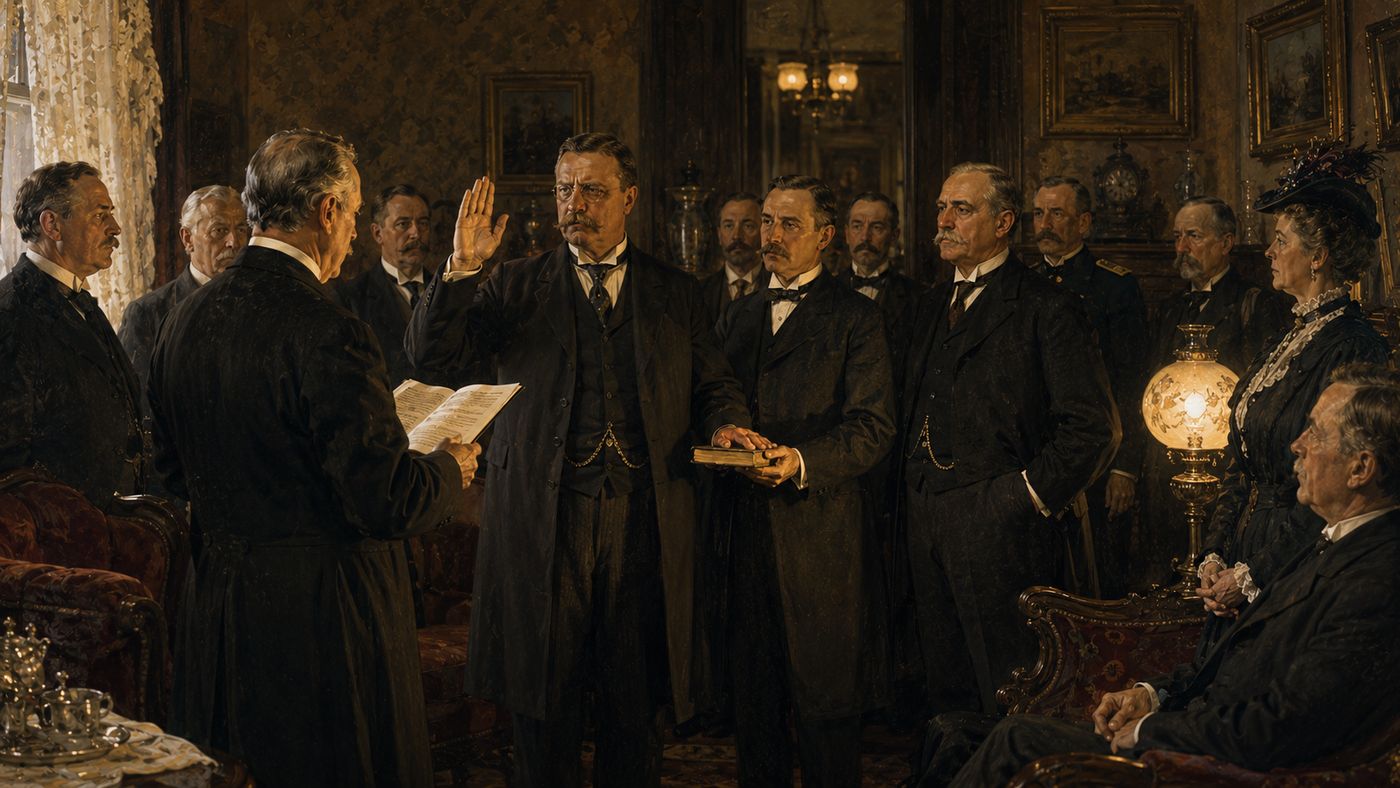
On September 14, 1901, President William McKinley died at 2:15 in the morning at a private residence in Buffalo, New York, eight days after being shot twice at the Pan-American Exposition, as we covered in our September 6 post. The wound that killed him was not the bullet itself — one had been removed, the other, lodged near his spine, had not been found — but the gangrene that set in around the abdominal wound as medical understanding of infection and its treatment lagged the crisis it was facing. McKinley had appeared to be recovering for several days, leading Vice President Theodore Roosevelt to leave Buffalo and rejoin his family in the Adirondacks; he was summoned back by urgent telegram and arrived too late. McKinley died without regaining consciousness. He was fifty-eight years old and had been in office since 1897. Within hours of his death, Theodore Roosevelt was sworn in at the home of a Buffalo friend, becoming the twenty-sixth president of the United States at the age of forty-two — the youngest person ever to hold the office.
The presidency that began on September 14, 1901, with Roosevelt's hasty swearing-in in Buffalo would prove to be one of the most consequential in American history. Roosevelt used the office to expand federal power in ways McKinley almost certainly would not have — breaking up trusts and monopolies under the Sherman Antitrust Act, creating the FDA and the Pure Food and Drug Act, establishing the national park system and dramatically expanding federal land conservation, and pursuing an activist foreign policy that included brokering the peace treaty that ended the Russo-Japanese War, for which he received the Nobel Peace Prize in 1906. Republican Party bosses who had maneuvered to put Roosevelt in the vice presidency specifically to neutralize his progressive ambitions — calculating that the vice presidency would end his career — had inadvertently put him in the White House. Mark Hanna, the Republican Party chairman who had opposed Roosevelt's nomination, is reported to have said on hearing of McKinley's death: "Now that damned cowboy is President of the United States." The damned cowboy served seven and a half years, left his mark on virtually every domain of American policy, and departed the presidency having made it larger than he found it.
The Missing Days
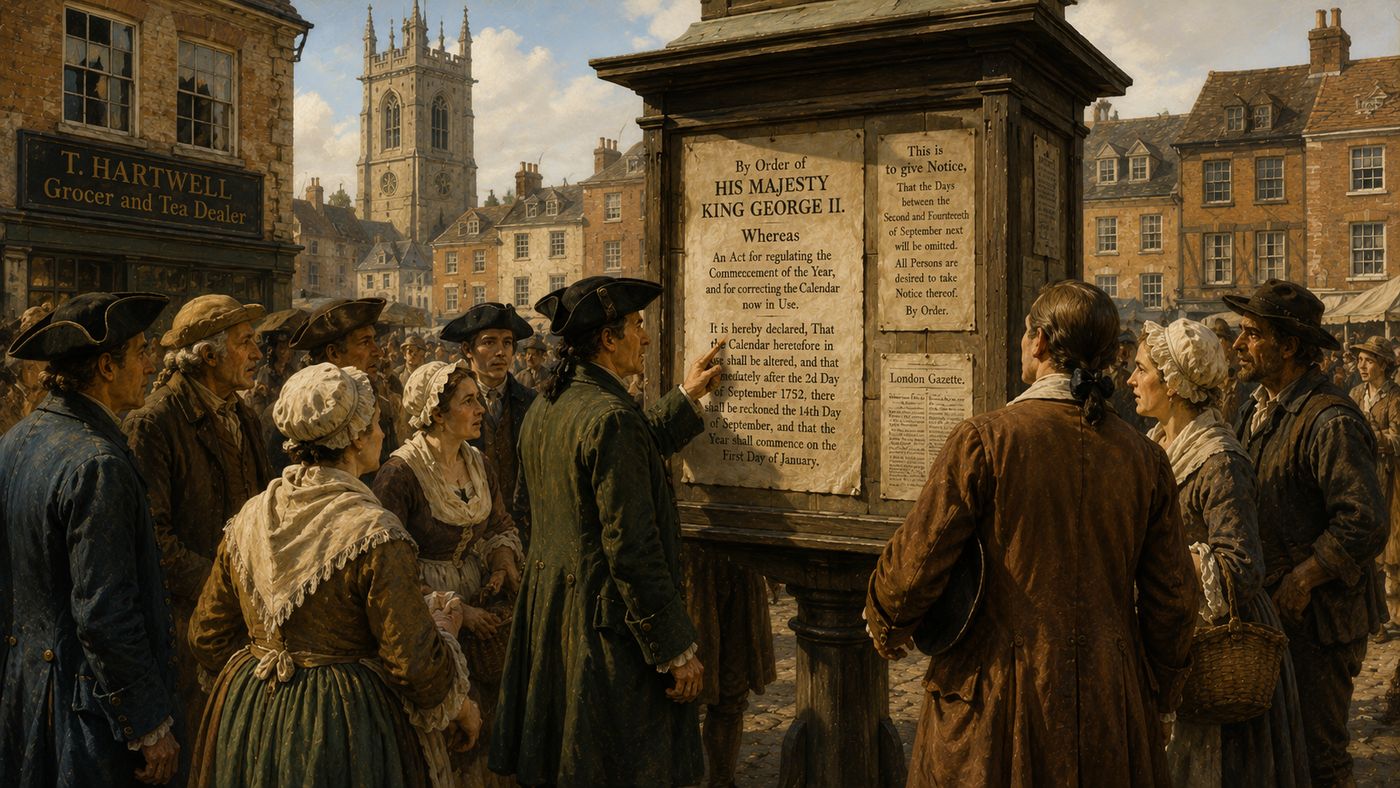
On September 14, 1752, Great Britain and its colonial territories woke up to a Thursday that was eleven days later than Wednesday had suggested it would be — the result of Parliament's adoption of the Gregorian calendar, which had replaced the Julian calendar across Catholic Europe in 1582 but which Protestant Britain had stubbornly refused to adopt for 170 years. The Julian calendar, in use since Julius Caesar's reform in 46 BCE, had slightly overestimated the length of the solar year, causing it to drift progressively out of alignment with the actual seasons. By 1752, the British calendar was eleven days behind the Gregorian calendar used by most of Europe, creating practical problems for trade, diplomacy, and navigation. Parliament's Calendar (New Style) Act of 1750 mandated the change, requiring that September 2, 1752 be immediately followed by September 14 — skipping eleven days entirely. Contracts, leases, wages, and interest calculations that had been structured around the Julian calendar suddenly required adjustment.
The transition of September 14, 1752, is famous for the "Give us our eleven days!" riots that are said to have erupted across England among workers who believed they were being robbed of eleven days of pay or life. The riots are almost certainly mythological — no contemporary account documents widespread civil unrest, and the claim appears to derive from a William Hogarth painting depicting a chaotic election scene that included a banner with the phrase. The actual transition appears to have proceeded with far less drama than the legend suggests, though the practical complications of adjusting financial and legal documents were real enough. The calendar change also required adjusting the official dates of historical events — George Washington, for example, was born on February 11, 1731 (Old Style) but is commemorated on February 22, the corrected New Style date. The adoption of the Gregorian calendar on September 14, 1752, brought Britain into alignment with most of the world and eliminated an accumulating confusion that had been building for 170 years — producing, in the process, one of the great myths of English popular history.
The Halls of Montezuma
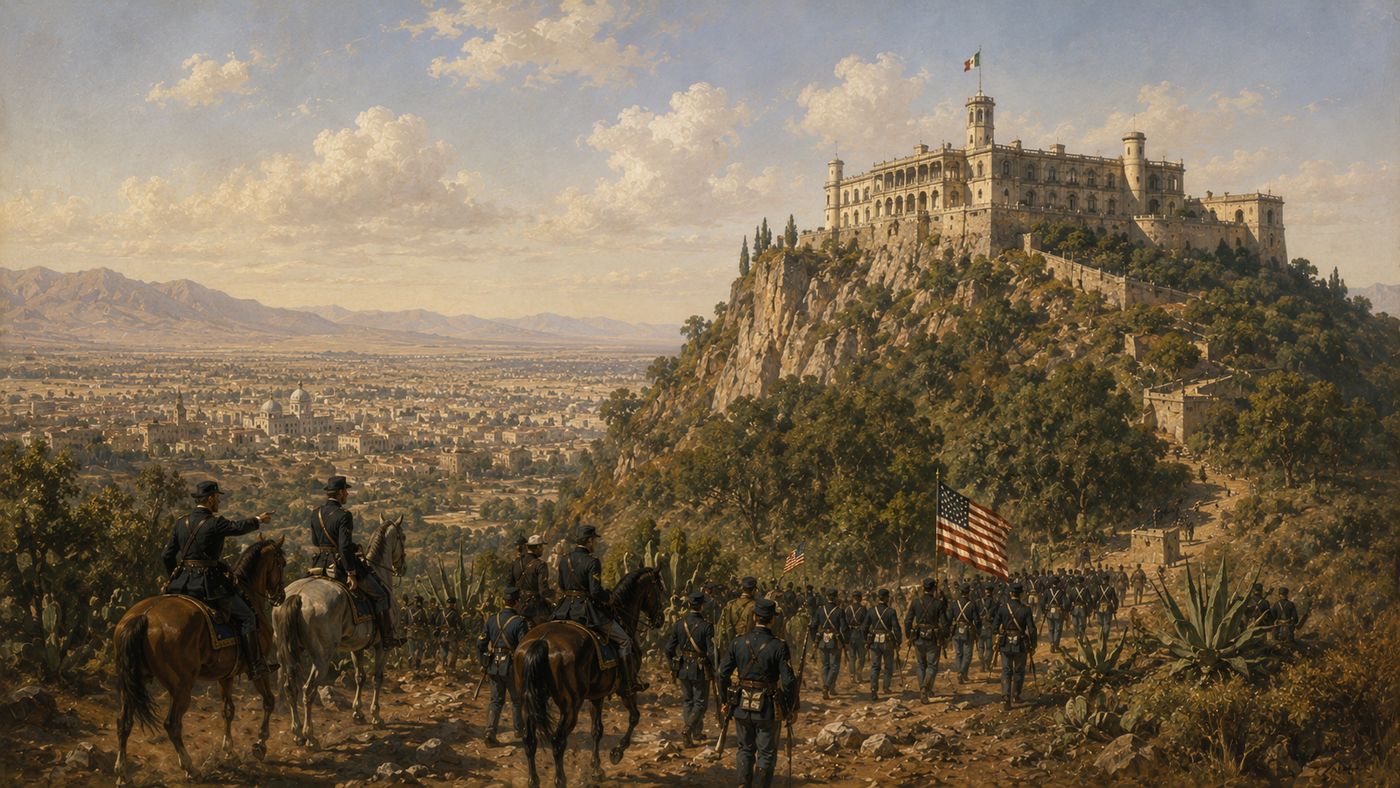
On September 14, 1847, American forces under General Winfield Scott entered Mexico City, completing a military campaign of remarkable strategic audacity that had begun with an amphibious landing at Veracruz in March 1847 and had driven through the mountain passes and fortified positions between the coast and the Mexican capital over six months of sustained fighting. The final battle for Mexico City had centered on Chapultepec Castle, a military academy on a rocky hill above the city that Scott's forces stormed on September 13 — the assault memorialized in the Marine Corps Hymn's opening line "From the Halls of Montezuma." The teenage military cadets who defended Chapultepec are remembered in Mexico as the Niños Héroes — the Boy Heroes — six of whom allegedly wrapped themselves in Mexican flags and jumped from the castle walls rather than surrender. Mexican resistance in Mexico City itself collapsed on September 14, and Scott's forces entered and occupied the capital.
The capture of Mexico City on September 14, 1847, effectively ended the military phase of the Mexican-American War, though a peace treaty was not signed until February 2, 1848. The Treaty of Guadalupe Hidalgo that concluded the war transferred to the United States an enormous swath of territory — present-day California, Nevada, Utah, most of Arizona, and parts of New Mexico, Colorado, and Wyoming — comprising approximately 525,000 square miles, or roughly a third of what had been Mexican territory. The United States paid Mexico $15 million for the cession and assumed approximately $3.25 million in debts that Mexico owed American citizens. The war's causes — primarily the disputed Texas border and American expansionist ideology — and its conduct were controversial at the time: Abraham Lincoln, then a congressman, challenged President Polk's justification for the war; Ulysses Grant called it "one of the most unjust wars ever waged by a stronger against a weaker nation." The territory that Scott's victory opened to the United States was the land where the California Gold Rush would begin just months later, in January 1848, and where the American West as a cultural and economic concept would take shape over the following decades.