September 12: We Choose to Go to the Moon, the Moon Gets Its First Visitor, and a Senator Gets Married
September 12 carries a remarkable internal symmetry. In 1962, a president stood before a stadium full of people in Houston and declared that the United States would go to the Moon before the decade was out — not because it was easy, he famously added, but because it was hard. Three years earlier, on September 12, 1959, the Soviet Union had already sent the first human-made object to reach another world, a probe called Luna 2 that impacted the lunar surface after a thirty-five-hour journey and demonstrated that the race Kennedy was accepting had already been joined and was already being run by the other side. And nine years before that speech — on September 12, 1953 — the man who would become president married the woman who would become First Lady, in a Newport ceremony that was, by the standards of its time, the social event of the season. The Moon threads through all three stories. So does the man who would stand in Houston and say we were going there.
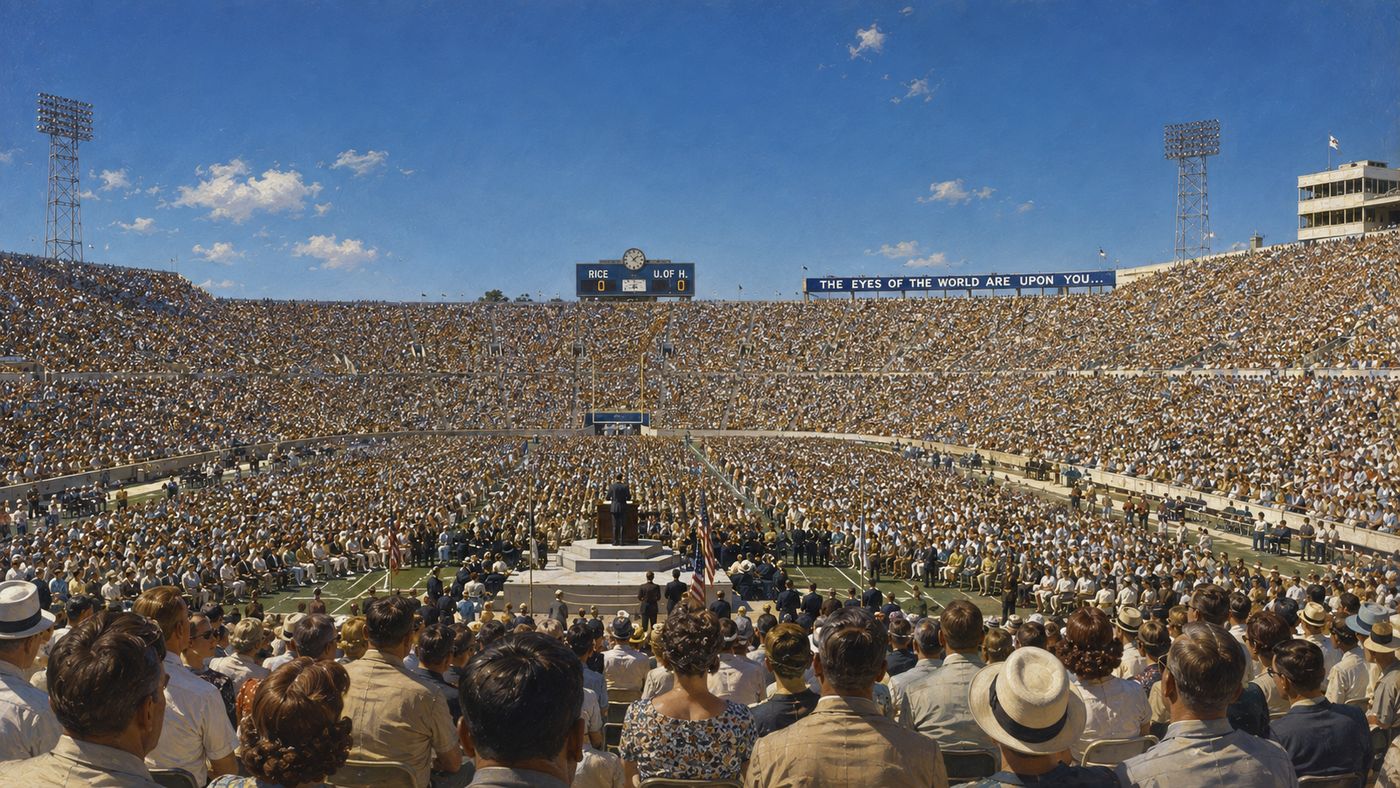
Rice Stadium, Houston
On September 12, 1962, President John F. Kennedy stood before approximately 35,000 people at Rice University Stadium in Houston, Texas, and delivered the speech that transformed the American space program from a collection of incremental achievements into a focused national commitment to reach the Moon before the end of the decade. The speech had been requested by NASA's James Webb and other space officials who wanted the president to publicly reaffirm the lunar landing goal that Kennedy had announced to Congress in May 1961. What Kennedy delivered at Rice was far more than a reaffirmation: it was one of the most rhetorically complete accounts of why a nation chooses to do a hard thing ever delivered by an American president. He acknowledged that the goal would be expensive, technically daunting, and not obviously achievable with technology that did not yet exist — and he argued, with apparent conviction, that these were reasons to do it, not reasons to hesitate.
The speech Kennedy delivered on September 12, 1962, is best remembered for one passage — "We choose to go to the Moon in this decade and do the other things, not because they are easy, but because they are hard" — but the whole of it rewards attention as a statement of the relationship between democratic ambition and technological aspiration. Kennedy argued that the exploration of space would proceed regardless of whether the United States participated, and that America's choice was not between going and not going but between leading and following. The commitment he made at Rice in 1962 was honored, posthumously, on July 20, 1969, when Apollo 11 landed on the lunar surface — seven years and eight months after the speech, within the decade Kennedy had specified. The program that fulfilled that commitment employed roughly 400,000 people at its peak, cost approximately $25 billion in 1960s dollars, and produced not only the Moon landings but an acceleration in materials science, computing, and systems engineering whose spillover effects shaped the technology of the following decades. The challenge issued at Rice Stadium on September 12, 1962, was not a small thing wearing large rhetoric. It was exactly what it sounded like.
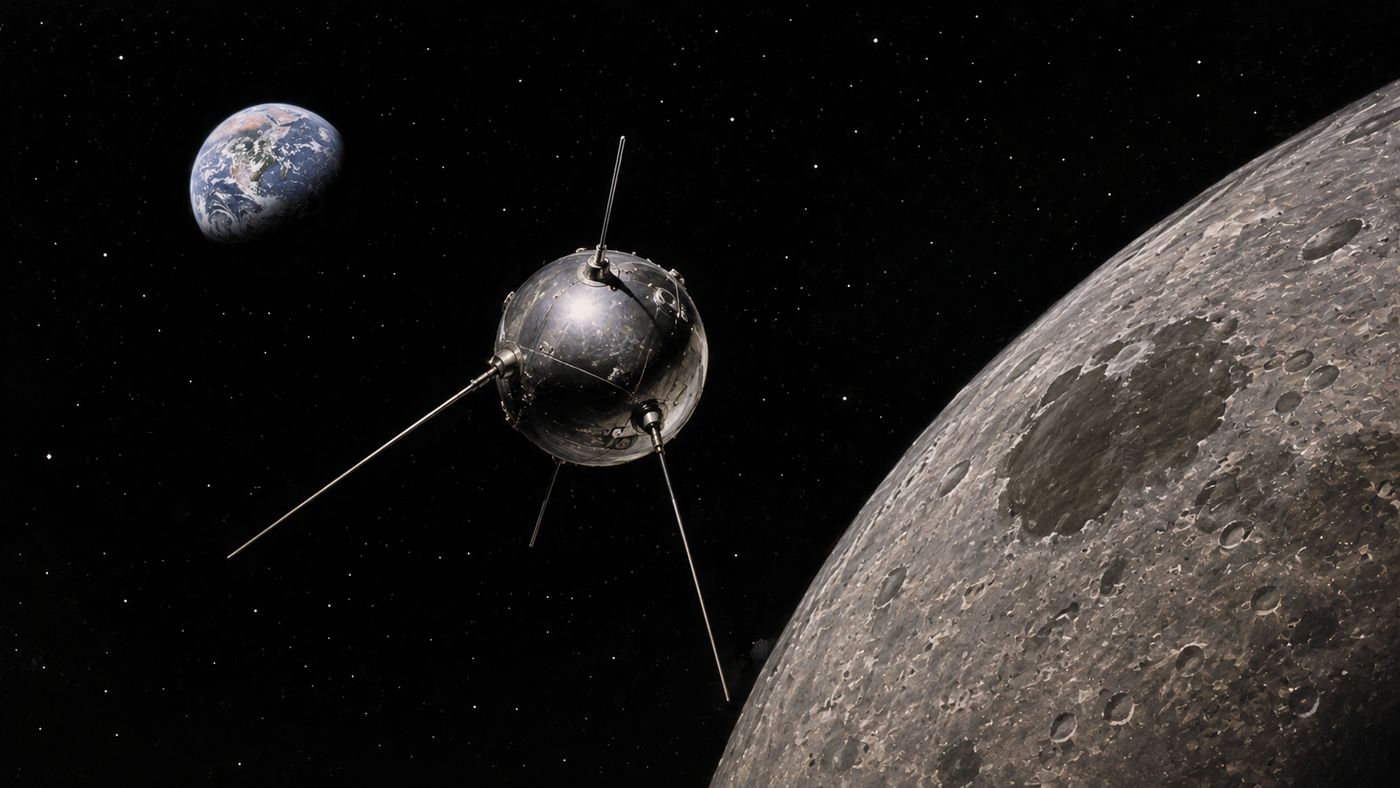
Luna 2
On September 12, 1959 — three years before Kennedy's speech at Rice and a decade before Apollo 11 — the Soviet spacecraft Luna 2 was launched from the Baikonur Cosmodrome in Kazakhstan on a direct trajectory toward the Moon. Thirty-five hours later, on September 14, it impacted the lunar surface near the Sea of Serenity, becoming the first human-made object to reach another celestial body. The achievement was announced by the Soviet news agency TASS and immediately understood by Western governments and the public for what it was: a demonstration that the Soviet space program had accomplished, with an unmanned probe, the first physical contact between human technology and another world. Luna 2 carried Soviet emblems and pennants to the lunar surface — making the point about Soviet achievement as clearly as the science. Its instruments confirmed that the Moon had no significant magnetic field and detected no radiation belts around the lunar body.
The Luna 2 mission of September 12, 1959, was part of the broader Soviet space program that had already launched the first satellite (Sputnik, October 1957), sent the first living creature into orbit (Laika the dog, November 1957), and would go on to launch the first human into space (Yuri Gagarin, April 1961). The steady accumulation of Soviet firsts was a significant factor in the political pressure that produced Kennedy's Moon speech three years later — the United States was losing the early stages of the space race, and the choice was between accepting that reality or committing the resources and determination to change it. Luna 2's first touch of the Moon on September 12, 1959, was the kind of achievement that could not be ignored, and that made Kennedy's challenge at Rice three years later not merely rhetorical but genuinely urgent. The probe that impacted the lunar surface in 1959 is still there — along with the Soviet pennants it carried — preserved by the Moon's airless environment exactly as it landed.
Newport, 1953
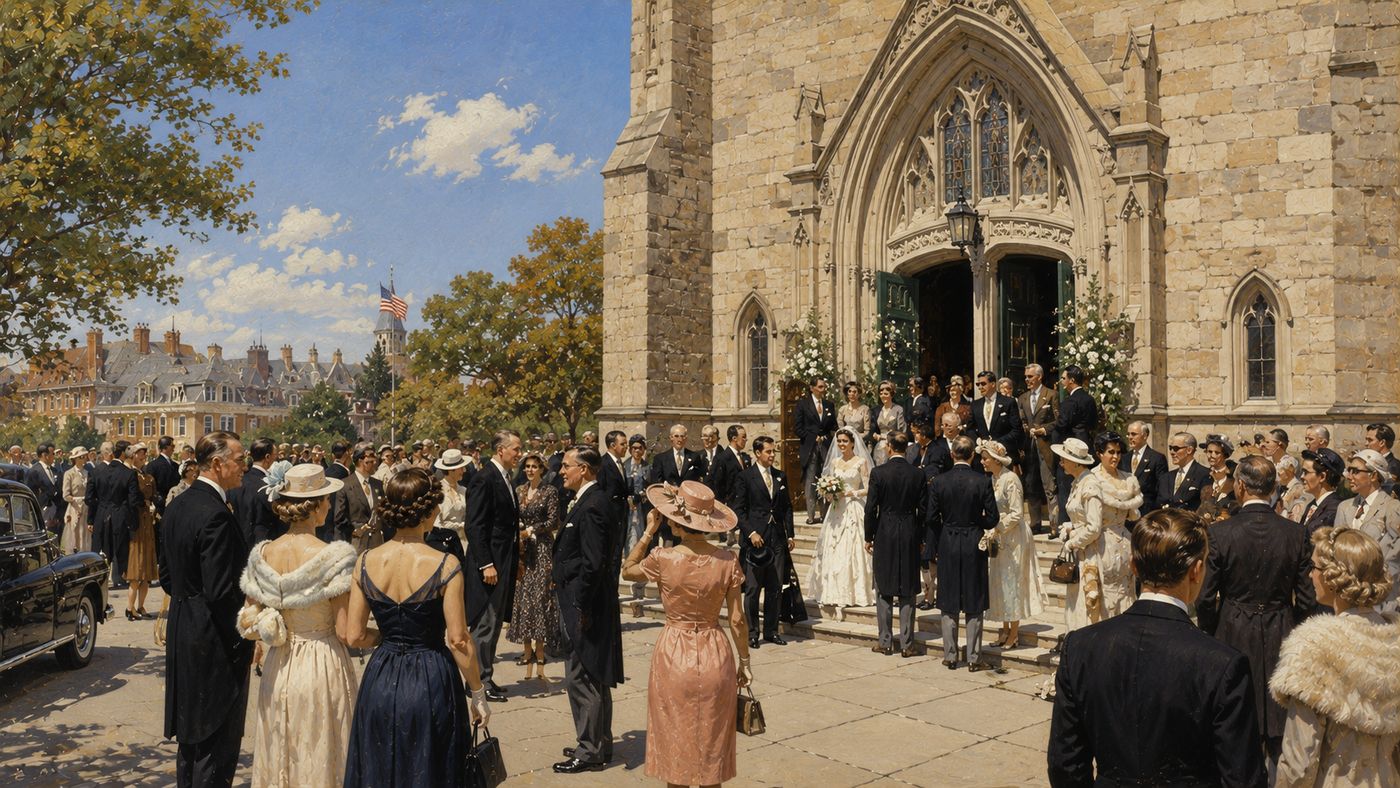
On September 12, 1953, John Fitzgerald Kennedy — thirty-six years old, United States Senator from Massachusetts, and the man his father had been grooming for the presidency for years — married Jacqueline Lee Bouvier at St. Mary's Church in Newport, Rhode Island, in a ceremony attended by approximately 700 guests that was covered extensively by the national press and represented one of the more closely watched social events of the year. The couple had met at a Washington dinner party in 1951 when Kennedy was a congressman and Jacqueline, twelve years his junior, was working as a photographer for the Washington Times-Herald. Their courtship had been interrupted by Kennedy's political ambitions and complicated by his reputation as a serial womanizer; the wedding of September 12 formalized a partnership that was, from the beginning, as much a political alliance as a conventional marriage.
The marriage celebrated in Newport on September 12, 1953, became one of the most discussed and documented partnerships in American political history. Jackie Kennedy's role as First Lady from 1961 to 1963 — her restoration of the White House, her promotion of the arts and cultural preservation, her extraordinary visual presence as a public figure — transformed the position and established standards that have influenced every subsequent First Lady's approach to the role. The marriage's private dimensions — Kennedy's infidelities, Jackie's complex experience of a public life she had not fully anticipated — have been documented extensively in memoirs, biographies, and oral histories that complicate the gilded public image. Kennedy was assassinated in Dallas on November 22, 1963, ten years and two months after the Newport wedding, leaving Jackie Kennedy to navigate her husband's death and its aftermath with a public composure that became, as we covered in our July 28 post, one of the defining images of the American century. The marriage begun on September 12, 1953, was brief and consequential in equal measure.