October 8: The Fire, the Fall, the First Case
October 8 has a talent for revealing what lies beneath the surface — for stripping away the assumptions a city makes about its own invincibility, the mythology a celebrity constructs around her own brand, and the comfortable distance a nation keeps from a crisis it has decided belongs to someone else. A fire that began in a barn on the southwest side of Chicago burned for two days and left a hundred thousand people with nowhere to go. A media mogul traded her Connecticut estate for a federal prison in West Virginia. And a virus that had been ravaging West Africa arrived, in the body of one man, at a Dallas hospital — and America discovered that preparedness is easier to assume than to demonstrate.
The Barn on DeKoven Street
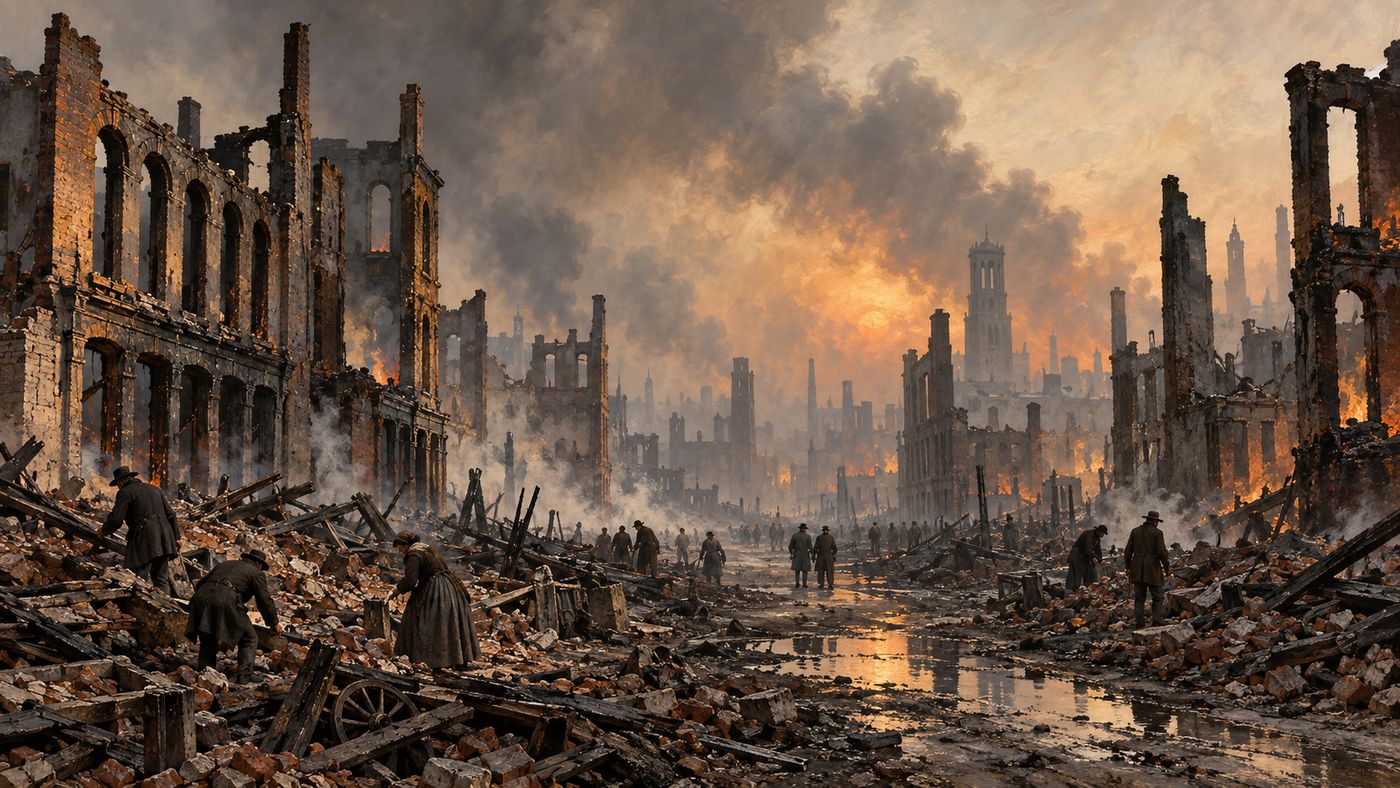
On the evening of October 8, 1871, a fire broke out in or near the barn of Patrick and Catherine O'Leary on DeKoven Street on Chicago's Southwest Side. The city had been dangerously dry — an unusually arid summer had left its largely wooden structures parched and brittle — and the wind off Lake Michigan carried the flames northeast with terrifying speed. By the time firefighters, already exhausted from battling a separate blaze the previous day, could mount an effective response, the fire had leapt the Chicago River and was consuming the commercial heart of the city. It burned for two days, killing approximately 300 people, destroying more than 17,000 structures, and leaving over 100,000 residents — roughly a third of Chicago's population — without shelter. The O'Leary family's cow, which legend blamed for kicking over a lantern to start the blaze, has never been conclusively proven culpable. Catherine O'Leary maintained her innocence until her death.
What Chicago did next became one of the great stories of American urban resilience. Relief poured in from cities across the country and around the world — London, Paris, and Berlin sent funds; President Grant dispatched federal aid. Within weeks, rebuilding had begun on a scale and with an ambition that the city's previous, more incremental growth had never permitted. The fire burned away the old Chicago and created a blank canvas for architects and planners who would transform it into one of the most innovative urban environments in the world. The first steel-frame skyscraper rose in Chicago in 1885. The 1893 World's Columbian Exposition announced the rebuilt city to the world. The disaster that had seemed like an ending was, in the accounting of history, a beginning.
Alderson
On October 8, 2004, Martha Stewart — founder of Martha Stewart Living Omnimedia, host of her own television programs, author of dozens of books on cooking and decorating and gracious living, and one of the most recognizable personal brands in American media — checked into the Federal Prison Camp at Alderson, West Virginia, to begin a five-month sentence for obstruction of justice and lying to federal investigators. The underlying matter involved the sale of approximately 3,928 shares of ImClone Systems stock in December 2001, the day before the FDA rejected the company's key drug application — a sale that saved her roughly $45,000 and that prosecutors argued was based on an illegal tip. Stewart maintained that she had acted on a pre-existing sell order. The jury did not believe her.
The Stewart case became a cultural flashpoint in the years after the Enron and WorldCom scandals had primed the public for stories about the rules that applied — or didn't — to the wealthy and powerful. Critics of the prosecution argued that Stewart's conviction was disproportionate: that the securities fraud charge had been dropped, that the amount of money involved was trivial by Wall Street standards, and that her celebrity made her a convenient example. Supporters of the verdict countered that no one is above the law, regardless of what they have accomplished. Stewart herself emerged from Alderson having apparently resolved the question to her own satisfaction. She returned to her company, launched a new television program, and rebuilt her brand with the kind of methodical precision that had always been her signature. She nicknamed the prison "Camp Cupcake." She left five months after she arrived, and she did not look back.

Dallas, 2014
On October 8, 2014, Thomas Eric Duncan died at Texas Health Presbyterian Hospital in Dallas, becoming the first person to die of Ebola virus disease on American soil. Duncan, a Liberian national, had traveled to the United States from Monrovia on September 19 — at a time when West Africa was in the grip of the deadliest Ebola outbreak in history, a crisis that would ultimately kill more than 11,000 people across Guinea, Sierra Leone, and Liberia. He had developed symptoms four days after arriving in Dallas and had initially been sent home from the emergency room with antibiotics before being admitted in critical condition two days later. He died eighteen days after his arrival in the United States, having never recovered. Two nurses who cared for him were subsequently infected — both survived — in what became the only cases of Ebola transmission on American soil.
Duncan's case exposed significant gaps in the American healthcare system's readiness for infectious disease containment. The initial misdiagnosis, the absence of adequate personal protective equipment protocols, the breakdown in communication between the emergency room and the treating physicians — each failure was examined and catalogued in the months that followed. The Centers for Disease Control dispatched teams to Dallas and issued revised guidance. Congress held hearings. The episode accelerated investment in epidemic preparedness infrastructure and informed — imperfectly, as it turned out — the systems that would face a far larger test six years later. Thomas Eric Duncan came to Dallas to be with family. He arrived carrying a disease that the hospital that received him was not prepared to recognize, and his death made certain that American hospitals would be better prepared for the next time. It was a costly and avoidable lesson, and it was not forgotten.