October 17: The Gangster Falls, the Pundit Rises, the Saint Works
Performance and authenticity have always been in conversation in American life — the con man who constructs a persona, the satirist who adopts one to dismantle another, the saint who simply refuses to perform anything at all. October 17 holds all three. A Chicago gangster who had spent years presenting himself as a legitimate businessman was unmasked not by a murder charge but by a tax bill. A comedian donned the costume of a cable news blowhard and, by playing the role perfectly, revealed something true about the people who played it unironically. And a Catholic nun in Calcutta, recognized with the world's most prestigious peace prize, continued doing exactly what she had always done — kneeling beside whoever needed her most.
The Tax Man Cometh
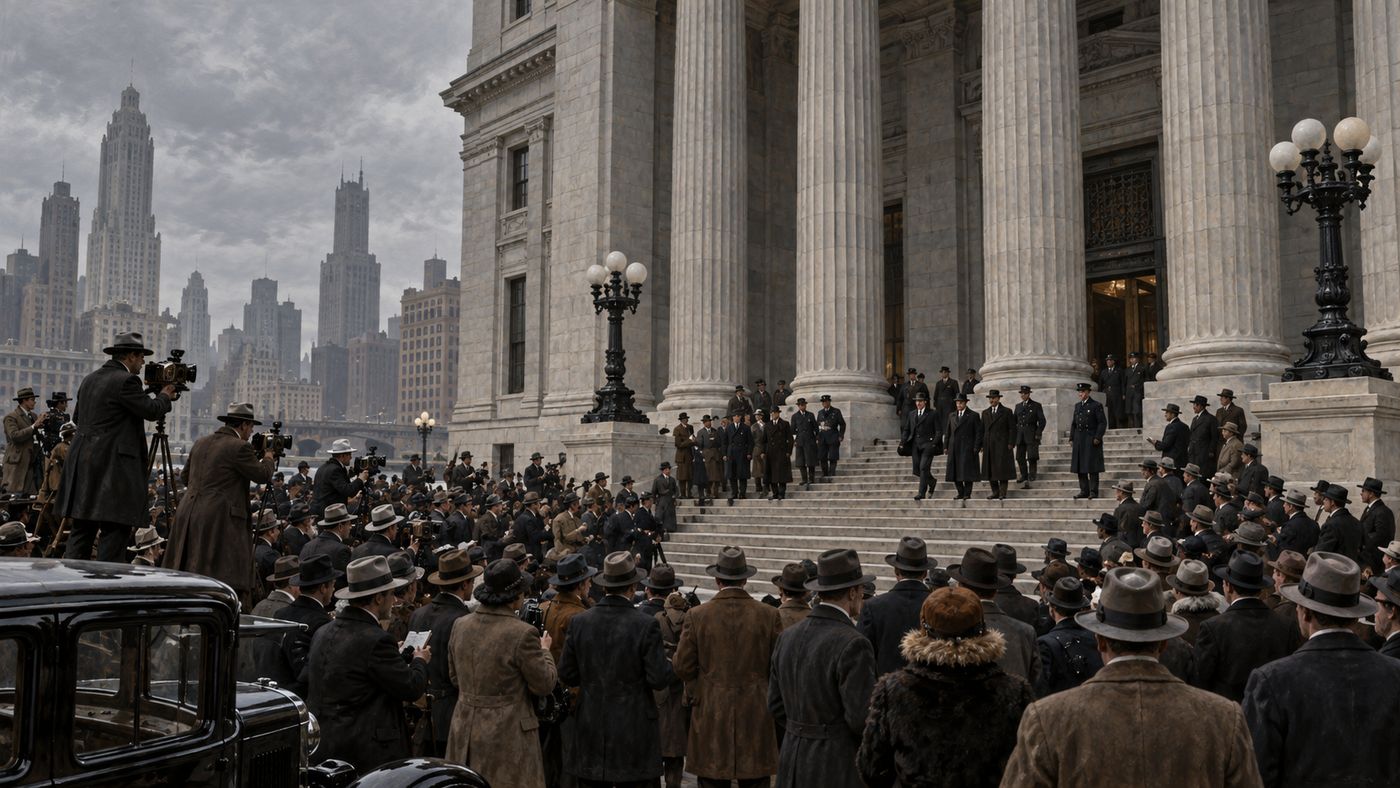
On October 17, 1931, Al Capone stood before a federal judge in Chicago and was sentenced to eleven years in prison, $50,000 in fines, and $7,692 in court costs for income tax evasion. The most powerful organized crime figure in American history — a man responsible, directly or indirectly, for dozens of murders, who had corrupted police departments and city government, who had built a bootlegging empire worth an estimated $60 million a year — was going to prison for not paying his taxes. The prosecution that put him there had been assembled by a team of IRS agents and Justice Department attorneys who had spent years building a financial case against Capone after traditional criminal prosecution repeatedly collapsed under witness intimidation, jury tampering, and the simple difficulty of making charges stick against a man who employed violence as a business tool.
Capone had genuinely believed he was untouchable — and for most of the 1920s, he had reason to. He was a public figure in Chicago, known to attend sporting events and charitable functions, photographed and interviewed, presenting himself as a businessman who simply operated in a competitive industry. The federal government's decision to pursue him through tax law rather than criminal charges was at the time legally controversial and tactically ingenious. It established a precedent that law enforcement agencies have used against organized crime, corrupt politicians, and financial criminals ever since: when the crime itself is too difficult to prosecute, follow the money. Capone served seven and a half years, his health deteriorating from neurosyphilis, and died in 1947 in Miami, a diminished figure who never recovered either his health or his empire.
Truthiness
On October 17, 2005, Comedy Central aired the first episode of The Colbert Report, and Stephen Colbert introduced the world to his character: a swaggering, flag-lapel-pin-wearing right-wing cable news anchor who delivered confident opinions on topics he had not researched, dismissed facts that contradicted his instincts, and was never, ever wrong. In that first episode, Colbert also introduced the word "truthiness" — the quality of seeming or feeling true without actually being true — which the American Dialect Society named its Word of the Year for 2005 and which has since become a standard term in discussions of media, politics, and epistemology. The show had been in existence for approximately twenty-four hours before it had contributed a word to the English language.
The Colbert Report ran for nine years and 1,447 episodes, winning two Peabody Awards and becoming, for a significant portion of its audience, a primary source of political information — a fact that the show's creators regarded with equal parts pride and alarm. Colbert's character was a precise and devastating parody of a specific strain of American media confidence: the pundit who mistakes certainty for knowledge, who treats the gut as a more reliable instrument than the brain, and who frames every question as a test of loyalty rather than a search for truth. The joke was sustained long enough and executed well enough that it became something more than satire. It became a lens. Colbert left the character behind when he moved to The Late Show in 2015, and the character has never quite stopped being relevant.

Come, Be My Light
On October 17, 1979, the Norwegian Nobel Committee awarded the Nobel Peace Prize to Mother Teresa — Agnes Gonxha Bojaxhiu, born in what is now North Macedonia in 1910 — for her decades of work among the destitute of Calcutta. Teresa had arrived in India in 1929 as a young novice and had spent eighteen years teaching at a convent school before receiving what she described as a "call within a call" in 1946 — a directive, she believed, to leave the convent and serve the poorest of the poor in the slums directly. The Missionaries of Charity, the religious order she founded in 1950, had by the time of the Nobel Prize established homes for the dying, clinics, orphanages, and leprosy centers across India and in dozens of countries around the world. She accepted the prize in Oslo and asked that the money typically spent on the Nobel banquet be donated to the poor instead.
Mother Teresa's legacy has been subject to growing scrutiny in the decades since her death in 1997 — critics have raised legitimate questions about the medical conditions in her homes for the dying, about her opposition to contraception in regions devastated by poverty and disease, and about the sources and uses of the enormous donations the Missionaries of Charity received. These are serious questions that her admirers and detractors continue to debate. What is not disputed is the scale of what she built, the personal commitment she sustained across more than five decades of work among people society had discarded, and the private spiritual crisis she endured for much of that time — letters published after her death revealed that she had lived in a state of profound doubt and spiritual darkness for decades, continuing her work without the consolation she had once felt. The Nobel Committee recognized what it saw on the surface. What lay beneath it was, in many ways, more remarkable.