October 10: The Academy, the Island Nation, the Post Office
Institutions shape the world quietly, over long stretches of time — until a single day arrives that makes their purpose, their promise, or their failure suddenly visible. On October 10, across three different decades and three very different corners of the world, institutions stepped into the light. A new naval academy opened its gates in Annapolis with fifty midshipmen and the ambition to professionalize a navy that had trained its officers through little more than experience and luck. A Pacific island nation lowered a colonial flag it had flown for nearly a century and raised its own. And a post office in suburban Michigan became the site of a tragedy that forced a reckoning with the human cost of institutional indifference to the people inside it.
Annapolis, 1845
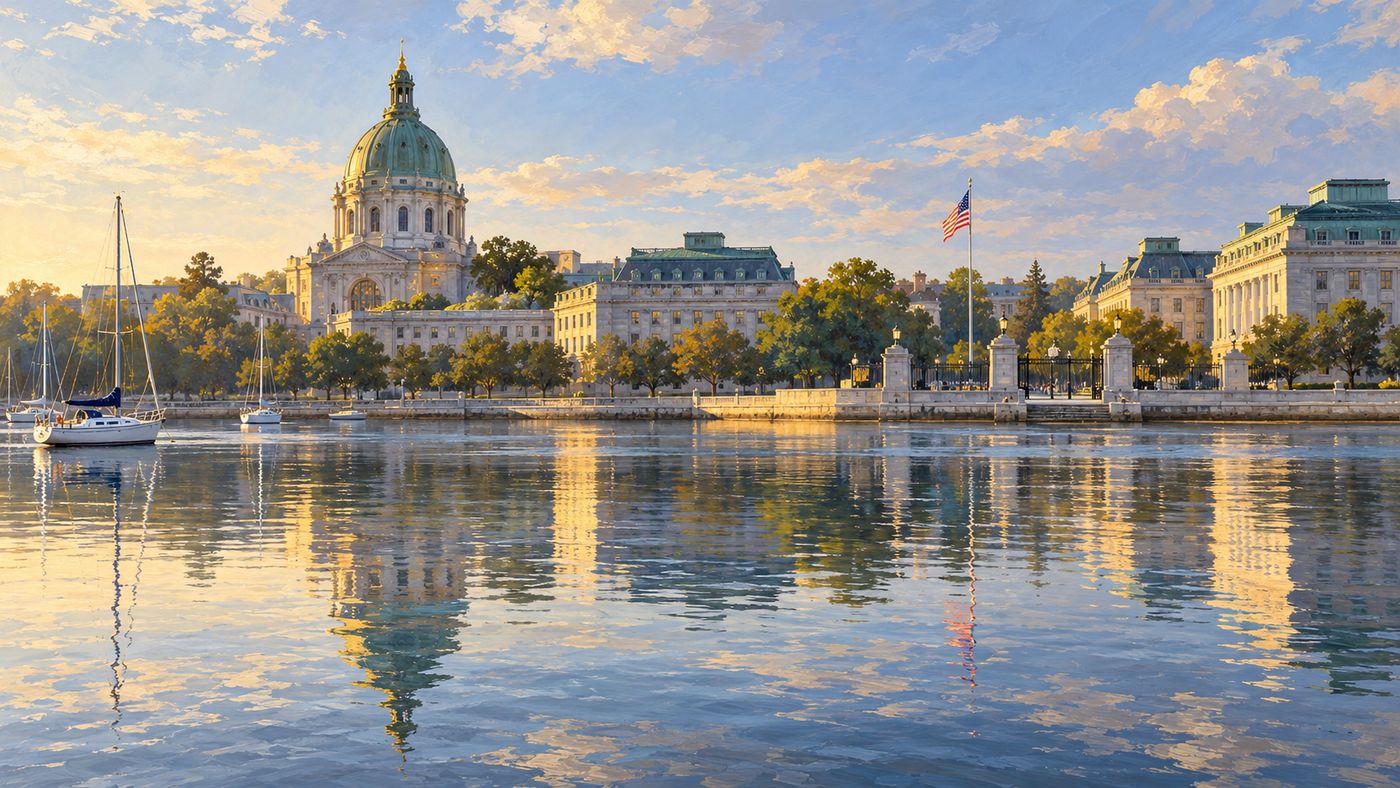
On October 10, 1845, the United States Naval Academy opened at the former site of Fort Severn in Annapolis, Maryland, with fifty midshipmen, seven instructors, and the conviction of Secretary of the Navy George Bancroft that the American navy could no longer afford to train its officers through informal apprenticeship and accumulated habit. Bancroft had established the school largely by executive action, consolidating existing naval schools and repurposing the old army fort without waiting for congressional approval — a move that reflected both his urgency and the institutional resistance he anticipated. The first superintendent, Commander Franklin Buchanan, set about building a curriculum from scratch: mathematics, navigation, gunnery, steam engineering, and the humanities that Bancroft believed were essential to producing officers of character as well as competence.
The academy that began with fifty midshipmen on a seven-acre campus has grown into a 338-acre institution that graduates roughly a thousand officers annually, each commissioned into the Navy or Marine Corps after four years of academic and military training as demanding as any in the world. Its alumni have included presidents, astronauts, admirals, and Medal of Honor recipients. The Civil War tested the institution almost immediately — graduates faced each other across the lines of battle, and Buchanan himself resigned to serve the Confederacy as an admiral. The academy survived that rupture, as it has survived every subsequent challenge, and it remains the institution Bancroft envisioned: a place where the navy invests in the formation of the officers it trusts to lead it.
Fiji
On October 10, 1970, the Union Jack was lowered over Suva, Fiji's capital, for the last time, and the new nation's flag rose in its place as Prince Charles presided over the independence ceremony. Britain had governed Fiji since 1874, when Fijian chiefs ceded sovereignty in exchange for protection from the instability and violence that had accompanied the earlier arrival of European settlers, traders, and adventurers. The ninety-six years of colonial rule that followed had profoundly reshaped the islands — most consequentially through the large-scale importation of indentured laborers from India to work the sugarcane plantations, a practice that created a demographic complexity Fijian society is still navigating more than a century later. By 1970, Fiji was a nation of indigenous Fijians, Indo-Fijians, and smaller communities of other backgrounds, all inheriting a shared geography and a contested political future.
Independence arrived through negotiation rather than conflict — Fiji became a constitutional monarchy within the Commonwealth, with the British monarch as head of state, a parliamentary system modeled on Westminster, and the careful ethnic power-sharing arrangements that its colonial administrators had designed and its new leaders inherited. The transition was celebrated as a model of peaceful decolonization. The decades that followed proved more turbulent: Fiji experienced four coups between 1987 and 2006, most of them rooted in the unresolved tensions between indigenous Fijian political aspirations and the substantial Indo-Fijian population. The country became a republic in 1987, rejoined the Commonwealth in 1997, and has been working toward stable democratic governance ever since. What was lowered in Suva on October 10, 1970, was a flag. What was raised in its place was a question the islands are still in the process of answering.

Royal Oak
On October 10, 1991, Thomas McIlvane, a former postal worker who had been fired from the Royal Oak, Michigan post office after a series of disciplinary incidents, returned to the building with a rifle and opened fire. Four employees were killed and five wounded before McIlvane took his own life. He was thirty-one years old. The shooting followed a pattern that investigators and postal service administrators were beginning to recognize with grim familiarity: a dismissed or aggrieved employee, a workplace culture that had failed to address escalating warning signs, and a violent conclusion that stunned a community which had seen nothing like it coming. Royal Oak was the fourteenth incident of lethal workplace violence at U.S. Postal Service facilities since 1983 — a frequency that had already prompted dark humor within the postal community and would soon give the English language a new and ugly phrase.
The term "going postal" entered common usage in the years following Royal Oak, a shorthand that flattened a complex institutional crisis into a cultural punchline. The underlying reality was more serious: a 1994 Postal Service commission found that postal workplaces were characterized by authoritarian management cultures, inadequate grievance mechanisms, and a systemic failure to identify and respond to employees in psychological distress. The commission's recommendations led to substantial reforms — expanded employee assistance programs, improved conflict resolution processes, and a dedicated threat assessment function within the Postal Service. The phrase that Royal Oak helped create has outlasted the conditions that produced it. The four people who died in Michigan on this October morning deserve to be remembered as more than the origin story of a figure of speech.