The Greatest Spectacle in Racing
Today, Sunday, May 24, 2026, the green flag drops at 12:45 p.m. ET on the 110th running of the Indianapolis 500 — and the storylines converging on the 2.5-mile oval in Speedway, Indiana are as rich as the race's 115-year history. Four-time IndyCar champion Alex Palou, who won last year's race from pole, starts from pole again and is looking to become one of the rare drivers to win back-to-back Indy 500s. Katherine Legge, the 45-year-old British racer and the only woman in today's 33-car field, will climb out of her IndyCar after the race and fly to Charlotte, North Carolina to attempt the NASCAR Coca-Cola 600 tonight — the first woman and first non-American ever to attempt "The Double," one of motorsport's most grueling single-day feats. Caitlin Clark, Indiana's most famous athlete, will give the command for drivers to report to their cars before a crowd of 350,000. And Artemis II astronaut Jeremy Hansen — who orbited the Moon just six weeks ago — is attending race weekend, a visitor from the edge of space to the oval where America's love of speed has never wavered for more than a century.
The Race That Invented the Rearview Mirror
The Indianapolis 500 was the idea of Carl Fisher, an Indiana automobile dealer who proposed building a private testing facility in 1906 because American roads were too poor for manufacturers to test their cars' top speeds. The result was Indianapolis Motor Speedway, built on 328 acres of farmland five miles northwest of downtown Indianapolis and paved, famously, with 3.2 million bricks — earning it the nickname "The Brickyard" that endures today. The first race was held on May 30, 1911, before a crowd of roughly 80,000 people. Forty cars lined up at the start. One of them was the Marmon Wasp, driven by a retired champion named Ray Harroun who had been coaxed back for one last race by his employer, the Marmon Automobile Company. Harroun made a design decision that would outlast every other innovation in that race by more than a century: since he was driving a single-seat car with no mechanic passenger to warn him of approaching cars, he mounted a small mirror on the cowling in front of him so he could see what was behind. It was the first rearview mirror ever used on an automobile. Harroun won the race at an average speed of 74.59 mph — a time that would have finished him tenth in the 1922 race, barely a decade later. The rearview mirror, meanwhile, is still in every car on earth.
In the 110 years since Harroun crossed the finish line, the Indy 500 has survived two world wars, the Great Depression, a pandemic postponement, and the near-constant evolution of racing technology — from front-engine roadsters to rear-engine cars, from carburetors to turbocharged engines to hybrid power. Average speeds have climbed from 74 mph to more than 220 mph. The purse has grown from $14,000 to more than $20 million. The race has been won by legends — A.J. Foyt, Al Unser Sr., Rick Mears, Helio Castroneves — and by shocking upsets. It has been the proving ground for automotive innovation, the place where aerodynamics were tested and safety standards advanced. Louis Meyer started the tradition of drinking milk in Victory Lane in 1936 — a habit born of a personal preference that has now been unbroken for 90 years, with a single exception in 1993 when a dairy-free winner substituted orange juice and was never forgiven for it. Today, Katherine Legge will become the ninth woman ever to start the Indy 500 — and the first to immediately climb into a NASCAR stock car and drive 600 more miles. Only five drivers in history have ever completed The Double: John Andretti in 1994, Tony Stewart three times, Robby Gordon, Kurt Busch in 2014, and Kyle Larson. Each time, it produced one of the most compelling stories in motorsport. Legge brings something none of them did: she is doing it, she said this week, "not to be the first woman, but because I'm a race car driver — and this is what race car drivers do."
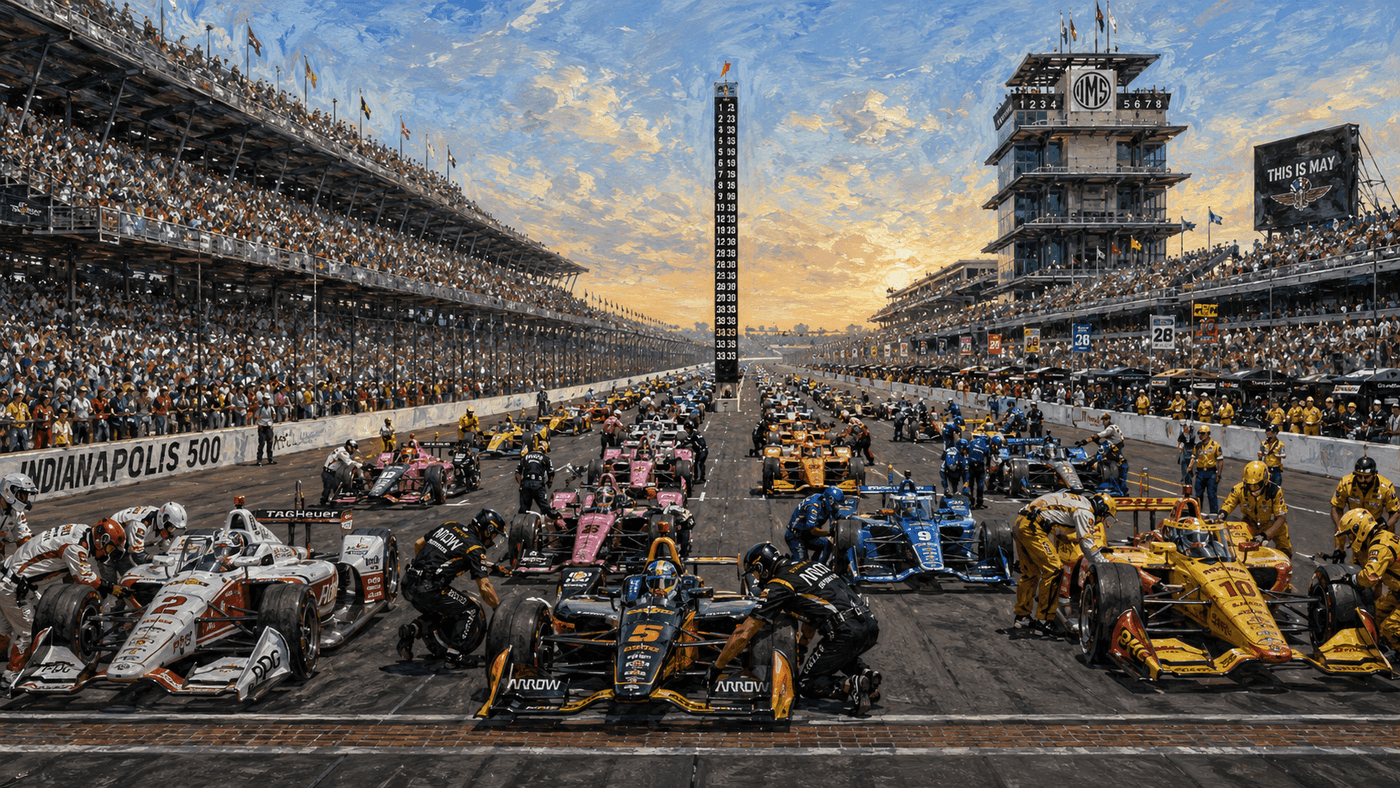
There is a brick embedded in the start-finish line at Indianapolis Motor Speedway — a single strip of the original 3.2 million that paved the track in 1909, left exposed when the rest of the surface was paved over in asphalt. Drivers and winners kiss it in Victory Lane. It is, in the most literal sense, where American motor racing began. The bricks have seen Harroun's Marmon Wasp cross the line at 74 mph in 1911, Wilbur Shaw's streak in the late 1930s, A.J. Foyt's four wins, Janet Guthrie becoming the first woman to start the race in 1977, Helio Castroneves climbing the fence four times, and every Memorial Day weekend for 115 years, the assembled 350,000 — the largest crowd in world sport — standing for the command that never changes. Gentlemen, start your engines. This year, it will be Caitlin Clark who says it. Whatever happens in the next 500 miles, and across the 600 more miles that Katherine Legge will attempt tonight in Charlotte, the Brickyard will keep its record: it has never once, in 115 years, failed to put on a show.