The Last Good Night
Tonight, Thursday, May 21, 2026, Stephen Colbert will walk out onto the stage of the Ed Sullivan Theater in midtown Manhattan for the 1,801st and final time, deliver a monologue, interview guests, say goodnight — and end one of the longest-running franchises in American television history. The Late Show on CBS, which began in August 1993 with David Letterman behind the desk, closes tonight not with a changing of the guard but with a permanent retirement of the franchise itself. CBS called Colbert "irreplaceable" and said the Late Show name would be retired with him. Both Jimmy Kimmel and Jimmy Fallon will go dark tonight in deference, leaving the 11:35 p.m. hour to Colbert alone. The week's final guests have included Jon Stewart, Steven Spielberg, David Byrne, and Bruce Springsteen. The finale's guests have been kept secret. Tonight, the curtain comes down on a tradition that stretches back, in one form or another, to a local New York City television program that debuted on NBC in September 1953 — and that became, across seven decades, the nightly ritual that America went to sleep to.
The Long Arc from Steve Allen to Stephen Colbert
Late-night television as Americans have known it was invented in a single burst of improvised energy by Steve Allen, who began hosting a local program called The Steve Allen Show on NBC's New York affiliate in 1953 before it went national as Tonight the following year. Allen was a pianist, comedian, and relentless experimenter who established almost every element of the format that would endure for 70 years: the opening monologue, the house band, the desk-and-couch interview setup, the man-on-the-street segment, the celebrity interview. Jack Paar followed in 1957 and transformed the program into something more personal and emotionally volatile — a place for honest conversation and unpredictable drama, including the night he walked off the set over a censored joke and returned two weeks later to 10 million viewers. Then came Johnny Carson in 1962, who refined everything Allen and Paar had invented into a nightly institution that ran for 30 years, drew 55 million viewers to his 1992 farewell, and whose shadow fell over every late-night host who came after him. David Letterman — who lost the Carson succession to Jay Leno in the most famous backstage battle in television history — moved to CBS in 1993 and created The Late Show, channeling his disappointment into something sharper, stranger, and ultimately more influential than anything that had come before. Letterman's retirement in 2015 produced the most scrutinized succession since Carson: the desk went to Stephen Colbert, who had spent nine years playing a fictional right-wing blowhard on Comedy Central before reinventing himself as something more earnest and politically pointed than any late-night host since Carson himself.
Colbert's 11 years at The Late Show were marked, from the beginning, by the collision of political comedy and a fractured national audience — and ended, ultimately, because of it. In July 2025, after Colbert publicly called CBS parent company Paramount's $16 million settlement of a Trump lawsuit over a 60 Minutes interview a "big fat bribe," the network announced it was canceling the show, citing "financial challenges in late night." Colbert had been winning his timeslot with 2.4 million viewers, the only late-night show gaining audience. David Letterman, watching from retirement, said he was "pissed off." The cancellation drew immediate speculation that it was connected to the Skydance-Paramount merger, which needed Trump administration approval — a deal approved by the FCC weeks after the cancellation was announced. Whatever the precise cause, the result is that tonight's finale is not merely the end of Colbert's tenure but the end of The Late Show as a franchise — 33 years, two hosts, 1,801 episodes, and the retirement of a title that CBS itself says will never be used again.
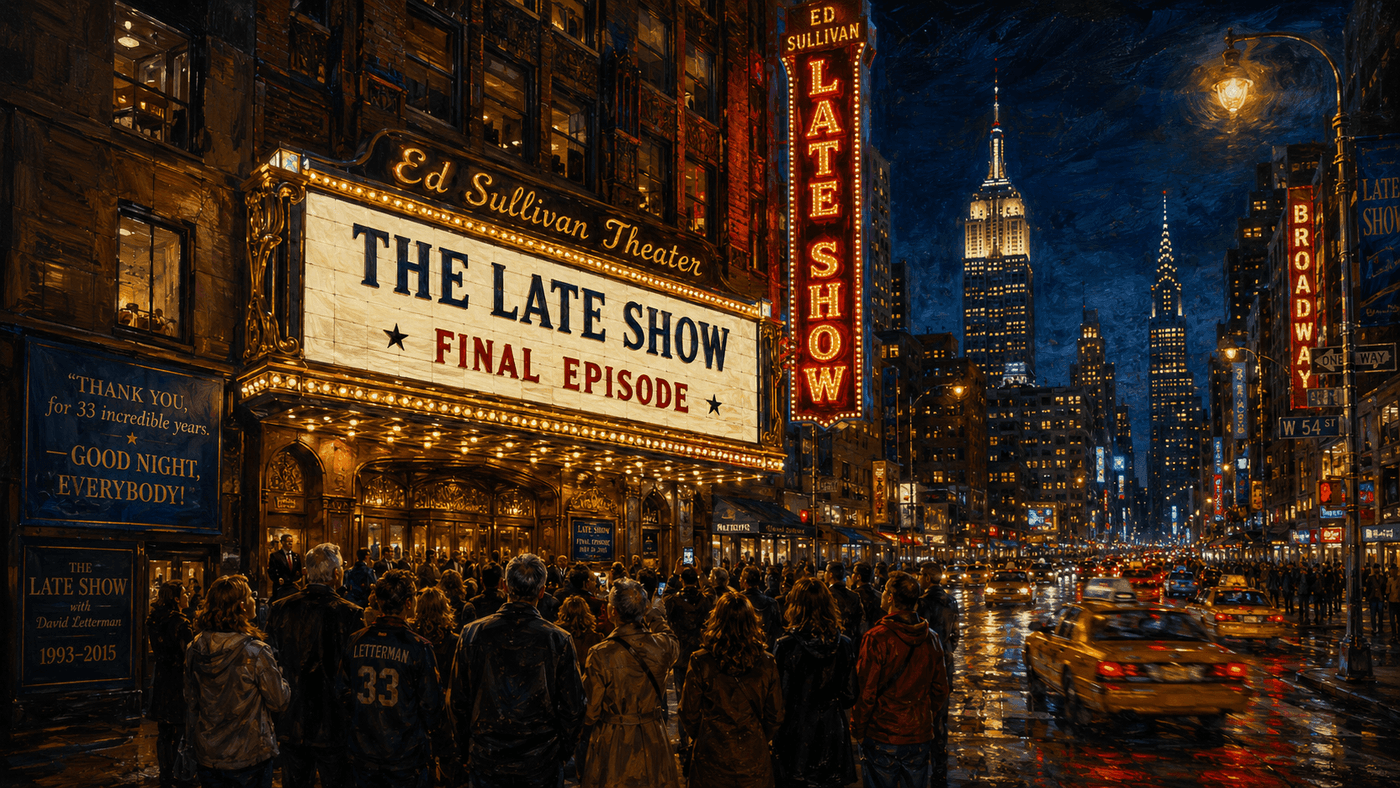
Steve Allen sat down behind a desk on a New York television soundstage in 1953 because someone needed to fill the hours after the evening news, and what he found there — the monologue, the band, the guests, the live energy of a room full of people laughing together at the end of a long day — turned out to be something Americans wanted deeply and consistently for 73 years. Carson made it an institution. Letterman made it an art form. Colbert made it a civic act, night after night, for eleven years in some of the most turbulent political conditions American late-night television has ever navigated. "I wish someone else was getting it," Colbert said when the cancellation was announced. "It's a fantastic job." Tonight, for the last time, he does it — and then the lights go down on Broadway, and the Ed Sullivan Theater goes quiet, and the long tradition of the American late-night desk passes not to a successor but simply into history, where it will keep very good company.