The Line That Was Always There
On Sunday, May 17, 2026, three drones entered the United Arab Emirates from the western border. Two were intercepted by UAE air defenses. The third struck an electrical generator outside the inner perimeter of the Barakah Nuclear Energy Plant in Abu Dhabi's Al Dhafra region, igniting a fire that was quickly contained. The Federal Authority for Nuclear Regulation confirmed that radiation levels at the facility remained normal, that no injuries were reported, and that all four of Barakah's units were operating normally. Emergency diesel generators provided backup power to Unit 3. The IAEA Director General Rafael Grossi expressed "grave concern" and stated that "military activity that threatens nuclear safety is unacceptable." The UAE Foreign Ministry called it a "treacherous terrorist attack," a "dangerous escalation," and a "flagrant violation of international law." No party claimed responsibility. Sources familiar with the attack told the Jerusalem Post the drone was intended to "send a message" — that the reactor itself could be next. The message was received.
The Norm That Has No Enforcement
The international community has been trying to protect nuclear power plants from military attack since the 1970s — with limited success. Article 56 of Additional Protocol I to the 1949 Geneva Conventions, adopted in 1977, prohibits attacks on installations containing "dangerous forces" — specifically dams, dykes, and nuclear power plants — when such attacks may cause severe civilian casualties. It is one of the most important provisions in the law of armed conflict. It is also one of the most selectively ratified. The United States never signed Additional Protocol I and explicitly rejects Article 56 in its own Law of War Manual. Israel has not ratified it. Iran has. The asymmetry matters: the legal prohibition on attacking nuclear plants is real, but it is binding only on those who have accepted it, and the countries most likely to conduct such attacks have most often been the ones who haven't. When Russia seized and repeatedly threatened the Zaporizhzhia Nuclear Power Plant in Ukraine beginning in March 2022 — the first time in history a working nuclear plant became a front-line military objective — the IAEA established seven pillars of nuclear safety and security for wartime contexts, the Security Council convened in emergency session, and the U.S. Embassy in Kyiv called it a war crime. Zaporizhzhia never released radiation. Yesterday's strike in Abu Dhabi did not either. But the line that the international community has spent decades trying to make inviolable has now been approached twice in four years, in two different wars, on two different continents.
The Barakah plant is the first and only nuclear power station on the Arabian Peninsula, built by Korea Electric Power Corporation and operational since 2021, with all four units reaching commercial operation by September 2024. It supplies approximately 25 percent of the UAE's electricity and avoids 22.4 million tons of carbon emissions annually — the equivalent of removing 4.8 million cars from the road. It is, in other words, not a military installation but a piece of critical civilian infrastructure on which millions of people depend daily. The UAE has not publicly attributed Sunday's attack to any specific actor, though officials and sources point toward Iranian-linked networks, and the UAE has accused Iran of previous strikes on Emirati oil and gas infrastructure since the war began February 28. Two Israeli Iron Dome systems and personnel were deployed to the UAE last week to help defend against Iranian attacks. The drone that reached Barakah was not stopped. The question now before every government with a civilian nuclear program near an active conflict — which in 2026 is more governments than at any time since the Cold War — is a question that the architects of Article 56 hoped would never have to be answered in practice: what happens when the norm fails?
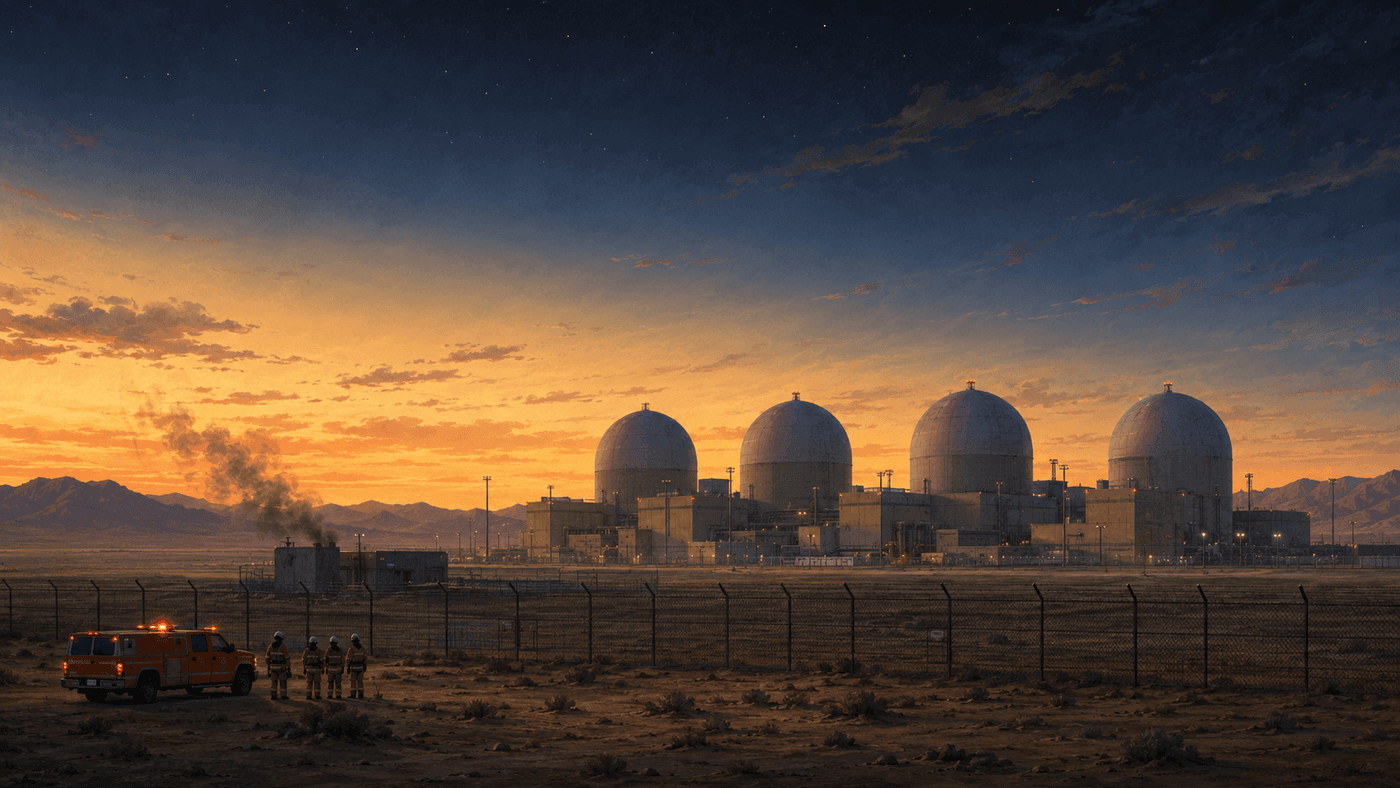
The history of nuclear safety norms is a history of humanity slowly building fences around the most dangerous technology it has ever created — fences made not of steel but of agreements, resolutions, and shared understandings that certain things are simply not done. The Treaty on the Non-Proliferation of Nuclear Weapons. The Comprehensive Nuclear-Test-Ban Treaty. The IAEA's safeguards regime. Article 56. Each was built in the aftermath of a near-catastrophe, or a real one, by people who understood that the alternative to these imperfect agreements was something far worse. None of them is enforced by anything stronger than international consensus and the willingness of states to comply. Yesterday's drone was small. The fire it started was contained. The radiation levels stayed normal. And yet what happened at Barakah on May 17, 2026 is precisely the kind of event that the architects of the post-war international order built their entire framework to prevent — and that the world is now watching happen, in real time, without a clear mechanism to stop it. The line was always there. Yesterday, it moved.