When Every Result Matters at Once
No day in international football carries quite the same chaotic, electric, heart-in-mouth drama as the final day of the World Cup group stage. Today, six matches unfold across three simultaneous time slots — Norway vs. France and Senegal vs. Iraq at 3 p.m. ET; Uruguay vs. Spain and Cape Verde vs. Saudi Arabia at 8 p.m. ET; Egypt vs. Iran and New Zealand vs. Belgium at 11 p.m. ET — and by midnight, the bracket will be set. Nations will advance and be eliminated in real time, sometimes by results happening thousands of miles away on the same pitch, and the whole strange, beautiful arithmetic of group stage football will resolve itself in a single day of controlled mayhem. The tradition of simultaneous final group matches was introduced at the 1982 World Cup in Spain, after West Germany and Austria played a notorious match in which both teams needed a 1-0 German victory to advance — and conveniently produced exactly that result while Algeria, who would have advanced with a different scoreline, watched helplessly. Never again, FIFA decided. From 1986 onward, final group matches have kicked off simultaneously. Today is why.
The Stories That Will Be Settled Tonight
At 3 p.m. ET in Foxborough, Massachusetts, France and Norway meet with both nations on six points and the group lead decided solely by goal difference — France ahead, Norway lurking. France have been dominant, scoring nine goals across their first two matches; Norway, with Erling Haaland running riot, have matched them. A win for either side sends them into the knockout stage as group winners, seeded accordingly. At 8 p.m. ET in Guadalajara, Spain — European champions, tournament favorites — face Uruguay in a match that could go several ways, while simultaneously in Houston, the smallest nation in this World Cup's history, Cape Verde, fights for a spot that would make them one of the great Cinderella stories in the tournament's 96-year history. And at 11 p.m. ET, in the group that has confounded every prediction, Egypt, Iran, and Belgium are separated by two points, with all three still mathematically alive — a three-way drama that will play out simultaneously in Seattle and Vancouver and won't be resolved until the final whistle blows in both cities at once.
The Iran storyline carries a weight beyond football. Eleven days ago, the United States and Iran signed a memorandum of understanding ending 107 days of war. Tonight, Iran's national team plays Egypt in Seattle — on American soil, in a stadium in a country that was, until less than two weeks ago, technically at war with theirs. The Iranian players have said little publicly about the geopolitical context surrounding their campaign. They don't need to. The sight of Iran's green, white, and red kit on an American pitch tonight, in a World Cup that was always meant to bring the world together, is its own statement. A win could send them into the knockout stage for only the second time in their history. The history of today is bigger than football.
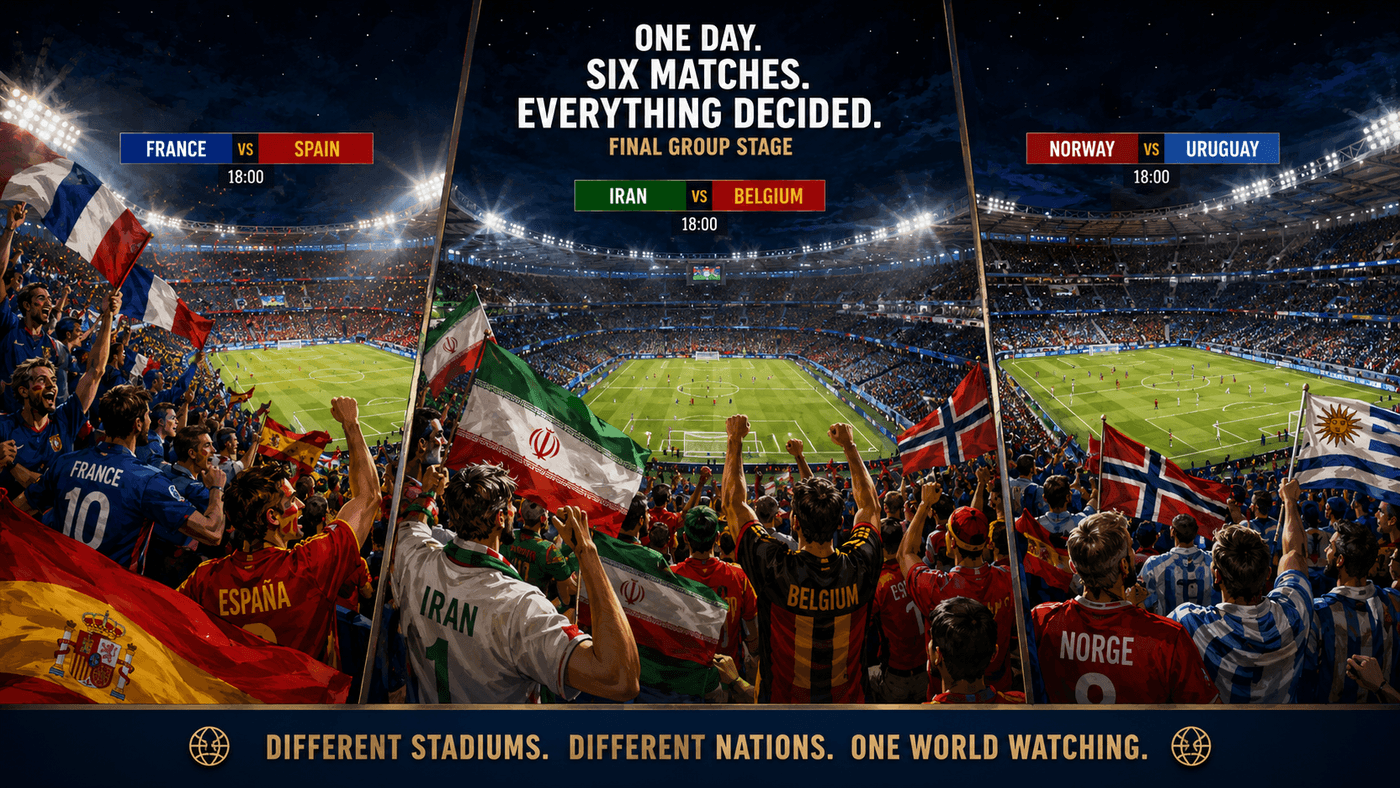
The simultaneous final group match format exists because of one of football's most infamous days: June 25, 1982, when West Germany and Austria played out what became known as the "Disgrace of Gijón" — a match so transparently engineered to suit both teams' qualification needs that Spanish fans in the stadium waved white handkerchiefs in disgust and Algerian supporters burned their flags outside. FIFA's response was swift and permanent. Today's format — chaotic, unpredictable, occasionally heartbreaking, always extraordinary — is what replaced it. Somewhere in six different stadiums tonight, sixteen nations will learn their fate at almost exactly the same moment. That's the group stage. That's the World Cup. The knockout rounds begin Sunday. Tonight, first, the chaos.