June 17: Liberty, Loss, and the Weight of a Promise
June 17 arrives carrying a word that Americans have never stopped arguing over: liberty. In 1885, a ship sailed into New York Harbor bearing 350 pieces of the most famous monument to that ideal ever built, a gift from one democracy to another and a declaration of shared faith in what free societies could become. Fifty-five years later, one of those democracies began to buckle under the weight of fascism, its government fracturing just as the darkness closed in. And 130 years after the statue arrived, nine people were killed inside a Charleston church that had survived slavery, arson, and suppression — simply because they opened their doors to a stranger. Together, these three moments ask the same hard question: what does it mean to promise liberty, and what does it cost when that promise is broken?
350 Pieces of a Promise
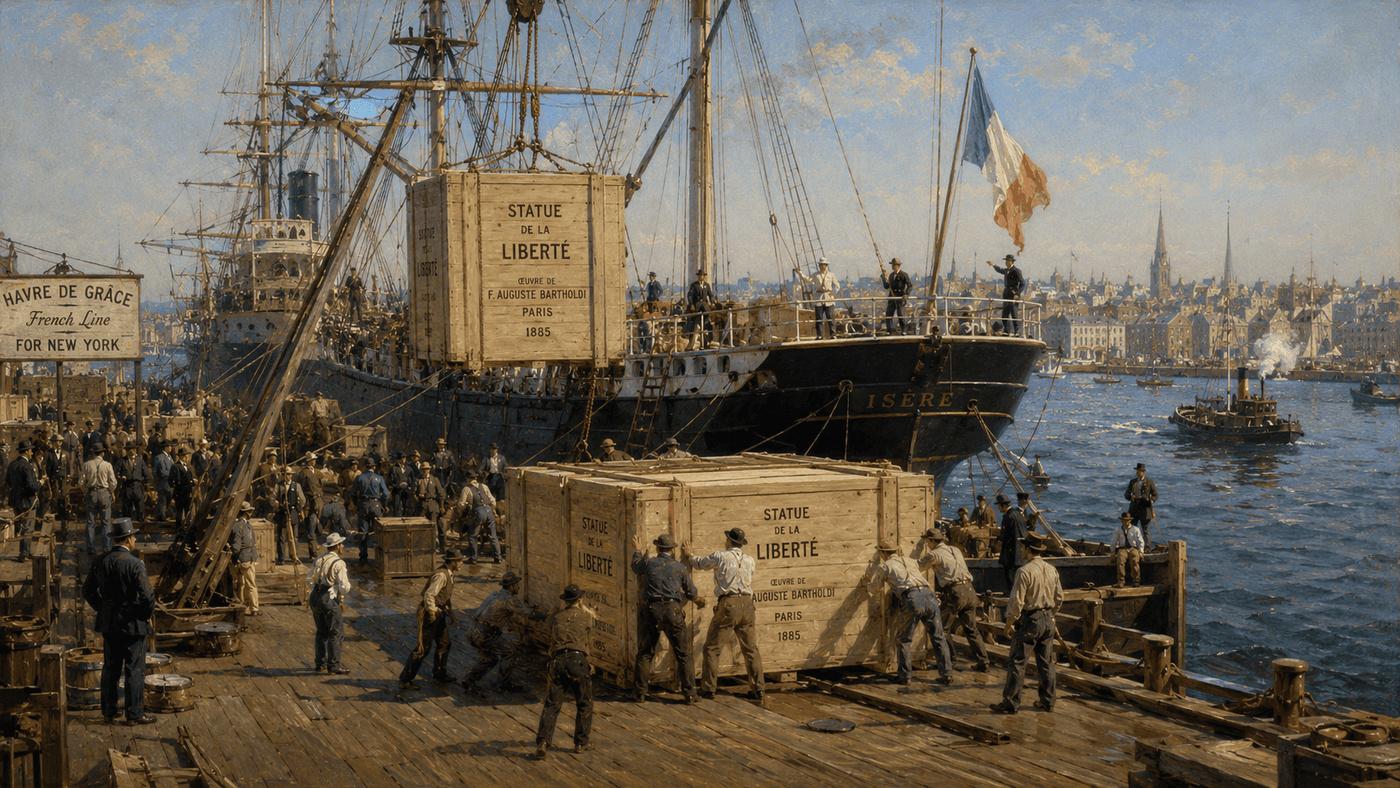
On June 17, 1885, the French naval vessel Isère entered New York Harbor with an unusual manifest: 350 individual crates containing the disassembled components of the Statue of Liberty. The statue had been conceived in the early 1870s by French political thinker Édouard de Laboulaye as a monument to the democratic ideals shared by France and the United States, and brought to life by sculptor Frédéric Auguste Bartholdi with a skeletal iron framework engineered by Gustave Eiffel. France funded the statue itself; the United States was responsible for the pedestal. Fundraising on the American side had lagged badly, and the crates sat in storage on Bedloe's Island for nearly a year while the money was gathered. The statue would not be formally dedicated until October 28, 1886.
What arrived in those crates that June morning has become the most recognized symbol of American identity in the world — and one of its most debated. Emma Lazarus's sonnet, affixed to the pedestal in 1903, reframed the statue as a beacon for the displaced and the desperate: "Give me your tired, your poor, your huddled masses yearning to breathe free." That vision of America as refuge has been embraced and challenged in every generation since. The statue has watched waves of immigrants pass beneath her torch, witnessed wars and recessions and social upheavals from her perch in the harbor, and endured as a complicated emblem of a nation that has always aspired to more than it has managed to deliver. She arrived in pieces. She has never quite been finished.
Mother Emanuel
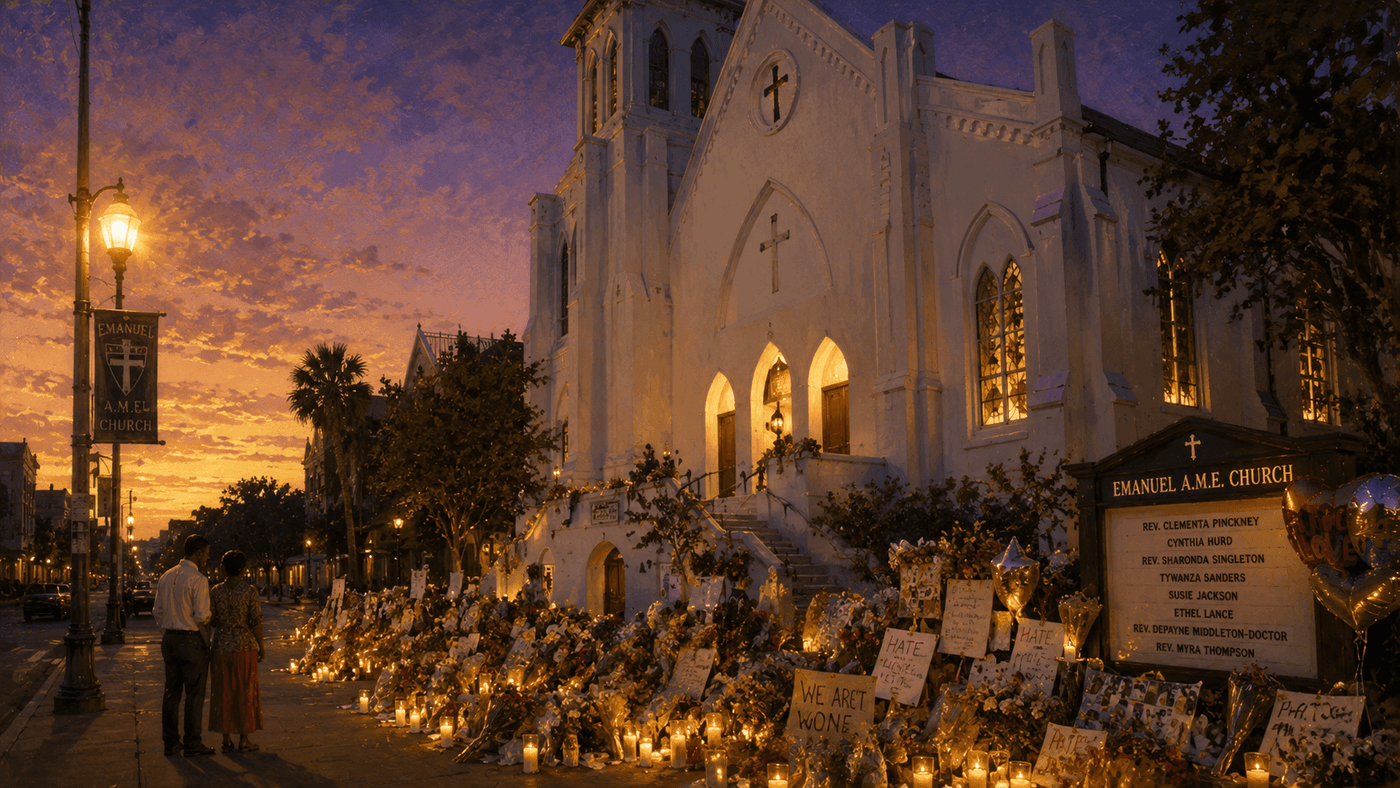
On the evening of June 17, 2015, a twenty-one-year-old white supremacist walked into Emanuel African Methodist Episcopal Church in Charleston, South Carolina, and joined a Wednesday night Bible study. He sat among the congregation for nearly an hour. Then he opened fire, killing nine people, including the church's senior pastor, Clementa C. Pinckney, who also served as a South Carolina state senator. The attack was the deadliest assault on a place of Black worship in the United States in decades, and it targeted one of the most historically significant Black churches in America. Emanuel AME — known as Mother Emanuel — was founded in 1816, survived being burned to the ground after an 1822 slave revolt plot, was forcibly closed for years under laws banning Black assembly, and endured. It had outlasted nearly two centuries of hostility. It opened its doors anyway.
The massacre sent shock waves through the country and ignited a fierce national debate about the Confederate battle flag, which flew on the grounds of the South Carolina State House. Within weeks, the flag was removed — a change that had been resisted for decades. The families of the victims delivered statements of forgiveness at the killer's bond hearing that stunned the nation and became the subject of widespread reflection on grace under the most unimaginable grief. The nine who died — Cynthia Hurd, Susie Jackson, Ethel Lance, DePayne Middleton-Doctor, Tywanza Sanders, Daniel Simmons, Sharonda Coleman-Singleton, Myra Thompson, and Clementa Pinckney — are remembered collectively as the Charleston Nine. Mother Emanuel still stands. Bible study still meets on Wednesday nights.
The Fall
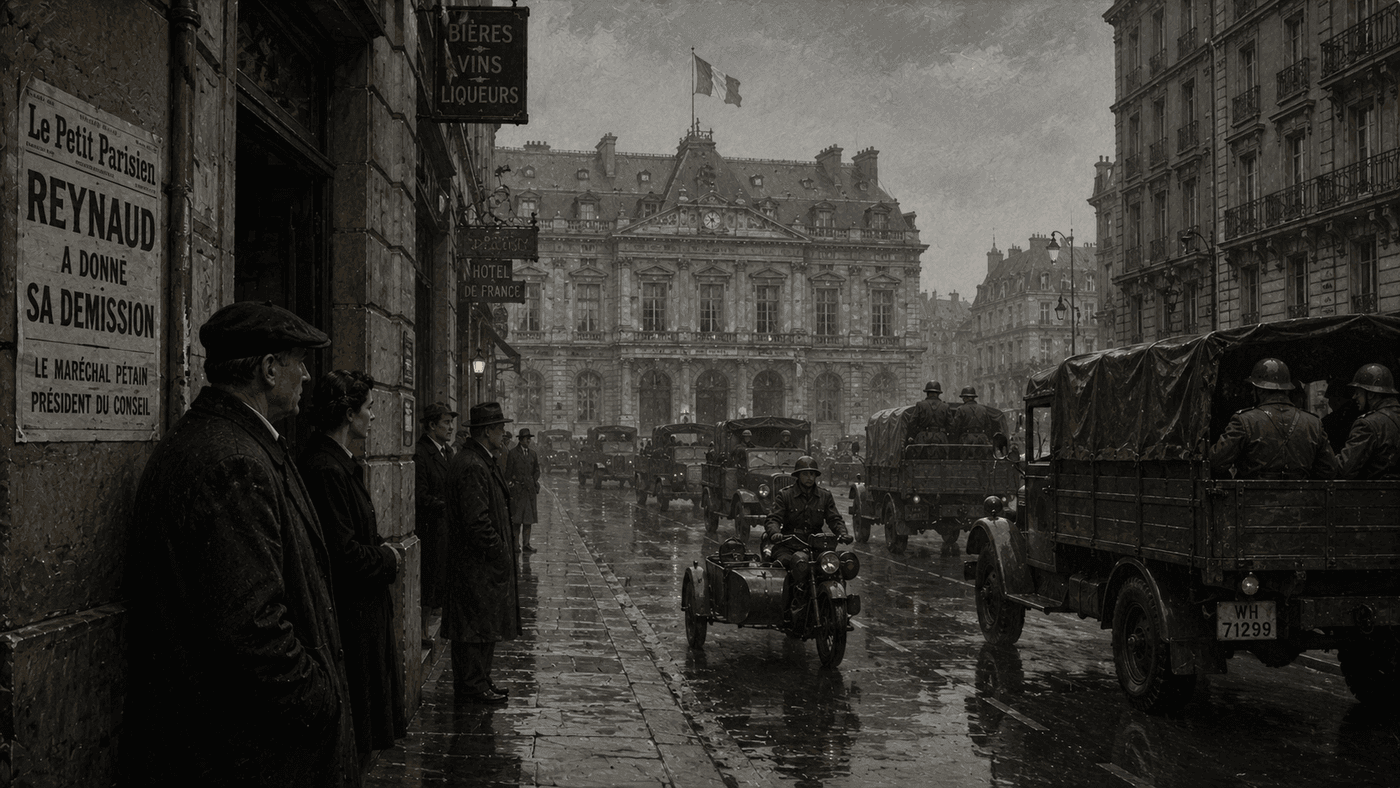
On June 17, 1940, French Prime Minister Paul Reynaud resigned, and with him went France's last serious voice for continued resistance against Nazi Germany. German forces had swept through the Low Countries and into France in a matter of weeks, bypassing the Maginot Line in a campaign so swift it left Allied commanders reeling. Reynaud had argued urgently for fighting on — retreating to North Africa if necessary, maintaining the alliance with Britain at all costs. His cabinet, led by the aging Marshal Philippe Pétain, disagreed. Pétain, a hero of the First World War, believed France had no choice but to seek armistice. When the cabinet sided with Pétain, Reynaud submitted his resignation. Hours later, Pétain requested terms from Hitler. France had fallen.
The consequences for the Allied cause were severe and immediate. Britain now stood alone in Western Europe, its army having barely escaped at Dunkirk. For Americans, still officially neutral, the fall of France was a galvanizing shock — a demonstration that the war in Europe was not a distant abstraction but an existential contest whose outcome would reshape the world. Reynaud survived the war, having been imprisoned by the Vichy government and later by the Germans. Pétain was convicted of treason after liberation and sentenced to death, a sentence commuted to life imprisonment. The France that emerged from the wreckage rebuilt itself around the resistance myth — the story of those who, unlike the men who forced Reynaud from office, had chosen to fight. It was a more consoling story than the full truth, but it gave a shattered nation somewhere to stand.