
June 13: You Have the Right to Remain Silent, The Pentagon Papers Hit the Press, Alexander the Great Exits History
Accountability is the thread connecting June 13's three stories, across twenty-three centuries and three very different systems of governance. A Supreme Court ruling established that the state must tell a citizen what rights they hold before it can use their words against them. A newspaper published documents proving that the state had been lying to its citizens about a war for decades. And an empire without formal accountability of any kind lost the one man whose force of personality had held it together — and then watched it fall apart. Three very different answers to the question of what happens when power is not answerable to anything outside itself.
Miranda
On June 13, 1966, the Supreme Court issued its ruling in Miranda v. Arizona, establishing that suspects in police custody must be informed of their constitutional rights — specifically, the right to remain silent, the right to be told that anything they say may be used against them in court, and the right to an attorney — before any interrogation may begin. Chief Justice Earl Warren wrote the majority opinion, which held that the Fifth Amendment's protection against self-incrimination and the Sixth Amendment's guarantee of counsel were meaningless in practice if suspects did not know they possessed them. The case arose from the 1963 arrest of Ernesto Miranda, a Phoenix man who had confessed to kidnapping and rape after two hours of interrogation without being told he had the right to refuse to speak or to have a lawyer present. Miranda's conviction was overturned; on retrial, he was convicted again on other evidence. He was paroled in 1972, stabbed to death in a bar fight in 1976, and the man arrested for his killing was read his Miranda rights.
The Miranda warning has been recited in American police stations, courtrooms, and television dramas so many times that its language has become part of the cultural furniture — "You have the right to remain silent" is one of the most recognizable sentences in the American legal vocabulary. Its practical impact has been debated by legal scholars for six decades: studies have found that the majority of suspects waive their Miranda rights and talk to police anyway, that the warning is often delivered too quickly or in language too formal to be fully comprehensible, and that its protections are less robust in practice than the Court's rhetoric suggested. But the principle it established — that the state must inform the individual of their rights before exploiting their ignorance of them — remains a meaningful constraint on police interrogation practice, and the ruling's underlying logic, that constitutional rights are only as real as the knowledge of them, has influenced law and legal thinking well beyond the criminal justice context in which it arose.

The Papers
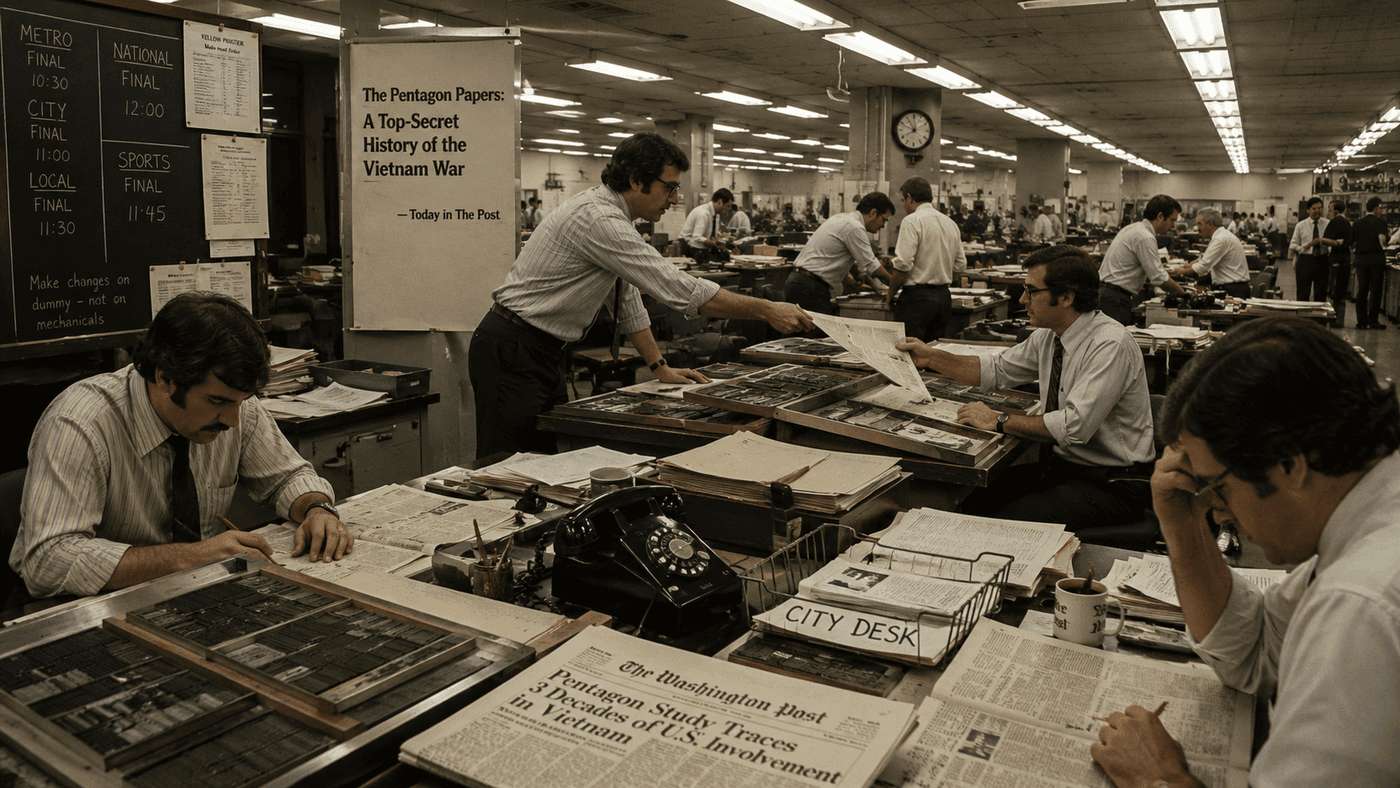
On June 13, 1971, The New York Times began publishing excerpts from the Pentagon Papers — a 7,000-page classified study commissioned by Secretary of Defense Robert McNamara in 1967 to document the history of U.S. involvement in Vietnam from 1945 onward. The study had been leaked to The Times and the Washington Post by Daniel Ellsberg, a former military analyst and RAND Corporation researcher who had worked on the study and had become convinced that the war was both unwinnable and fundamentally dishonest in its premises. The documents revealed that four successive administrations — Truman, Eisenhower, Kennedy, and Johnson — had systematically misled Congress and the public about the nature, scope, and prospects of American involvement in Vietnam, escalating a war they privately doubted could be won while publicly maintaining that progress was being made. The Johnson administration in particular had expanded the war significantly while publicly describing its policies as limited and defensive.
The Nixon administration immediately sought a court injunction to halt publication — the first attempt at prior restraint of the press by the federal government in American history. The case reached the Supreme Court in fifteen days, a record for the institution, and the Court ruled 6-3 against the government, with the majority holding that the government had not met the heavy burden required to justify suppressing publication. The Times and Post resumed publishing. The Pentagon Papers case established one of the most consequential press freedom precedents in American legal history, making it substantially more difficult for any future government to prevent publication of information it considered sensitive. Ellsberg, who was charged with espionage and theft and faced 115 years in prison, had all charges against him dismissed in 1973 after it emerged that the Nixon administration had authorized a covert team — the "Plumbers" — to break into his psychiatrist's office to find damaging information about him. That operation was one of the threads that led, via Watergate, to Nixon's resignation. The papers Ellsberg leaked, and the government's response to their publication, produced consequences that extended far beyond Vietnam.
Babylon, 323 B.C.
On June 13, 323 B.C., Alexander III of Macedon — known to history as Alexander the Great — died in the Palace of Nebuchadnezzar II in Babylon, at the age of thirty-two. The cause of his death has been debated by historians and physicians for more than two thousand years: typhoid fever complicated by excessive drinking is the most widely accepted modern diagnosis, though theories ranging from deliberate poisoning to a rare autoimmune disease have been proposed and argued. He had returned to Babylon the previous year after his campaigns in Persia, Central Asia, and the Indian subcontinent — a military journey of approximately 22,000 miles conducted over thirteen years that had destroyed the Achaemenid Persian Empire, founded or refounded more than seventy cities, and extended Macedonian control over a territory stretching from Greece and Egypt to modern Pakistan and Afghanistan. He had never lost a battle.
What his death revealed, immediately and brutally, was that the empire he had built was a function of his personal authority rather than any durable institutional structure. He died without a clear succession plan — when asked on his deathbed to whom he left his empire, he is said to have replied "to the strongest," though historians debate whether this exchange occurred. His generals — the Diadochi, or "successors" — began fighting for pieces of the empire almost before his body was cold, and by the early third century B.C. the Macedonian world empire had fractured into competing kingdoms that would fight each other for generations. What survived was not the political structure but the cultural one: the spread of Greek language, art, architecture, and intellectual life across the Near East and Central Asia that Alexander's campaigns had produced — a process called Hellenization that shaped the development of mathematics, philosophy, science, and eventually Christianity and Islam in ways that outlasted every kingdom his generals built. He died at thirty-two having changed the world more comprehensively than almost any individual who has ever lived, and having made no provision for what came next. The empire dissolved. The influence did not.