June 11: Standing in the Schoolhouse Door, A King Takes a Wife Who Will Change England, The Duke Rides Off
June 11 is a date that understands the weight of symbols — the literal weight of a man standing in a doorway to say that two students may not pass, the ceremonial weight of a royal wedding whose long unraveling would crack a church in two, and the quieter, more diffuse weight of a film star's death whose significance lay less in any single event than in what his presence had meant to the culture that watched him for fifty years. Three very different kinds of symbolic power, on three very different June 11s — and the persistent human need to give large, contested ideas a face and a place to stand.
The Schoolhouse Door
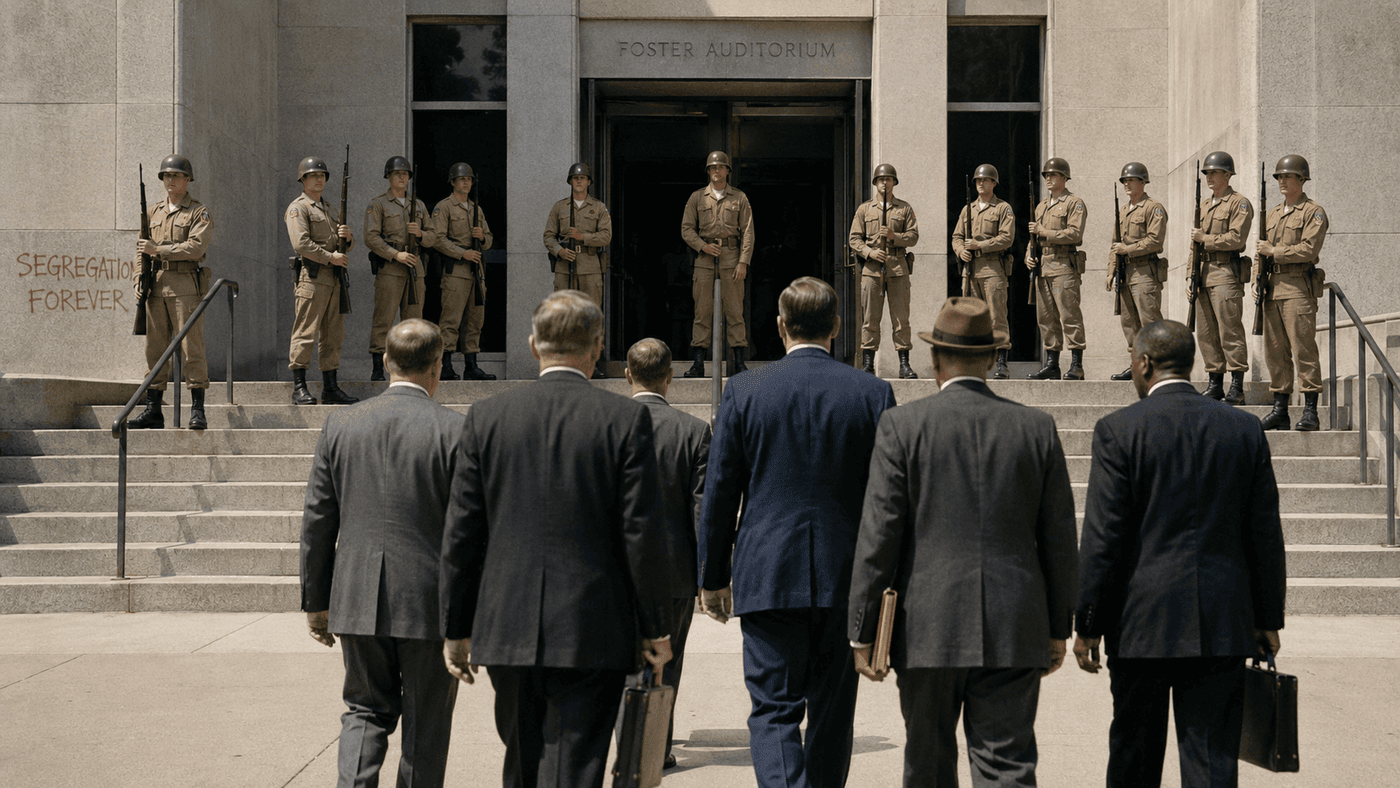
On June 11, 1963, Alabama Governor George Wallace stood in the entrance of Foster Auditorium at the University of Alabama in Tuscaloosa, physically blocking the enrollment of Vivian Malone and James Hood — two African American students whose admission had been ordered by a federal court. Wallace had won the Alabama governorship in 1962 on an explicit pledge of "segregation now, segregation tomorrow, segregation forever," and his presence in the doorway was less a practical obstacle than a theatrical statement: he knew that the federal government had the authority to enforce the court order and that his stand would ultimately fail. Deputy Attorney General Nicholas Katzenbach arrived at the auditorium to formally request that Wallace step aside; Wallace refused and delivered a prepared statement denouncing federal tyranny. President Kennedy federalized the Alabama National Guard later that day, and when Brigadier General Henry Graham arrived and informed Wallace that he was under presidential orders, the governor stepped aside. Malone and Hood enrolled. They were the first Black students to attend the University of Alabama.
The "Stand in the Schoolhouse Door" was theatrical in its staging but consequential in its effects. That evening, Kennedy addressed the nation in a televised speech that he had largely not prepared in advance, delivering what many historians consider the most direct and morally unequivocal presidential statement on civil rights since Lincoln — calling racial discrimination a moral crisis "as old as the scriptures and as clear as the American Constitution" and committing his administration to comprehensive civil rights legislation. The Civil Rights Act of 1964, which Kennedy would not live to sign, had its clearest political catalyst in the events of June 11, 1963. Vivian Malone graduated from the University of Alabama in 1965. James Hood left after one semester due to the hostile environment but returned to complete his doctorate in 1997. Wallace himself, after a 1972 assassination attempt that left him paralyzed, underwent what he described as a genuine conversion on race and sought the forgiveness of Black Alabamans in the years before his death in 1998. The doorway at Foster Auditorium is now a historical landmark, with a plaque marking the spot where he stood.
The Marriage That Broke a Church
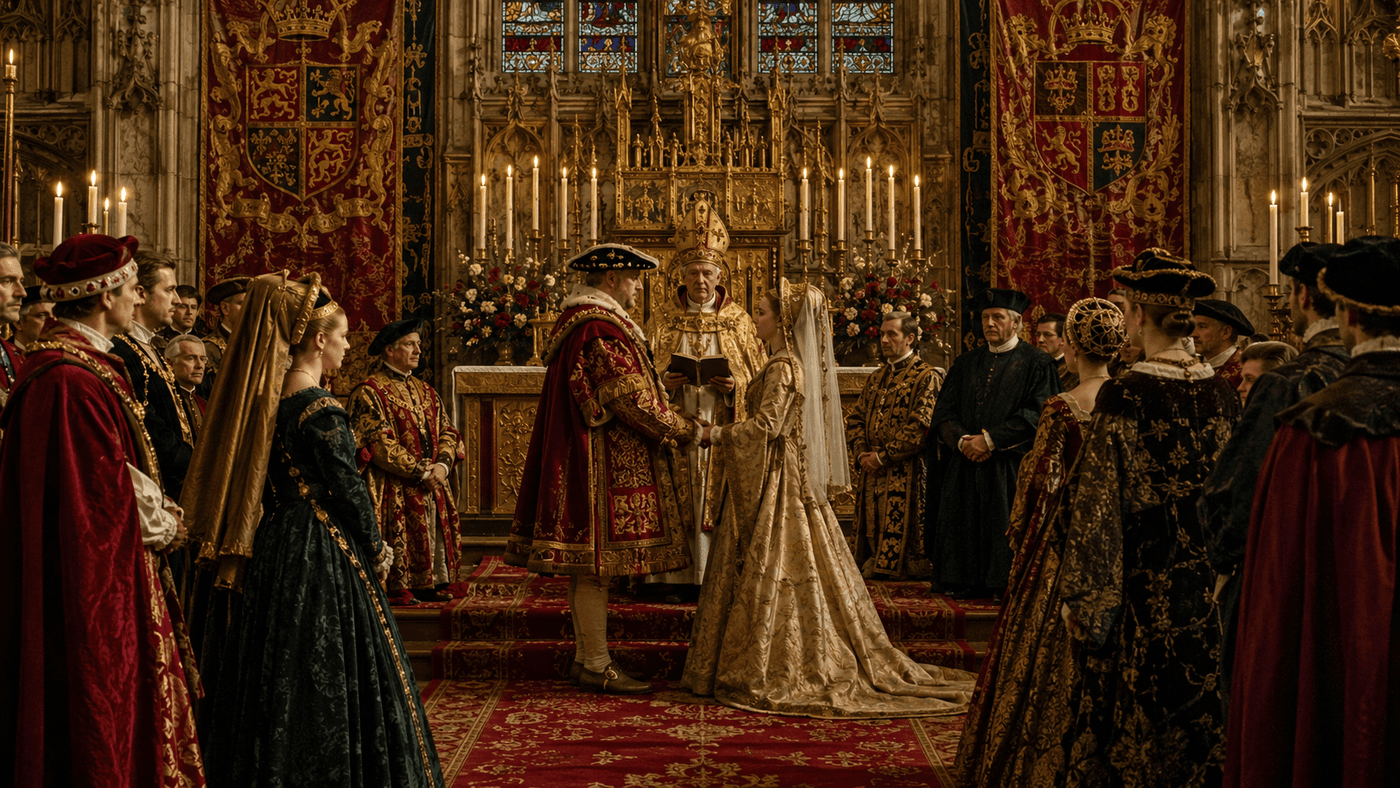
On June 11, 1509, eighteen-year-old Henry VIII of England married Catherine of Aragon — the widow of his elder brother Arthur, who had died at fifteen in 1502 — in a private ceremony at Greenwich. The marriage had been arranged primarily to maintain the Spanish alliance that Catherine's parents, Ferdinand and Isabella of Spain, had been the other half of, and to secure the substantial dowry that had been paid for Catherine's first marriage and had not been returned. Catherine was twenty-three, a composed and capable woman whose years of widowhood in England had not diminished her political intelligence. Henry was young, athletic, intellectually ambitious, and genuinely enamored of his new queen — or at least appeared to be. For the first decade and more of the marriage, the union seemed not merely successful but happy, and Catherine served as regent of England while Henry was in France in 1513 and wrote him a letter about the Scottish victory at Flodden Field that military commanders would not have been embarrassed to send.
The unraveling began with Catherine's failure to produce a surviving male heir — she had six pregnancies, only one of which, the future Mary I, resulted in a child who survived infancy — and with Henry's infatuation with Anne Boleyn, whom we met on May 19 in this series, at her execution. Henry's attempts to obtain an annulment from the Pope — who was not inclined to grant one, partly because Catherine's nephew, Holy Roman Emperor Charles V, controlled much of Italy and had effectively taken the Pope prisoner during the Sack of Rome in 1527 — produced the English Reformation: Henry's break with Rome, his establishment of the Church of England with himself as its Supreme Head, and the dissolution of the monasteries that transferred an enormous amount of wealth and property from the Church to the Crown and its allies. A marriage contracted for dynastic convenience in a Greenwich palace on June 11, 1509, had, within three decades, produced a new national church, the execution of figures including Thomas More and Thomas Cromwell, and a religious rupture whose effects are still visible in the denominational landscape of the English-speaking world today.
The Duke
On June 11, 1979, John Wayne died of stomach cancer at UCLA Medical Center in Los Angeles, at the age of seventy-two. He had been born Marion Robert Morrison in Winterset, Iowa, in 1907, and had spent most of his adult life playing a character — the laconic, physically formidable, morally uncomplicated American — that he himself had constructed and that the movie-going public had found so compelling for so long that the character and the man became, in most people's minds, indistinguishable. Wayne had appeared in more than 170 films over five decades, won an Academy Award for True Grit in 1970 — which we covered in the April 7 post — and become, by the time of his death, something considerably larger than a movie star: an embodiment of a particular idea of American masculinity, American patriotism, and American historical mythology that his westerns had done as much to create as to reflect.
Wayne's politics were as outsized as his screen presence: an ardent conservative and anti-communist who had been a prominent supporter of the House Un-American Activities Committee investigations in Hollywood, a vocal opponent of the counterculture movements of the 1960s, and a public defender of American involvement in Vietnam at a time when the country was bitterly divided on the question. His politics made him a polarizing figure well before his death, and they have complicated his legacy considerably since — as has the racial condescension evident in some of his public statements about Indigenous peoples and Black Americans, statements that have received increased scrutiny in recent years. He was also, by the accounts of those who worked with him, a man of genuine personal generosity and loyalty, and the sustained quality of his best performances — in films made with John Ford and Howard Hawks in particular — represents a body of work of real artistic substance. The country that turned out to mourn him on June 11, 1979, was mourning something larger than one man: an image of America that his films had constructed, that his generation had believed in, and that the decades since his best work had made increasingly difficult to hold uncritically. The Duke rode off on June 11, 1979. The argument about what he represented is still going.