June 10: Two Men in an Akron Living Room, The First to Hang at Gallows Hill, The Speech That Almost Ended the Cold War
Some of the most consequential things in history happen in small rooms, without ceremony, between people who have no idea what they are starting. June 10 offers three of those moments: a founding conversation between two struggling men in an Akron, Ohio home that would eventually produce the most widely used addiction recovery framework in the world; a judicial murder on a Massachusetts hillside that opened one of colonial America's most terrifying episodes of mass hysteria; and a speech at a Washington, D.C., university in which a president who had recently survived the Cuban Missile Crisis looked directly at the logic of nuclear confrontation and asked, in public and on the record, whether there was another way. Three June 10s, three encounters with something intractable — and three different attempts to find a path through it.
The Meeting That Became a Movement
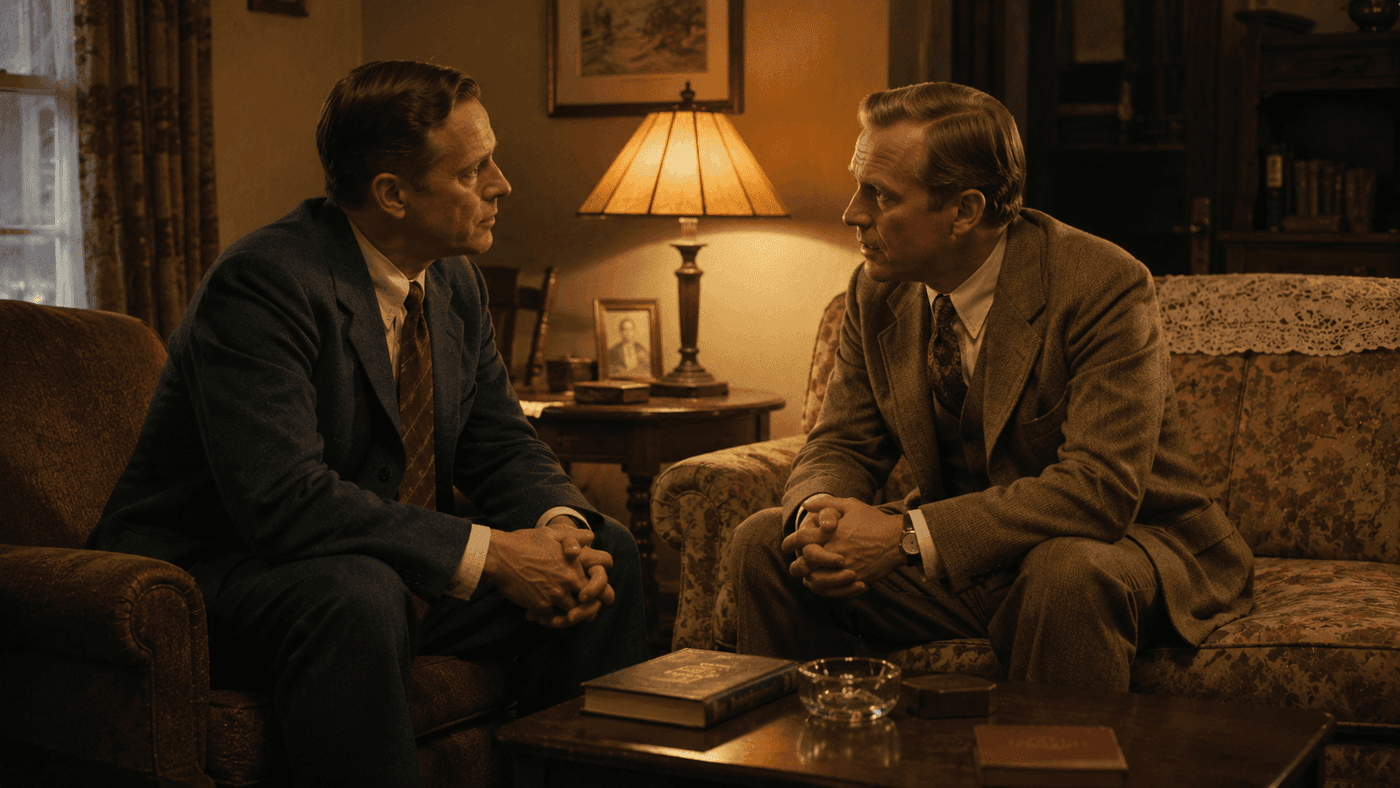
On June 10, 1935, a New York stockbroker named Bill Wilson — sober for several months after years of severe alcoholism and recently convinced that talking to other alcoholics was the key to maintaining his own sobriety — met for the first time with Dr. Robert Smith, an Akron surgeon whose drinking had nearly destroyed his medical career. The meeting, arranged through a chain of contacts that included the Oxford Group, a Christian fellowship that had helped Wilson achieve sobriety, lasted several hours. Wilson talked; Smith listened and talked back; and something happened between the two men that neither had quite experienced before: the recognition that sharing their experience of addiction with someone who had lived it was more effective than any other approach either had encountered. Smith had his last drink on June 10, 1935, and never drank again. Wilson and Smith began meeting regularly with other alcoholics, and what grew from those conversations was formalized in 1939 with the publication of a book they called Alcoholics Anonymous — giving the organization its name and its foundational text.
The core insight of Alcoholics Anonymous — that one alcoholic talking to another is more effective than medical treatment, moral instruction, or willpower alone — was revolutionary in 1935, when alcoholism was widely understood as a moral failing rather than a disease, and when the available treatments were largely useless. AA's Twelve Steps, developed by Wilson and refined through experience, created a structured framework for recovery that has been adapted for virtually every form of addiction and compulsive behavior in the decades since — Narcotics Anonymous, Gamblers Anonymous, Overeaters Anonymous, and dozens of others. Today AA alone estimates it has approximately two million members worldwide in more than 180 countries, and its peer support model has influenced addiction treatment, mental health care, and the design of countless support programs that do not carry the AA name. All of it traces back to an Akron living room on June 10, 1935, and two men who were honest with each other about what they couldn't do alone.
Gallows Hill
On June 10, 1692, Bridget Bishop was hanged on a hill in Salem, Massachusetts — the first of twenty people executed during the Salem witch trials and the only one killed on that date. Bishop was a Salem tavern keeper in her late fifties, had been married three times, kept irregular hours, and was known for her colorful clothing and forthright manner in a community that found all of these things unsettling. She had been accused of witchcraft previously in 1679 and acquitted, but the renewed accusation in 1692 — during the wave of hysteria that had swept Salem beginning in January, when a group of young girls began exhibiting convulsive behavior and accusing community members of afflicting them — carried more momentum. At her trial before the Court of Oyer and Terminer, spectral evidence — testimony about visions seen in dreams — was admitted alongside physical evidence, and she was convicted. The court's willingness to accept spectral evidence as sufficient proof of guilt was the legal mechanism that made the trials possible and the executions inevitable.
The Salem witch trials of 1692 lasted approximately a year, produced twenty executions — fourteen women and six men, most of them hanged, one pressed to death under stones — and resulted in the imprisonment of more than two hundred people. They ended not through any single act of justice but through a gradual accumulation of doubt: prominent ministers began questioning the admissibility of spectral evidence, Governor Phips dissolved the Court of Oyer and Terminer, and the colony's legislature eventually passed a general pardon. In 1957, Massachusetts formally apologized to the victims. In 2001, the state legislature cleared the last remaining names that had not been previously exonerated. The location of the actual executions — Gallows Hill — was not definitively identified until 2016, when a researcher pinpointed the site as a rocky outcropping in what is now a commercial area of Salem. The hill itself is unmarked. Bridget Bishop's remains have never been found. Her name, like those of the other nineteen people killed in 1692, has been formally restored by the state that executed her.

The Peace Speech
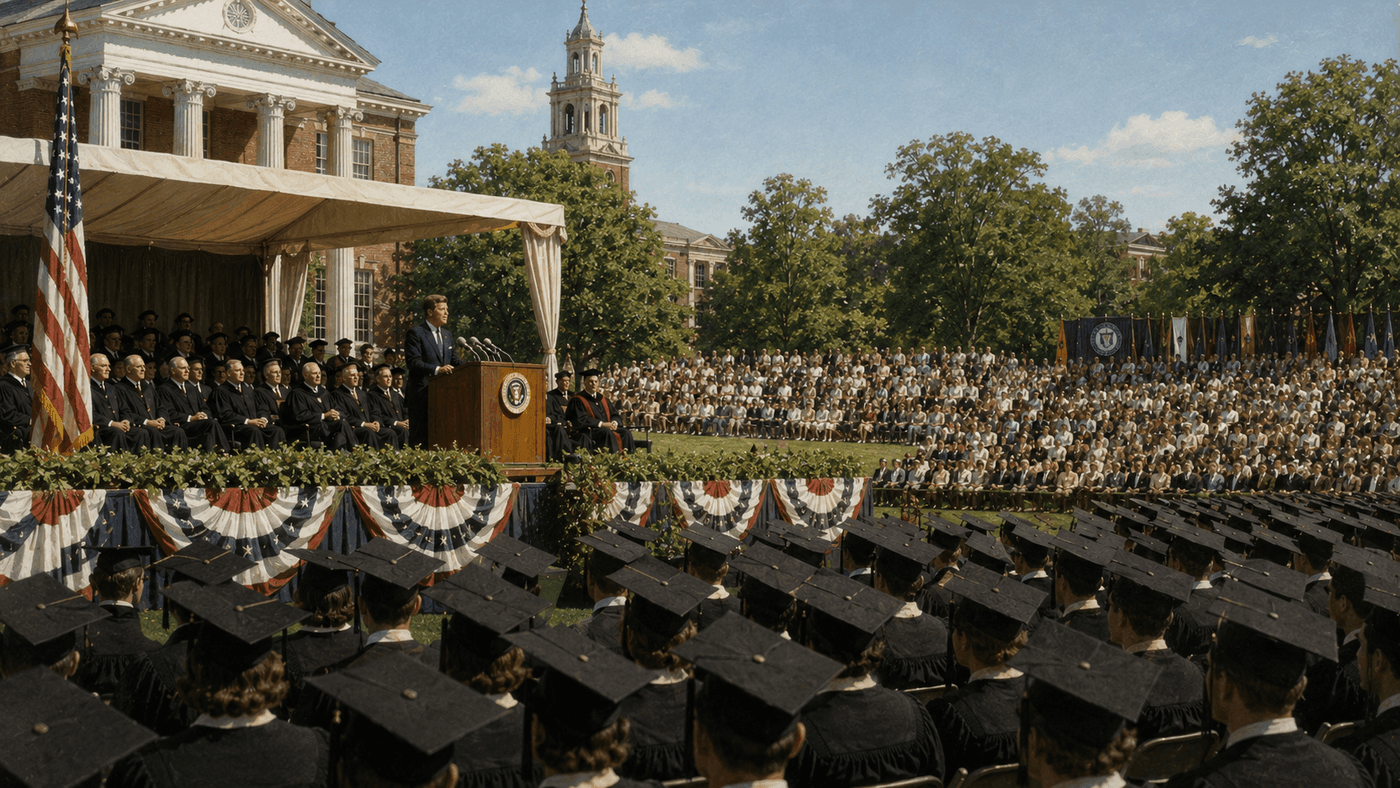
On June 10, 1963, President John F. Kennedy delivered a commencement address at American University in Washington, D.C., that many historians consider the most important foreign policy speech of his presidency — and one of the most significant American speeches of the Cold War era. Kennedy had been shaken by the Cuban Missile Crisis of October 1962, during which the world had come within hours of nuclear war, and he had spent the intervening months privately reconsidering the premises of American Cold War strategy. The speech he delivered on June 10 — written largely by his national security adviser Ted Sorensen and not shared in advance with the State Department or the Pentagon — called for a fundamental reexamination of the Cold War, asked Americans to reconsider their assumptions about the Soviet Union, and announced that the United States would unilaterally suspend atmospheric nuclear testing as a gesture toward negotiation. It was, by the standards of Cold War presidential rhetoric, almost shockingly conciliatory.
The Soviet response was immediate and startling: the Kremlin allowed the full text of Kennedy's speech to be published in Soviet newspapers — a courtesy not extended to American presidential addresses — and Radio Moscow broadcast it in its entirety. Nikita Khrushchev later told the American diplomat Averell Harriman that it was the best speech by an American president since Franklin Roosevelt. Within weeks, negotiations on a nuclear test ban treaty had resumed in earnest; the Limited Test Ban Treaty, prohibiting nuclear weapons tests in the atmosphere, underwater, and in outer space, was signed on July 25, 1963 — forty-five days after the American University speech. Kennedy was assassinated five months later. The détente he had begun to build was set aside under Lyndon Johnson and the escalating Vietnam War, and the full nuclear arms reduction that the speech had seemed to anticipate would not come for another two decades. But the speech itself stands, as one of Kennedy's speechwriters later said, as the clearest statement he ever made of what kind of world he was trying to build — and as evidence that, in the right moment, a president willing to say something genuinely different can move the world a degree or two in a better direction.