July 9: An Empress, a Harbor, and a Court
July 9 is a day for people who don't wait for permission. In 1762, a German-born princess who had spent decades mastering the language, religion, and politics of a country not her own moved against her own husband and claimed the Russian Empire before breakfast. Eighty-four years later, an American naval captain sailed into a bay on the California coast, raised a flag over the plaza, and handed the United States one of the finest natural harbors in the world without a shot being fired. And in 1877, twenty-two men paid a guinea each to play tennis on a club's lawn in London, inaugurating a tournament that would become the most storied in the history of the sport. Three claims staked on a single date — each one reshaping the map in its own way.
Catherine
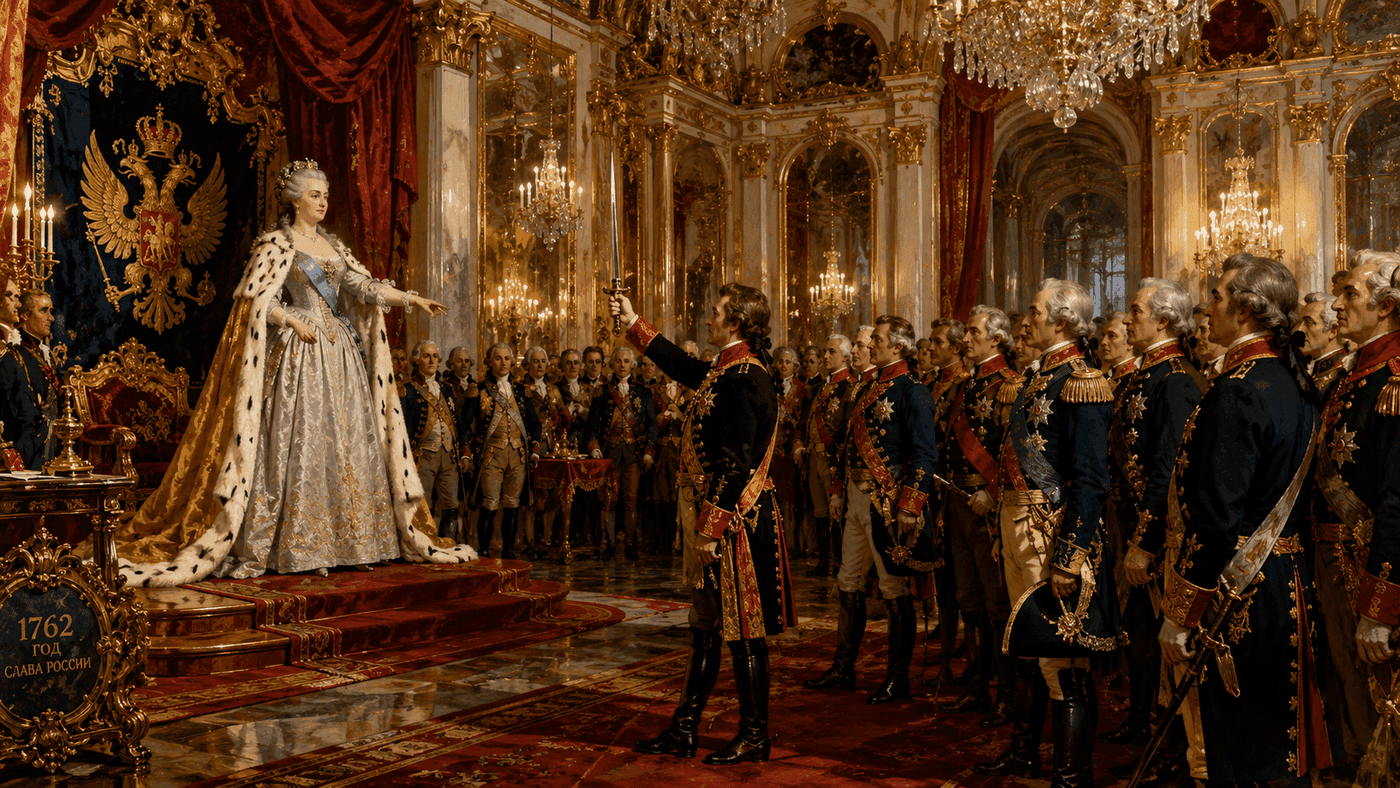
On July 9, 1762, Catherine — born Sophie Friederike Auguste, Princess of Anhalt-Zerbst-Dornburg, a minor German noble house — deposed her husband Tsar Peter III and seized control of the Russian Empire in a coup so swiftly executed it was effectively over before most of St. Petersburg knew it had begun. Peter had ruled for barely six months, alienating the Russian military by withdrawing from the Seven Years' War at the moment of near-victory, ceding gains to Prussia in what soldiers and courtiers alike regarded as an act of irrational admiration for Frederick the Great. Catherine, who had arrived in Russia at fourteen as a bride-to-be, had spent nearly two decades becoming more Russian than her husband — learning the language fluently, converting to Orthodox Christianity, studying Russian history and law, and cultivating the loyalty of the military officers and court officials whose support she would need. When she moved, she moved with their backing.
The coup was bloodless — Peter abdicated within days and died shortly afterward under circumstances that have never been fully explained. What followed was one of the longest and most consequential reigns in Russian history: thirty-four years during which Catherine expanded the empire's territory by some 200,000 square miles, reformed the legal code, corresponded with Voltaire and Diderot, founded schools and hospitals, and established Russia as an undeniable European power. She was not without contradictions: a ruler who corresponded with Enlightenment philosophers while tightening the bonds of serfdom, who expanded religious tolerance while suppressing the Pugachev Rebellion with brutal force. She died in 1796, having never relinquished power, and left behind an empire transformed. The girl from a minor German principality who had decided, at some point in her long Russian apprenticeship, that she would not merely survive the court but rule it, had been entirely correct.
The Bay
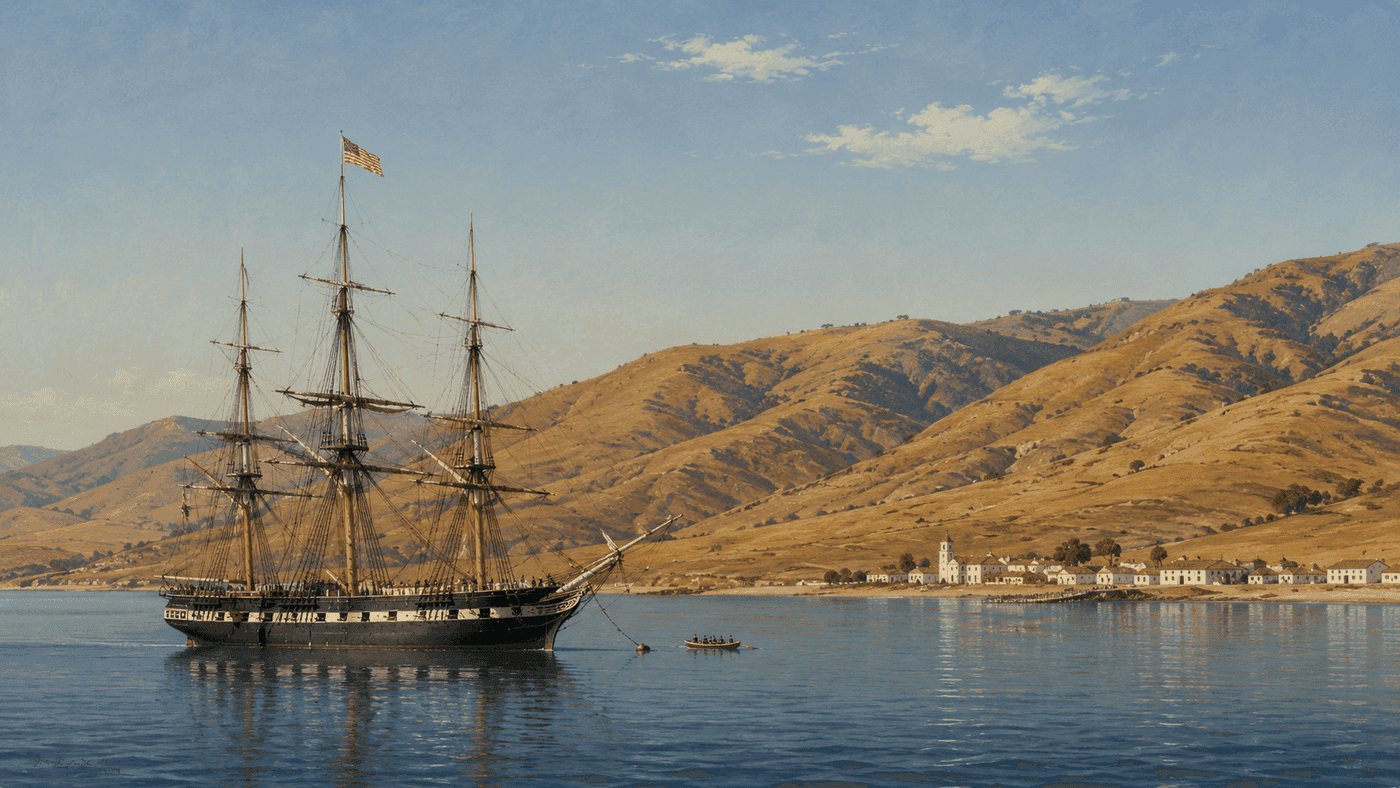
On July 9, 1846, Captain John B. Montgomery sailed the USS Portsmouth into San Francisco Bay and raised the American flag over the central plaza of the small settlement then known as Yerba Buena — claiming it, without resistance, for the United States. The Mexican garrison offered no fight; the American naval presence was overwhelming, and word had already reached California that war between the two nations had begun. The action was part of a broader American campaign to seize California during the Mexican-American War, a conflict that had erupted two months earlier over the disputed Texas border and the United States' barely concealed ambition to acquire the Pacific coast territories that Mexico held. San Francisco Bay — one of the finest natural deepwater harbors in the world — was the strategic prize above all others on that coast, and Montgomery's bloodless occupation secured it in a single morning.
The small settlement that Montgomery's men raised a flag over in 1846 was, by almost any measure, unremarkable — a few hundred inhabitants, a trading post, a mission. Within three years it would be transformed beyond recognition. Gold was discovered at Sutter's Mill in January 1848, and by 1849 San Francisco had become the entry point for tens of thousands of fortune-seekers pouring into California from around the world, its population exploding from a few hundred to more than 25,000 in less than two years. The harbor that Montgomery claimed on July 9, 1846 — quiet, contested, strategically vital — became one of the busiest ports in the Americas, and the city that grew around it one of the most consequential in American history. California itself was admitted to the Union in 1850, less than four years after the flag went up over Yerba Buena's plaza, completing an acquisition whose long-term significance neither Montgomery nor anyone else in that bay could have fully grasped.
One Guinea, One Champion
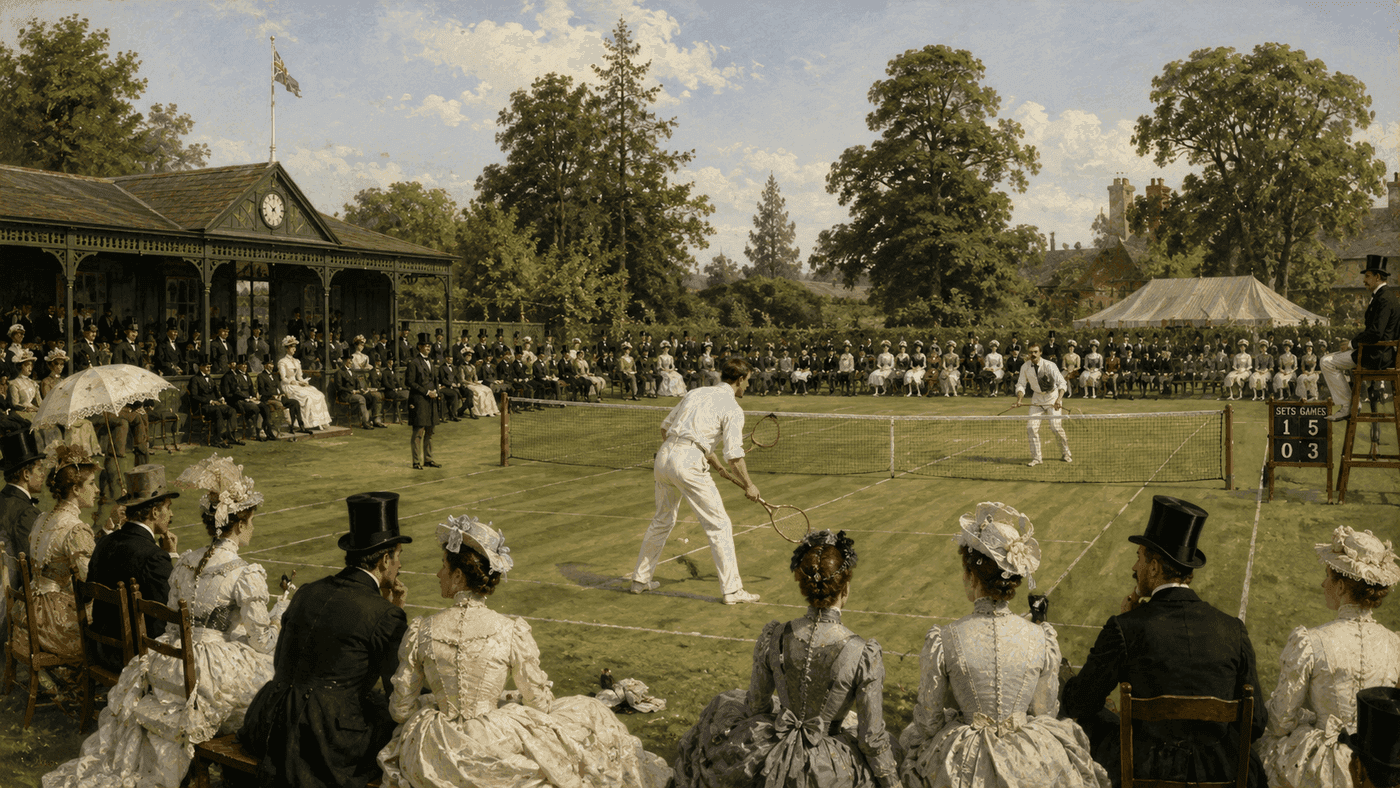
On July 9, 1877, the All England Croquet and Lawn Tennis Club opened the gates of its grounds in Wimbledon, London, for the first championship lawn tennis tournament ever held — an event conceived not as a landmark occasion but as a practical fundraiser to repair the club's broken roller. Twenty-two men paid a one-guinea entry fee to compete for the inaugural men's singles title. Spectators paid one shilling each for admission, and roughly two hundred of them turned out to watch. The champion who emerged from that modest field was Spencer Gore, a rackets player who defeated William Marshall in the final. Gore's success was notable but his enthusiasm for the new sport was limited: he predicted, in an interview shortly after his victory, that lawn tennis would never catch on as a serious game. He did not return to defend his title the following year.
Whatever Gore's reservations, the tournament he won on July 9, 1877, grew into something its organizers could not have imagined. Wimbledon is today the oldest and most prestigious tennis tournament in the world — one of the four Grand Slams, the only one still played on grass, and the one whose traditions, from the all-white dress code to the strawberries and cream, have remained most deliberately unchanged. Its Centre Court has hosted the defining matches of every era of tennis, from the great amateur champions of the early twentieth century through the Open Era rivalries that produced some of the sport's most watched moments. The broken roller that necessitated the 1877 fundraiser was eventually repaired. The tournament it spawned has never stopped.