The Call That Changed the World Cup
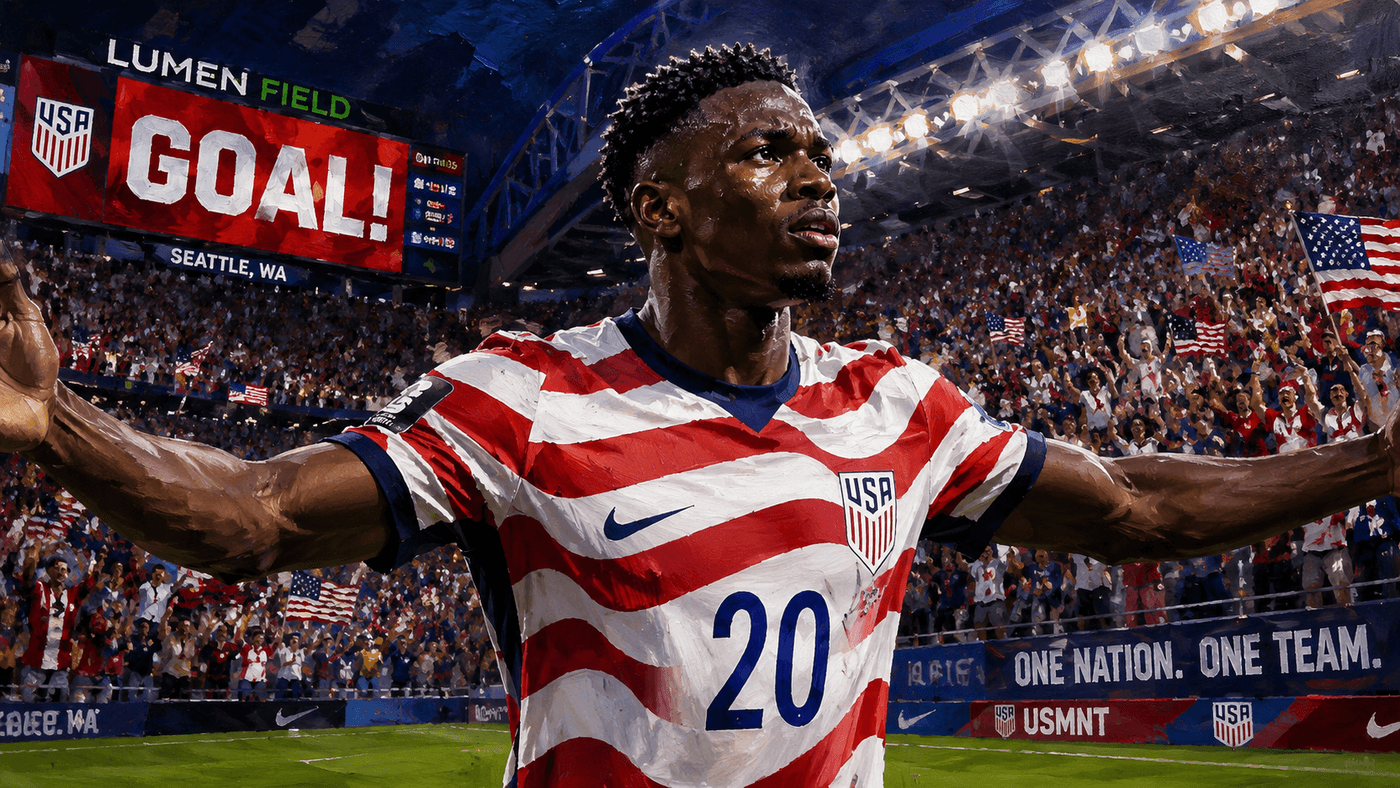
On Sunday morning, the U.S. Men's National Team was riding a bus to a training session in Seattle when word came through: Folarin Balogun could play. FIFA's Disciplinary Committee had announced it was suspending Balogun's one-game red card ban for a probationary period of one year — reinstating the USMNT's leading scorer for tonight's Round of 16 match against Belgium at 5 p.m. ET in Seattle, on FOX and Telemundo. The decision followed a phone call in which President Trump personally urged FIFA President Gianni Infantino to review the case. Secretary of Commerce Howard Lutnick and Andrew Giuliani, executive director of the White House's World Cup task force, had also been in communication with FIFA. Belgium's football federation called the ruling "astonishing." UEFA, European football's governing body, called it "unprecedented, incomprehensible and unjustifiable." And historians of the sport noted that it appeared to be only the second time FIFA has ever lifted a World Cup red card suspension — the first since Brazil's Garrincha was cleared to play the 1962 World Cup final after being sent off in the semifinal. Tonight, in one of the most controversial buildups to any American sporting event in recent memory, Balogun plays.
A Decision Sixty Years in the Making — and Its Aftermath
The red card itself was contentious from the moment it was shown. Balogun was not initially cautioned by referee Maurizio Mariani during the Bosnia match; VAR reviewed a slow-motion replay of his challenge — a step on the ankle of Bosnian defender Tarik Muharemović — and recommended the red card only after extended review. Referee analyst Christina Unkel, a former FIFA referee, told NBC News the foul "should not have been reviewed in the first place" because it was "not clear and obvious." Under normal World Cup rules, a red card triggers an automatic one-match suspension with no right of appeal for the affected team — a rule that Belgium says was explicitly reaffirmed at FIFA's own pre-match coordination meetings and included in every workshop presentation for the tournament. Belgium's federation pointedly noted that when FIFA gave their team its standard pre-match presentation on Sunday, one slide — the one covering automatic red card suspensions — was suddenly missing. FIFA invoked Article 27 of its Disciplinary Code, which gives its judicial committee the power to suspend the implementation of a sanction, to overturn the ban. Belgium has been granted the right to appeal, with a member of FIFA's Appeals Committee assigned to review the case. Whether a ruling comes before tonight's kickoff remains unclear.
The match itself, controversy aside, is the biggest American soccer game since the 2002 World Cup quarterfinal against Germany — a match the U.S. lost 1-0 in circumstances that remain disputed to this day. Belgium arrive as a dangerous, technically gifted side, having come from behind to beat Senegal in the Round of 32. Balogun has scored three goals in three appearances at this World Cup; his ability to hold the ball, create space for Pulisic, and finish in tight areas is irreplaceable in Pochettino's system. His demeanor through the entire controversy has been notable: he shook the referee's hand after the red card, told reporters the contact was unintentional but that he accepted the decision, and posted a Michael Jackson "Bad" clip on social media — calm, composed, unbothered. "I never want to react out of anger and out of emotion," he said. "There's still lots of people we're inspiring." Whatever one thinks of the path that led here, tonight he plays. The country watches. History waits.
The Balogun case has reignited a question that has circled this World Cup since before it began: what does it mean for the integrity of the sport when the host nation's president directly lobbies FIFA on behalf of a player from the home team? The parallel with Cristiano Ronaldo is instructive — FIFA made a similar probationary ruling earlier this tournament to allow Ronaldo to participate after a red card in qualifying — but Ronaldo's case involved a pre-tournament suspension, not a mid-tournament one. The broader principle that a red card in a World Cup knockout match triggers an automatic ban, stated explicitly in the tournament's own competition regulations, has now been suspended for the second time. Belgium's appeal is pending. The football world is watching. And tonight at 5 p.m. ET in Seattle, in the middle of all of it, the United States plays the most important soccer game it has hosted since 1994.