To Protect and Serve — and Play GTA 6
Last month, Lieutenant Colonel Ryan D. Hodgson — commander of the 9th Brigade Engineer Battalion, 2nd Armored Brigade Combat Team, 3rd Infantry Division, stationed at Fort Stewart, Georgia — signed a memorandum. Its subject line read: "Special Reenlistment Incentive – Grand Theft Auto VI (GTA 6) 4-Day Pass." The memo offered any soldier in the battalion who signed a reenlistment contract between August 1 and November 14, 2026, a four-day pass "specifically designated to coincide with the highly anticipated release of the video game Grand Theft Auto VI." The pass would run November 20 through November 23 — the days immediately following the game's November 19 release on PlayStation 5 and Xbox. The memo circulated on social media this week, went viral, was authenticated by the Army's 3rd Infantry Division public affairs office, and prompted a spokesperson to explain its logic with admirable simplicity: "The idea was to have a unique incentives program that connects to what soldiers are interested in." Twenty soldiers have already accepted the offer. About 130 are eligible. And Grand Theft Auto VI — a game in which players steal cars, evade police, and commit sundry fictional crimes — is now officially a U.S. Army reenlistment incentive. The country contains multitudes.
The Army and the Gamer — A Longer Relationship Than You Might Think
The U.S. military's relationship with video games is older and stranger than the GTA 6 memo might suggest. In 2002, the Army released America's Army — a free-to-download first-person shooter developed at a cost of $7.5 million as a recruiting tool, available directly from the Army's website, and one of the most downloaded PC games of that era. The game was played by an estimated nine million registered users at its peak and was cited by Army researchers as one of its most effective recruitment devices: surveys found that America's Army had influenced the enlistment decision of approximately 30 percent of new Army recruits who had played it. The military has also invested heavily in virtual reality simulation training, drone operation systems that share interfaces with commercial gaming controllers, and an esports program — the Army Esports Team, founded in 2018 — that recruits competitive gamers for specific technical roles. When the Army missed its recruiting goals in 2018 for the first time in 13 years, its response included a significant investment in gaming-adjacent outreach. The 9th BEB's GTA 6 memo is, in this context, not a quirk but a logical extension of a strategy the military has been refining for more than two decades.
Grand Theft Auto VI, for its part, is perhaps the most anticipated video game release in the medium's history. The previous installment, GTA V, was released in 2013, generated more than $8 billion in revenue, and became — alongside Minecraft and Tetris — one of the three best-selling video games of all time. GTA VI, delayed multiple times from its originally planned 2025 release, finally arrives November 19 in a Vice City setting inspired by Miami — with a female co-protagonist named Lucia for the first time in franchise history. Pre-release estimates project it could generate more revenue in its first 24 hours than any entertainment product in history. It was, before the battalion commander's memo, already the most discussed video game of the year. It is now also, somehow, a discussion about military retention policy. Rockstar Games, which makes the series, has not commented on being used as an Army reenlistment tool. This is understandable. There may not be a response adequate to the moment.
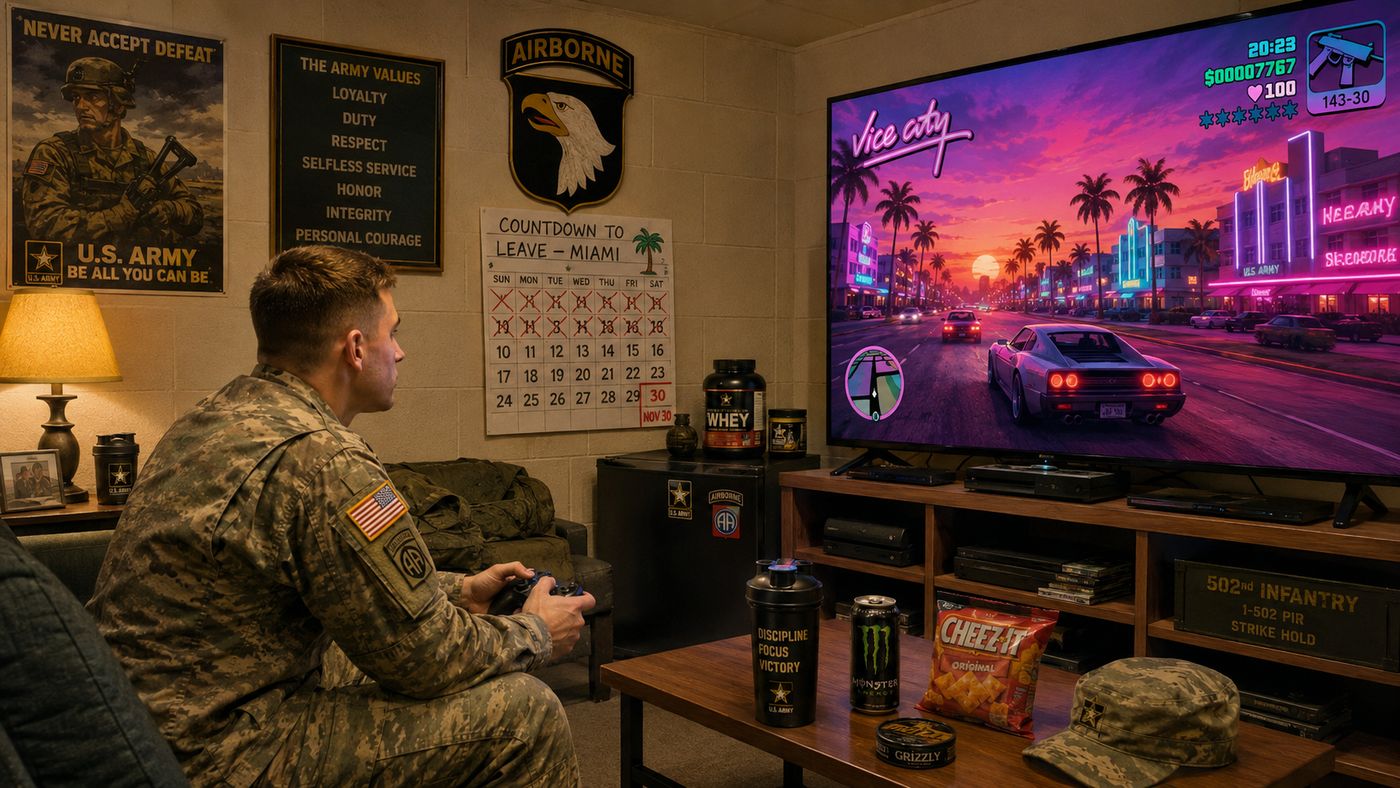
The irony that the Army is using a game franchise built around crime, mayhem, and elaborate police evasion as a reenlistment incentive has not been lost on anyone. Social media has offered the predictable range of takes: that it is genius, that it is absurd, that it is both, that the Army perhaps did not fully think through the branding implications of incentivizing soldiers with a game in which the entire premise is evading military and law enforcement. Lt. Col. Hodgson, who signed the memo, appears to be simply a battalion commander who wanted to give his soldiers something to look forward to and was creative enough to connect that ambition to the biggest pop culture event of the fall. "The command team, in conjunction with the career counselor, wanted to get soldiers excited to reenlist," said the 3rd Infantry Division spokesperson. Twenty of them are. November 19 is coming. The red jersey is hanging in the barracks. The Army, which has seen stranger things than this in its 251 years, is waiting.