The One He Hasn't Won
This morning in Monaco — where Tadej Pogačar happens to live — the 81st Vuelta a España begins with a 9.6-kilometer individual time trial through the streets of the principality. The race will spend the next 23 days crossing through southern France, Andorra, and the length of Spain before finishing in Granada on September 13. It is the third and final Grand Tour of the 2026 cycling season. It is the only one Pogačar has never won. He won the Tour de France in July for the fifth time, equalling the all-time record shared by Jacques Anquetil, Eddy Merckx, Bernard Hinault, and Miguel Indurain. He won the Giro d'Italia in 2024. The Vuelta — the race that launched him in 2019, the race where a 20-year-old nobody from Slovenia won three stages and finished third and introduced himself to the world — is the last piece. A victory in Granada would make him only the ninth man in history to win all three Grand Tours. He is 27 years old.
The Club of Nine — and How Difficult It Is to Join
The Grand Tour sweep — winning the Tour de France, the Giro d'Italia, and the Vuelta a España, in any order, across any span of a career — is the most demanding achievement in professional cycling. Eight men have done it. The first was Jacques Anquetil of France, who completed the set in 1963. Eddy Merckx of Belgium, who won everything he entered with a ferocity that remains unmatched in the sport's history, did it by 1973. Felice Gimondi of Italy in 1968. Bernard Hinault of France in 1978. Giovanni Battaglin of Italy in 1981. Alberto Contador of Spain — three times winner of each Grand Tour — completed the set in 2008. Vincenzo Nibali of Italy in 2014. And most recently, Jonas Vingegaard of Denmark, who won the Vuelta in 2025 and the Giro in 2026 to join the club — and who was supposed to be here defending his Vuelta title before a crash on Stage 15 of the Tour de France on July 19 broke his collarbone and ended his season. Vingegaard's absence removes the man most capable of challenging Pogačar from the field, making the Slovenian an overwhelming favorite — and raising the possibility that the 2026 Vuelta becomes a coronation rather than a contest. The field has other quality: four-time Vuelta champion Primož Roglič returns with Red Bull-BORA-hansgrohe; Wout van Aert brings his climbing form from a strong Tour de France; Oscar Onley of INEOS arrives as a genuine dark horse. But the race's architecture — 58,156 meters of climbing across 21 stages, seven summit finishes, a route designed around the kind of relentless mountain terrain where Pogačar has been functionally unbeatable for four years — does not flatter doubters.
The one genuine question mark over Pogačar is the one that cannot be settled until the race is over: recovery. He won a three-week Grand Tour in July. He is now starting another three-week Grand Tour in August. This has been done before — Merckx famously raced Grand Tours back to back in the early 1970s, winning both — but even at his level, physiology is physiology. The Vuelta's 58,000 meters of climbing is actually more vertical gain than the 2026 Tour de France, and the Spanish summer heat through which it will be raced adds a physiological dimension that the Tour's Alpine and Pyrenean stages do not. Pogačar's own last experience of the Vuelta — 2019, when he was a teenager discovering what his body could do — ended in third place, behind Primož Roglič and Alejandro Valverde. He was 20 years old. He is now 27, with five Tour de France titles, a Giro, a world championship, and an Olympic bronze medal accumulated in the years since. "The time is right to go back," he said when confirming his participation. "Spain is a country I love to visit and race in." Monaco's streets will echo this morning with the sound of time trial bikes. Pogačar's will be among them. The last piece of his collection is 3,300 kilometers away in Granada.
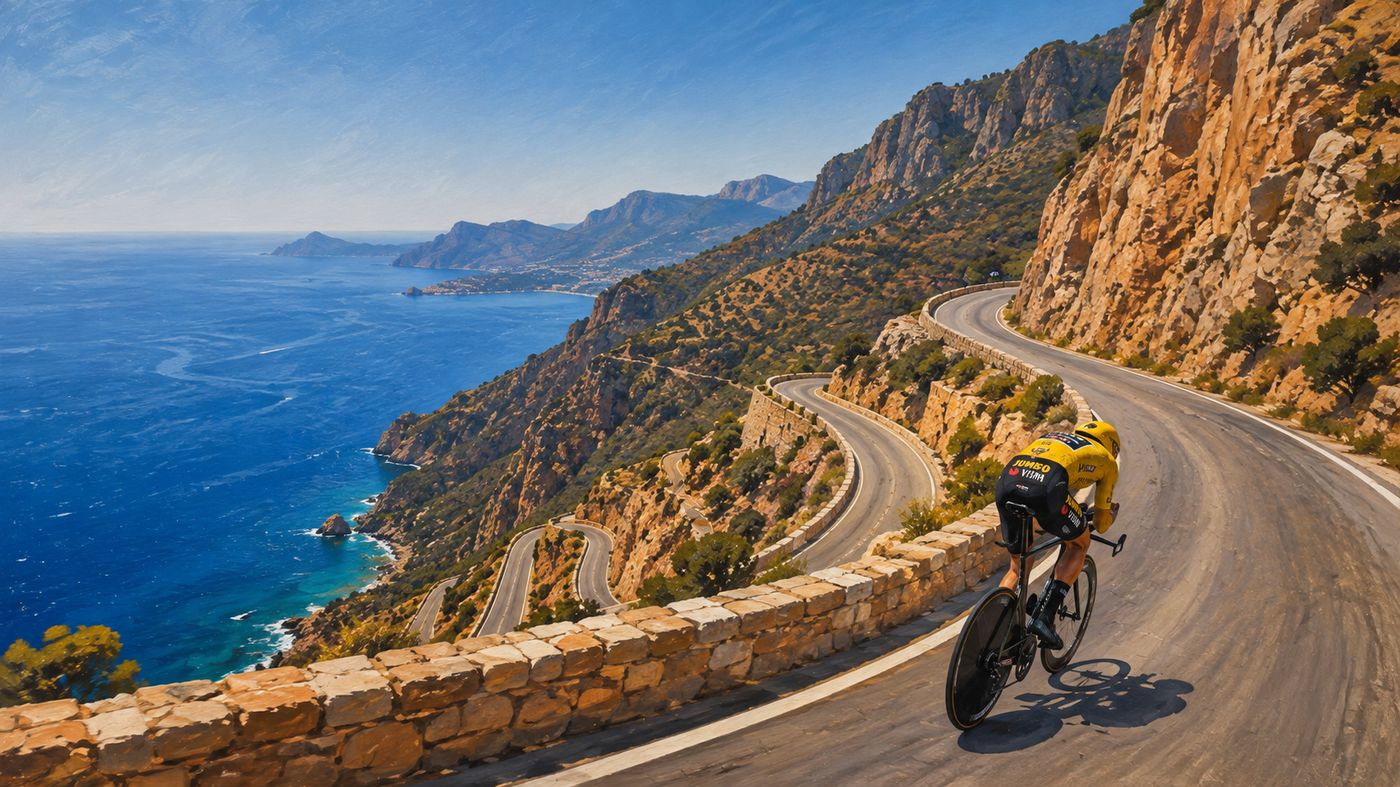
The Vuelta a España has its own rich history — founded in 1935, suspended during the Spanish Civil War and World War II, revived in 1941 and held every year since, it predates the Tour de France's current format and has produced some of the most dramatic finishes in Grand Tour history. Its identity as the third Grand Tour — often dismissed as the least prestigious of the three, the most chaotic, the most given to spectacle over strategy — is both its limitation and its charm. It has produced champions who won nowhere else (Félix Rodríguez, Jens Voigt), and champions who won everywhere (Merckx, Indurain). It finishes, this year, in Granada — beneath the Alhambra, in Andalusia, in the city that was the last stronghold of Moorish Spain and that contains, within its walls, one of the most beautiful buildings ever constructed by human hands. The race will end there on September 13. What matters, between Monaco today and Granada in three weeks, is whether the man who has won everything else can add the one thing he hasn't.