We Own It
Yesterday afternoon, President Trump posted a message on Truth Social that stopped newsrooms around the world. "The U.S.A. has total control over the Strait of Hormuz. I THINK WE WILL KEEP IT!" he wrote. "Our Naval Blockade is being called, by everyone, 'A WALL OF STEEL,' and there is nothing Iran can do about it." He described Iran as having no navy, no air force, unpaid soldiers, a decimated IRGC, and uncertain leadership. "All they have is FAKE NEWS and 300% INFLATION," he continued. "Iran is all talk and no action, the Bully of the Middle East No Longer." Then, deploying a phrase he has used previously in his most confrontational Iran communications, he concluded: "Praise be to Allah!" The post generated immediate global reaction — from bewilderment, to alarm, to careful diplomatic parsing — and raised a question that eight ships crossing a strait that once carried 130 per day does not easily resolve: what does it mean to have "total control" of a waterway that has now been effectively closed for 167 days, and what does it mean to "keep it"?
The Strait That Has No Owner — and Has Never Had One
Trump's claim of "total control" over the Strait of Hormuz is extraordinary for reasons that go beyond the immediate military and diplomatic context. The strait is an international waterway — one of the most critical on Earth, through which roughly 20 percent of the world's seaborne oil normally flows — and its legal status under international law has been a settled matter since the United Nations Convention on the Law of the Sea was adopted in 1982. Under UNCLOS, vessels of all nations have the right of transit passage through international straits, a right that cannot be suspended or revoked by any single nation, including the nations whose territory the strait borders. The United States has invoked this principle repeatedly over decades to contest Iranian attempts to restrict shipping. Secretary of State Marco Rubio stated explicitly earlier this year that "no country is allowed to charge tolls or fees on an international waterway — that's existing international law." Trump's claim yesterday that the U.S. "owns" the strait and intends to "keep it" has no legal basis under the framework the United States itself helped construct. Whether it has a practical military basis is a separate question — and here the picture is more complicated than the Truth Social post suggests. Eight ships transited the strait on Tuesday. That figure represents approximately six percent of the pre-war daily rate. Al Jazeera, citing Kpler shipping analytics data, reported the transit figure as the lowest in a week, down from a ten-day average of approximately twelve. Iran is not transiting the strait in force. Neither is anyone else. "Total control," in this context, describes a waterway that the United States has successfully prevented almost everyone — including itself — from using.
The phrase "Praise be to Allah" has generated significant international commentary, much of it missing its context. This is the third time Trump has used the phrase in communications related to the Iran war — he used it on Easter morning in April in a profanity-laced post threatening Iran's power plants and bridges, and again in June when announcing the initial naval blockade. The phrase is consistent with the mocking, taunting register of Trump's Iran communications throughout the conflict — aimed at Iranian leadership and its religious framing of the war, rather than being a sincere religious expression or a statement of any broader significance. International reactions that have treated it as the latter have misread the rhetorical register, though the reactions themselves — from governments across Asia, Europe, and the Gulf — are a real and significant development in their own right. Saudi Arabia and the UAE, whose oil exports depend on Hormuz passage, have privately communicated alarm at Trump's language about "keeping" the strait. China, which imports more Persian Gulf oil than any other nation, has called for "freedom of navigation to be restored" without directly addressing Trump's ownership claim. Iran's response was dismissive: "America's fantasy," said a statement from the Foreign Ministry. The gap between Trump's post and the diplomatic reality it describes will be measured in ships per day.
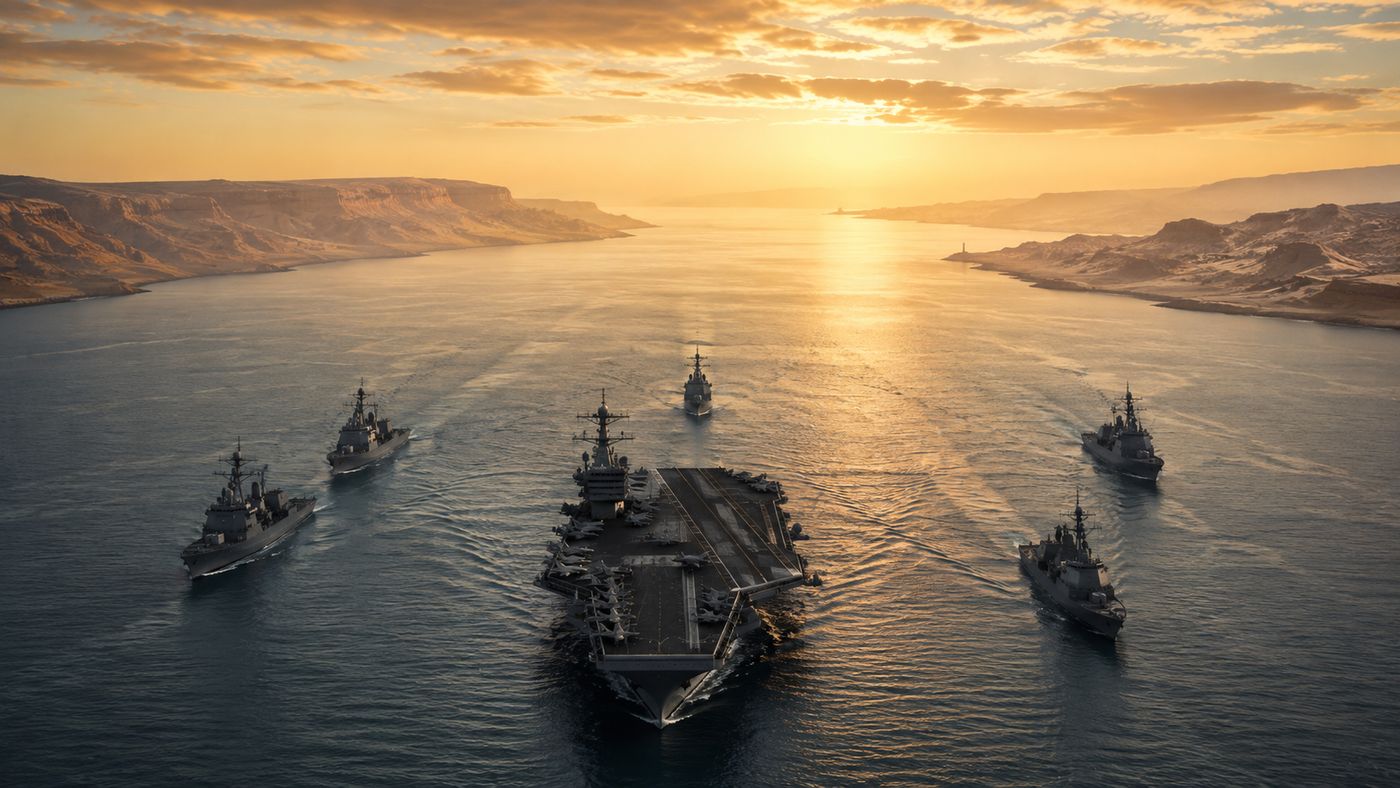
Trump also told reporters separately on Wednesday that "We own it. And at some point, maybe they'll do something, and then they get blown away. But we, right now, we're in a very good position." The statement is consistent with his overall posture since the July 14 reinstatement of the naval blockade — projecting military supremacy while acknowledging, implicitly, that the political and diplomatic questions remain open. What the U.S. military presence in the Gulf has achieved, unambiguously, is the elimination of Iran as a functional naval power: the IRGC's small-boat fleet, which was the primary mechanism for Iranian harassment of commercial shipping, has been severely degraded by months of American and Israeli strikes. What it has not achieved is a Strait of Hormuz open to commercial traffic — which was, at the beginning of this conflict, the stated objective. The oil is not flowing. The diplomatic negotiations have stalled. The 60-day MOU window has expired. And the president of the United States is posting "Praise be to Allah" on Truth Social. The most consequential waterway on Earth is being controlled, in the sense that almost no one is using it — by anyone, for any purpose. History will determine whether that is victory.