September 18: Scotland Votes, a Diplomat Dies, and a Pendulum Proves the Earth Moves
September 18 is a day for things that move — or don't, depending on the outcome. In 2014, 84.6 percent of eligible Scottish voters turned out for a referendum that asked whether Scotland should leave the United Kingdom — the highest voter participation in a British election in living memory — and answered no, by a margin that was decisive without being comfortable, and that settled the question for a period of time rather than permanently. In 1961, a plane carrying the United Nations Secretary-General crashed in the African night while he was en route to negotiate a ceasefire, killing everyone aboard in circumstances that have never been definitively explained and that remain, more than sixty years later, a subject of active investigation. And in 1819, in Paris, a boy was born who would grow up to hang a pendulum from the dome of the Panthéon and demonstrate, to anyone who chose to watch, that the Earth beneath it was rotating — making visible, through a swinging weight and a circle of sand, one of the fundamental facts of planetary existence. Three September eighteenths. Three kinds of evidence that things are not as fixed as they appear.
Should Scotland Be an Independent Country?
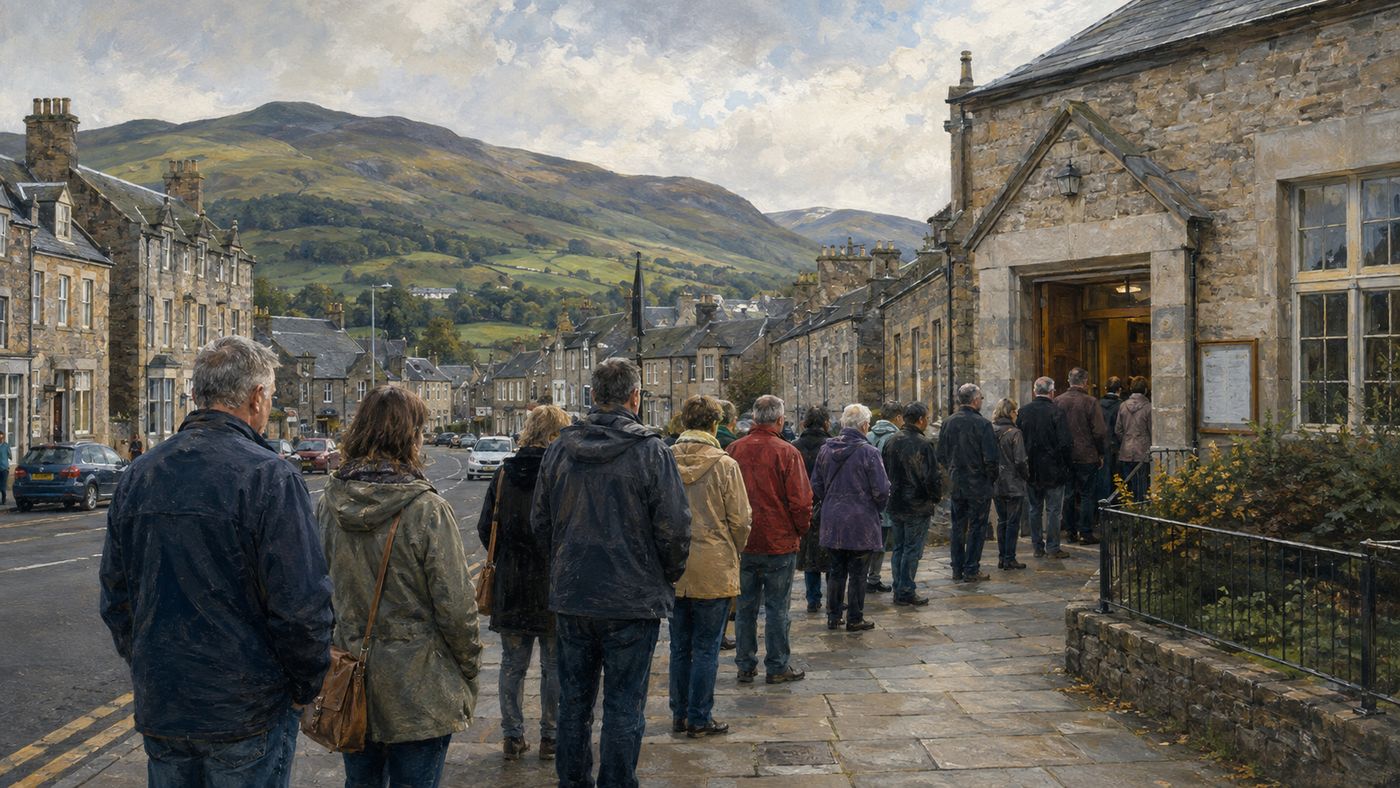
On September 18, 2014, Scotland held an independence referendum — the first in its history — asking the single question: "Should Scotland be an independent country?" The referendum had been agreed between the Scottish National Party government, which had won a majority in the Scottish Parliament in 2011, and the UK government of David Cameron, who had calculated that the yes side would lose and that a definitive vote would settle the independence question for a generation. Voter turnout was 84.6 percent — the highest in any UK election since the introduction of universal suffrage, reflecting both the scale of engagement the question had generated and the effectiveness of campaigns on both sides in mobilizing their supporters. The result was 55.3 percent no to 44.7 percent yes — a margin of approximately 383,000 votes out of more than 3.6 million cast. Scotland remained part of the United Kingdom.
The result of September 18, 2014, did not settle the question as permanently as the no campaign had suggested it would. In June 2016, the United Kingdom voted to leave the European Union — and Scotland voted to remain by 62 percent to 38 percent, a divergence from the rest of the UK that the SNP argued represented a material change in the circumstances that had been the basis of the 2014 vote. Demand for a second referendum has persisted in Scottish politics throughout the subsequent decade, complicated by the UK Supreme Court's ruling in 2023 that Scotland does not have the legal authority to hold a referendum without Westminster's consent. The political conversation that the September 18, 2014 vote was supposed to close remains open. The turnout it produced — that 84.6 percent — stands as evidence that when people believe a vote will actually decide something about their lives and their identity, they show up for it in numbers that routine elections rarely approach.
Ndola, 1961
On September 18, 1961, a Douglas DC-6B aircraft designated SE-BDY crashed near Ndola in Northern Rhodesia — now Zambia — killing all sixteen people aboard, including Dag Hammarskjöld, the second Secretary-General of the United Nations, who had been flying from Léopoldville (now Kinshasa) in the Congo to meet with Moise Tshombe, the leader of the secessionist Katanga province, in an attempt to negotiate a ceasefire during the Congo Crisis. Hammarskjöld had led the UN since 1953, had navigated the organization through the Suez Crisis of 1956, and had been deeply involved in the Congo Crisis since the Belgian Congo became independent in 1960 and the subsequent secession of Katanga plunged the country into civil war. The crash occurred in the middle of the night; the wreckage was not found until the following morning. The cause of the crash has never been definitively determined.
The death of Hammarskjöld on September 18, 1961, produced both immediate mourning and a mystery that has deepened rather than resolved over the following decades. Hammarskjöld was awarded the Nobel Peace Prize posthumously in 1961. Initial investigations by Rhodesian and UN authorities were inconclusive. Over subsequent decades, evidence has accumulated suggesting that the crash may not have been accidental: declassified documents, witness testimony, and communications intercepts have pointed toward the possibility that the aircraft was shot down or attacked — by Belgian mercenaries, by American or British intelligence agencies hostile to Hammarskjöld's sympathies for African decolonization, or by other actors. A UN panel of inquiry established in 2015 concluded that a "substantial" basis existed for believing that the aircraft was shot down or subjected to some form of external attack. A further inquiry in 2019 reached similar conclusions. No definitive determination has been made, no one has been charged, and the full truth of what happened near Ndola on September 18, 1961, has not been established. Hammarskjöld's diaries, published posthumously as Markings, revealed an interior life of remarkable spiritual depth — the private counterpart to the public career of a man who died trying to make peace in a place where several powerful interests did not want it.
The Pendulum
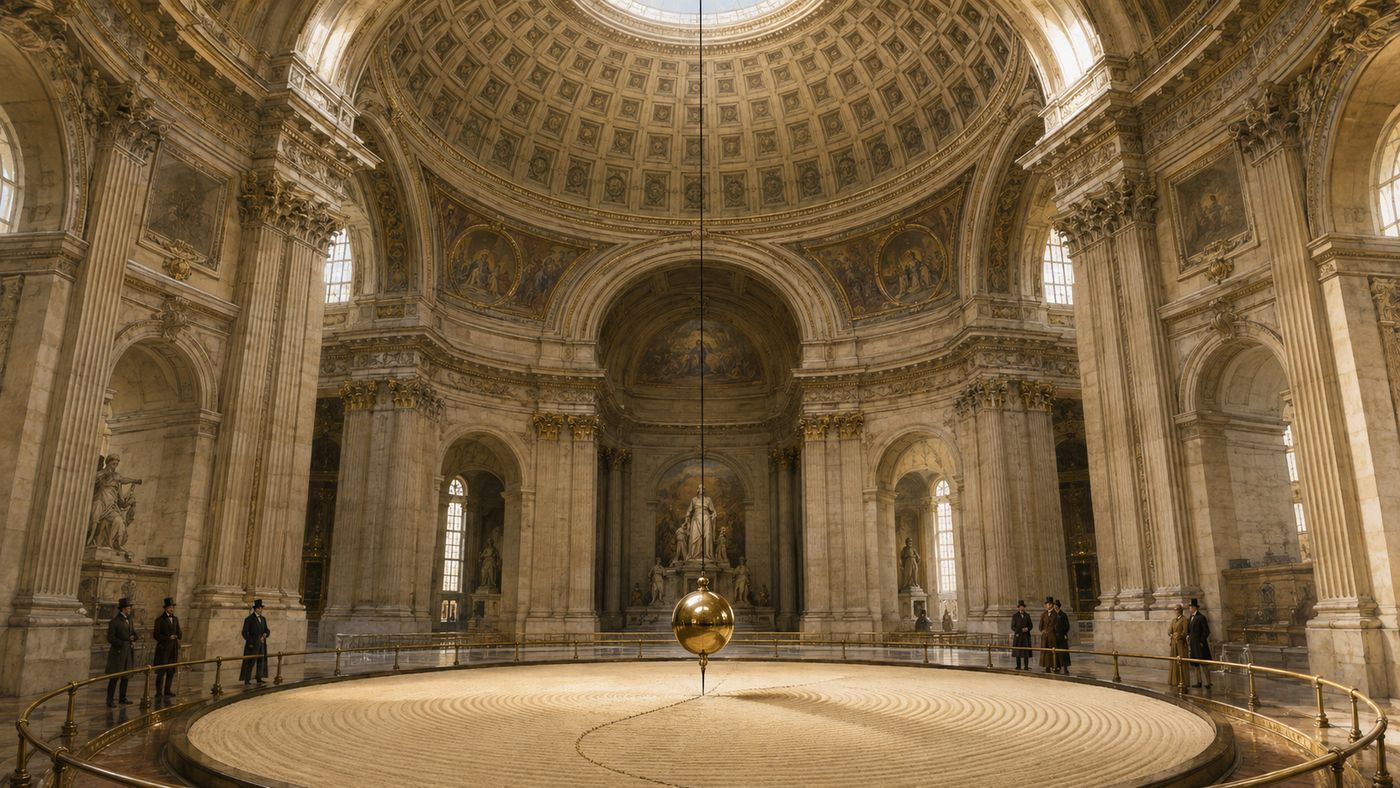
On September 18, 1819, Jean-Bernard-Léon Foucault was born in Paris — a physically frail child who would grow into a scientist of extraordinary experimental ingenuity, largely self-taught in the mathematical physics of the era, who found his calling in devising demonstrations so elegant that they made abstract truths directly visible. Foucault's most famous achievement came in 1851, when he suspended an iron ball weighing about 28 kilograms on a 67-meter wire from the dome of the Panthéon in Paris, set it swinging, and placed a layer of sand in a circle beneath it. As the pendulum swung back and forth, its plane of oscillation slowly rotated — relative to the floor beneath it — tracing a pattern in the sand that revealed the Earth rotating beneath the pendulum's steady swing. The demonstration was the first direct, visible, experimental proof of the Earth's rotation — something that had been accepted as fact in scientific circles since Copernicus and Galileo but that had never before been demonstrated in a form a non-scientist could simply stand and watch.
The man born in Paris on September 18, 1819, made several other significant contributions to nineteenth-century physics. He measured the speed of light in air with remarkable accuracy using a rotating mirror apparatus in 1850. He invented the gyroscope in 1852 and demonstrated that its axis of rotation would maintain its orientation in space while the Earth rotated around it — another elegant proof of the same phenomenon his pendulum had demonstrated the year before. He discovered the eddy currents named for him (Foucault currents) in conducting materials exposed to changing magnetic fields, a discovery with significant practical applications in electromagnetic engineering. He died in 1868 of multiple sclerosis, at the age of forty-eight. Foucault pendulums now swing in science museums and public spaces around the world — including the Smithsonian Institution in Washington and the United Nations headquarters in New York — each one demonstrating, to anyone who chooses to watch, that the ground beneath their feet is moving. The physicist born on September 18, 1819, made that visible. It remains one of the most quietly spectacular demonstrations in the history of science.