October 16: The Dream Factory, the Queen's End, the Fifth Power
Power takes many forms. It can be built with $500 in startup capital in a back office in Los Angeles by two brothers who believed that cartoons could be more than novelties. It can be dismantled on a scaffold in a Paris square by a revolution that had decided a queen was an obstacle to the future it was building. And it can be announced in a flash of light over a remote desert test site, the kind of announcement that changes every calculation every other nation on earth has to make. October 16 has seen all three — the birth of an empire, the death of a monarchy, and the arrival of a new nuclear power. Three very different expressions of what it means to change the world.
The Brothers Disney
On October 16, 1923, Walt Disney and his older brother Roy signed the papers that officially established the Disney Brothers Cartoon Studio in a small rented office behind a real estate company on Kingswell Avenue in Los Angeles. Walt was twenty-one years old. Roy was twenty-seven. Their startup capital was $500 — Roy's savings, supplemented by a small loan from their uncle — and their assets consisted of a used camera, some basic animation equipment, and Walt's conviction that there was a market for animated short films with characters audiences could actually care about. The studio's first contract, to produce a series of films featuring a character called Alice in a cartoon world, had already been signed. What they were building, in that borrowed office, was everything else.
The company that grew from that $500 investment became, over the century that followed, the most recognizable entertainment brand in the history of human commerce. Mickey Mouse arrived in 1928. Snow White and the Seven Dwarfs — the first feature-length animated film — arrived in 1937, financed on a budget that Hollywood called "Disney's Folly" and that became the highest-grossing film of its time. Disneyland opened in 1955. The acquisitions of Pixar, Marvel, Lucasfilm, and 21st Century Fox transformed the company into a media conglomerate of almost incomprehensible scale. None of it would have existed without Roy, whose financial discipline rescued the company from collapse more than once and whose insistence on sound business practice gave Walt's visions the infrastructure they needed to survive contact with reality. Walt got the fame. Roy made it possible. The studio they founded together on October 16, 1923 belongs to both of them.

Place de la Révolution
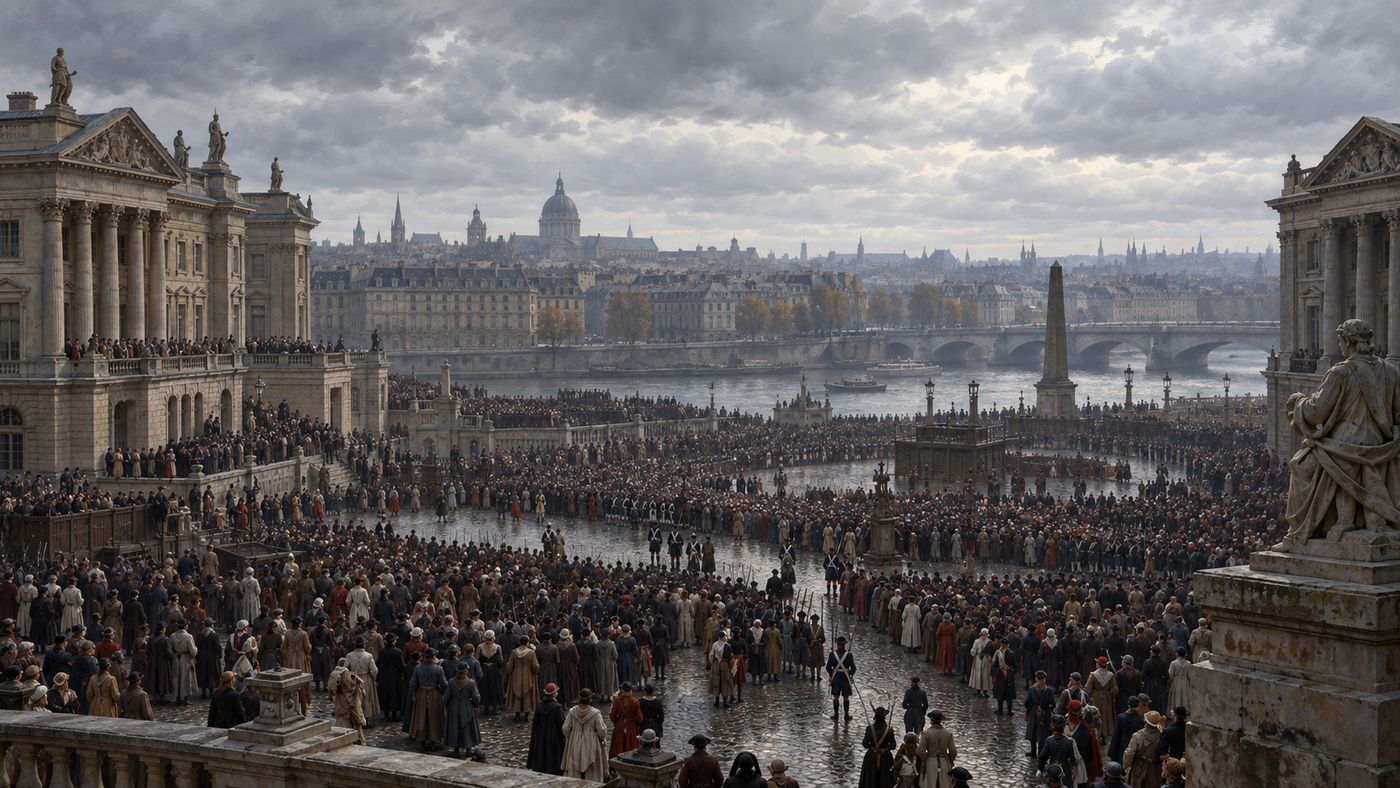
On October 16, 1793, Marie Antoinette was taken from her cell in the Conciergerie prison, her hair shorn, her hands bound behind her back, and transported by cart through the streets of Paris to the Place de la Révolution, where the guillotine awaited. She was thirty-seven years old. The Austrian-born princess who had arrived in France at fourteen as the bride of the future Louis XVI had spent more than two decades as one of the most scrutinized and caricatured women in Europe — celebrated on her arrival, resented for her extravagance during a period of French poverty, and ultimately transformed by revolutionary pamphlets and popular fury into a symbol of everything the old regime had gotten wrong. Her husband had been executed ten months earlier. Her children had been taken from her. She had spent the last seventy-six days of her life in a cell, subjected to a show trial that lasted two days.
Witnesses to her execution noted that she faced the scaffold with composure — that she apologized to her executioner when she accidentally stepped on his foot, saying "Pardon me, sir, I did not do it on purpose." Whether the story is historically precise or retrospectively embellished, it has endured as the detail by which her final moments are most often remembered: a queen, at the end of everything, offering a small courtesy. Marie Antoinette has been argued over ever since — as a victim of circumstance, as a symbol of aristocratic indifference, as a woman whose real complexity was buried beneath the mythology that both her supporters and her enemies required. What is not disputed is that her death on October 16, 1793, completed a revolution that had announced, to monarchies across Europe, that the old arrangements were no longer safe.
596
On October 16, 1964, China detonated its first nuclear weapon at the Lop Nur test site in the Xinjiang desert, a 22-kiloton explosion that announced to the world that the global nuclear order had acquired a fifth member. The test — codenamed "596" in reference to June 1959, when the Soviet Union had withdrawn the technical assistance it had been providing to China's nuclear program — represented the culmination of five years of entirely independent scientific and engineering effort. China's nuclear scientists had been developing the bomb without Soviet blueprints or components, under conditions of considerable material scarcity and in the shadow of the Great Leap Forward's economic catastrophe. That they succeeded was a demonstration of scientific capability that the United States, the Soviet Union, and China's neighbors received with varying degrees of alarm.
China's entry into the nuclear club fundamentally complicated the Cold War's already complex geometry. It meant that the bilateral nuclear standoff between Washington and Moscow now had a third major player whose relationships with both superpowers were deeply adversarial. The Sino-Soviet split that had led to the Soviet withdrawal of technical assistance had created a situation in which China was simultaneously estranged from both blocs — neither aligned with the West nor reliably cooperative with the Soviet Union. The detonation at Lop Nur accelerated India's own nuclear calculations, which would eventually produce its own test in 1974. It reshaped the strategic environment across Asia in ways that are still unfolding. The explosion in the Xinjiang desert on October 16, 1964, was not the end of anything. It was the beginning of a very different kind of world.