The Contract That Wrote the Rules for AI
On Thursday, June 5, 2026, SAG-AFTRA — the union representing some 160,000 film and television actors — announced that its members had ratified a new four-year contract with the Alliance of Motion Picture and Television Producers, which negotiates on behalf of Hollywood's major studios and streaming services. The vote was not close: 91.42 percent in favor. The deal covers compensation, pension plans, residuals, and the usual terrain of labor agreements — but the provision that will be studied by labor historians, AI researchers, and workers in industries far beyond Hollywood is the one about synthetic performers. Under the new contract, producers who wish to use an AI-generated actor must demonstrate that the synthetic performer brings "significant additional value" over a live human actor or that actor's own digital capture. Producers are prohibited from using a digital replica of any performer to replace them during a strike. They must have "an articulable business reason" to scan someone for a digital replica in the first place. Additional protections cover digital replicas of minors specifically. The studios agreed to all of it. SAG-AFTRA President Sean Astin called it "a contract that delivers meaningful gains in compensation, strengthens protections around artificial intelligence and digital identity, and recognizes the realities of how performers work today." Three years after the most disruptive Hollywood strike in a generation, the actors and the studios have agreed — for now — on what the rules are.
From the Studio System to the Strike — How Hollywood Labor Got Here
The Screen Actors Guild was founded in 1933, in the depths of the Great Depression, by a group of actors who had no leverage against the major studios that controlled every aspect of their professional lives under the old studio system. Under that system, studios owned actors on long-term contracts, controlled what films they appeared in, managed their public images, and could loan them out to other studios like equipment. The founding of SAG gave actors for the first time a collective bargaining unit — a body that could negotiate minimums, working hours, and residuals on their behalf. The first SAG strike came in 1960, when Ronald Reagan, then SAG president, led actors out on a 43-day walkout that won the union its first residuals from television rebroadcasts of theatrical films — the foundational principle that actors deserved ongoing compensation when their work continued to generate revenue after its initial release. That principle, extended and reapplied, became the template for every subsequent labor negotiation in Hollywood, including the 2023 strikes that made the current contract necessary.
The 2023 strikes — in which both SAG-AFTRA and the Writers Guild of America walked out against the studios and streamers simultaneously for the first time since 1960 — were the longest and most economically damaging Hollywood labor action in modern history. SAG-AFTRA's strike lasted 118 days; the combined impact on the California economy was estimated at $6 billion. The central issue was not wages but existential: actors and writers feared that studios were moving toward using artificial intelligence to generate scripts, replicate performances, and ultimately reduce their dependence on human creative labor entirely. The 2023 contract that ended the strikes included the first AI protections ever negotiated into a Hollywood labor agreement. The 2026 contract, ratified yesterday, builds on those protections and extends them — and does so in a four-year deal rather than the typical three-year term, a length that studios pushed for specifically because they want labor peace while they navigate the AI transition. The union leveraged that desire for stability into stronger protections than a shorter deal might have produced. Duncan Crabtree-Ireland, SAG-AFTRA's chief negotiator, called it "a contract that is in the vanguard of what any industry wants to achieve" on AI. He is not wrong. No major industry has negotiated AI protections at this scale and specificity into a labor agreement before. Hollywood has been forced, by the nature of its product and its workforce, to confront what most industries are still arguing about — and to write the rules down.
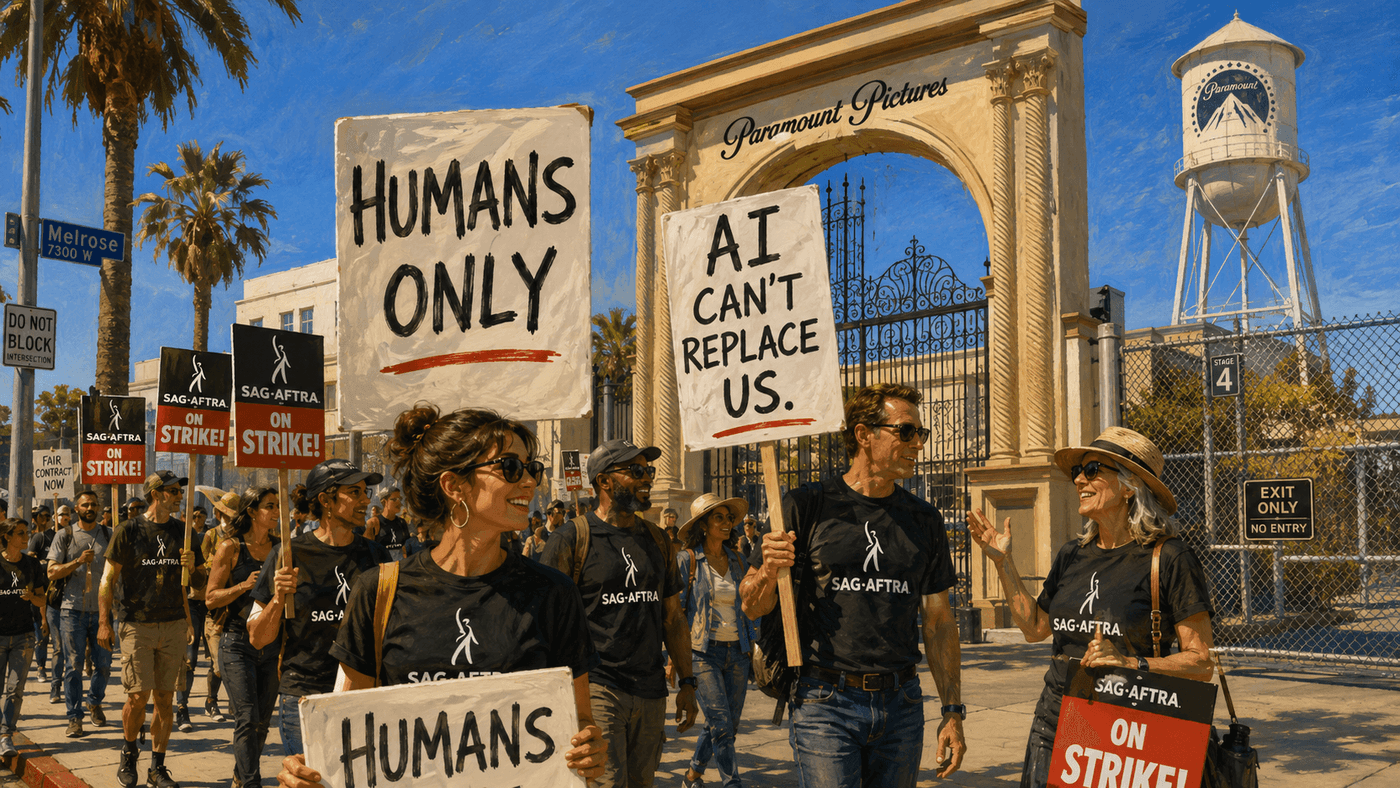
The history of American labor law is a history of industries that resisted acknowledging new technology's impact on workers until workers organized to force the acknowledgment. The railroads fought unionization for decades before the Railroad Labor Act of 1926 created a framework for collective bargaining that kept the industry from collapsing into permanent industrial warfare. The autoworkers' strikes of the 1930s produced the UAW and the framework of labor relations that governed American manufacturing for the rest of the century. In each case, the specific provisions negotiated in a specific contract — the right to a closed shop, the grievance procedure, the seniority system — became the model that other industries then adapted to their own circumstances. The SAG-AFTRA AI provisions ratified yesterday — "significant additional value," "articulable business reason," no digital replicas during strikes — are specific to Hollywood, written for a specific industry at a specific moment. But AI is not specific to Hollywood. It is coming for writers, for graphic designers, for legal researchers, for radiologists, for anyone whose work can be observed, digitized, and replicated. The rules being written in Hollywood this week are the first draft of something much larger. History will be watching how they hold.