When Midtown Held Its Breath
At 7:57 a.m. yesterday morning, the FDNY received a call reporting bricks falling from a building at 235 East 42nd Street in Midtown Manhattan. When first responders arrived, they found something far more alarming: two load-bearing columns on the 21st floor of a 37-story skyscraper had buckled, the floors above were sagging between the 21st and 26th stories, and monitoring equipment was detecting continuous movement inside the compromised structure. What followed was one of the most dramatic urban building emergencies in New York City in recent memory — a multi-block frozen zone stretching from 40th to 45th Street and between Second and Third Avenues, seven surrounding buildings evacuated, more than 150 firefighters and 50 emergency units deployed, and hotel guests hauling suitcases through the streets as the city held its breath. By late Tuesday night, after emergency shoring was installed and new steel supports put in place, buildings commissioner Ahmed Tigani told reporters: "The building is stable. It has not moved since we started monitoring." No injuries were reported.
Pfizer's Old Headquarters, and the Weight It Couldn't Bear
The building at the center of yesterday's crisis is not just any Midtown tower. From 1960 until 2018, 235 East 42nd Street served as the global headquarters of Pfizer — the pharmaceutical company that would later develop one of the world's first COVID-19 vaccines in partnership with BioNTech. When Pfizer relocated to Hudson Yards, developer MetroLoft acquired the 1970s-era office building and embarked on one of the largest office-to-apartment conversion projects in New York City history, transforming the upper floors of the 37-story tower into luxury residential units. The conversion is what appears to have caused yesterday's crisis. MetroLoft's managing principal, Nathan Berman, told the Wall Street Journal that the building's upper 15 floors — from the 22nd floor upward — were being renovated to expand outward, making them wider than the floors directly below. "This additional load that we put on those floors caused those two particular columns to collapse," Berman said, adding that the columns may not have been properly reinforced to bear the added weight. The building had already been the subject of multiple safety complaints, including allegations of falling debris and an on-site worker injury serious enough to generate a lawsuit.
New York City's skyline is, in one sense, a perpetual construction project — always reaching higher, always converting, always transforming one kind of building into another as the city's needs evolve. The office-to-residential conversion boom accelerated dramatically in the post-pandemic years, as emptied commercial towers across Lower Manhattan and Midtown became candidates for reinvention. The engineering challenges that come with those conversions are formidable: floors built for the distributed weight of office furniture, filing cabinets, and thousands of workers must be adapted to bear the different and in some ways more concentrated loads of residential living. When those adaptations go wrong — as they appear to have gone wrong yesterday at 235 East 42nd — the consequences can be extraordinarily serious in one of the most densely occupied urban environments on Earth. A full collapse onto 42nd Street was deemed unlikely by fire officials, who cited the building's steel-frame construction. An internal partial collapse was the genuine fear. It didn't happen. The emergency shoring held.
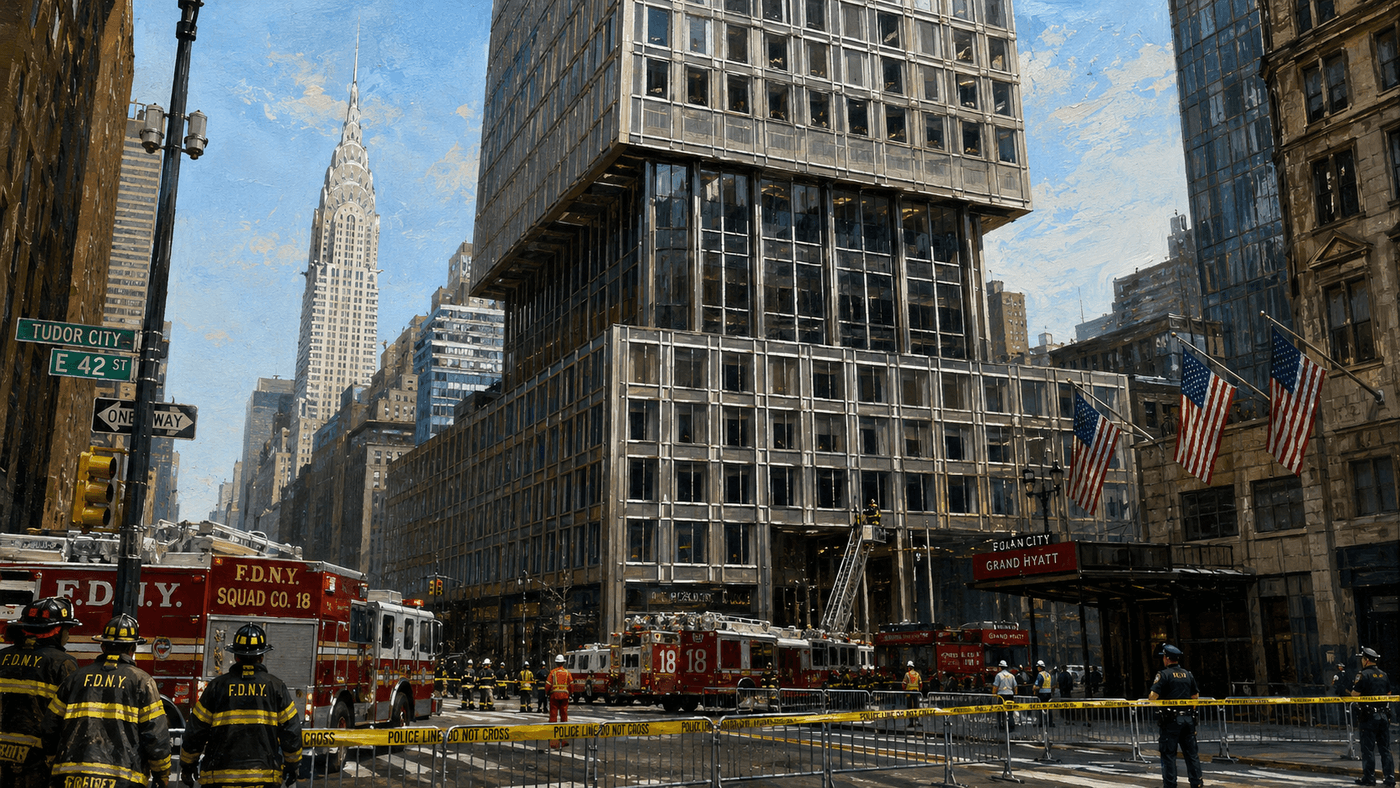
This morning, with stabilization work continuing and some evacuation orders lifted, the immediate crisis appears to have passed. Four buildings in the surrounding area remain under evacuation orders, and structural engineers are conducting a forensic investigation into the cause and extent of the damage. The larger questions — about oversight of complex conversion projects, about the adequacy of pre-construction reinforcement reviews, about what the city's Department of Buildings knew about the multiple prior complaints at this site — will take considerably longer to answer. New York has built, demolished, and rebuilt itself continuously for four centuries. Yesterday's emergency on 42nd Street is, in that long view, one more chapter in the ongoing story of a city that never stops changing — and occasionally has to stop, hold its breath, and make sure the ground beneath it will hold.