The Dream Ends in Seattle
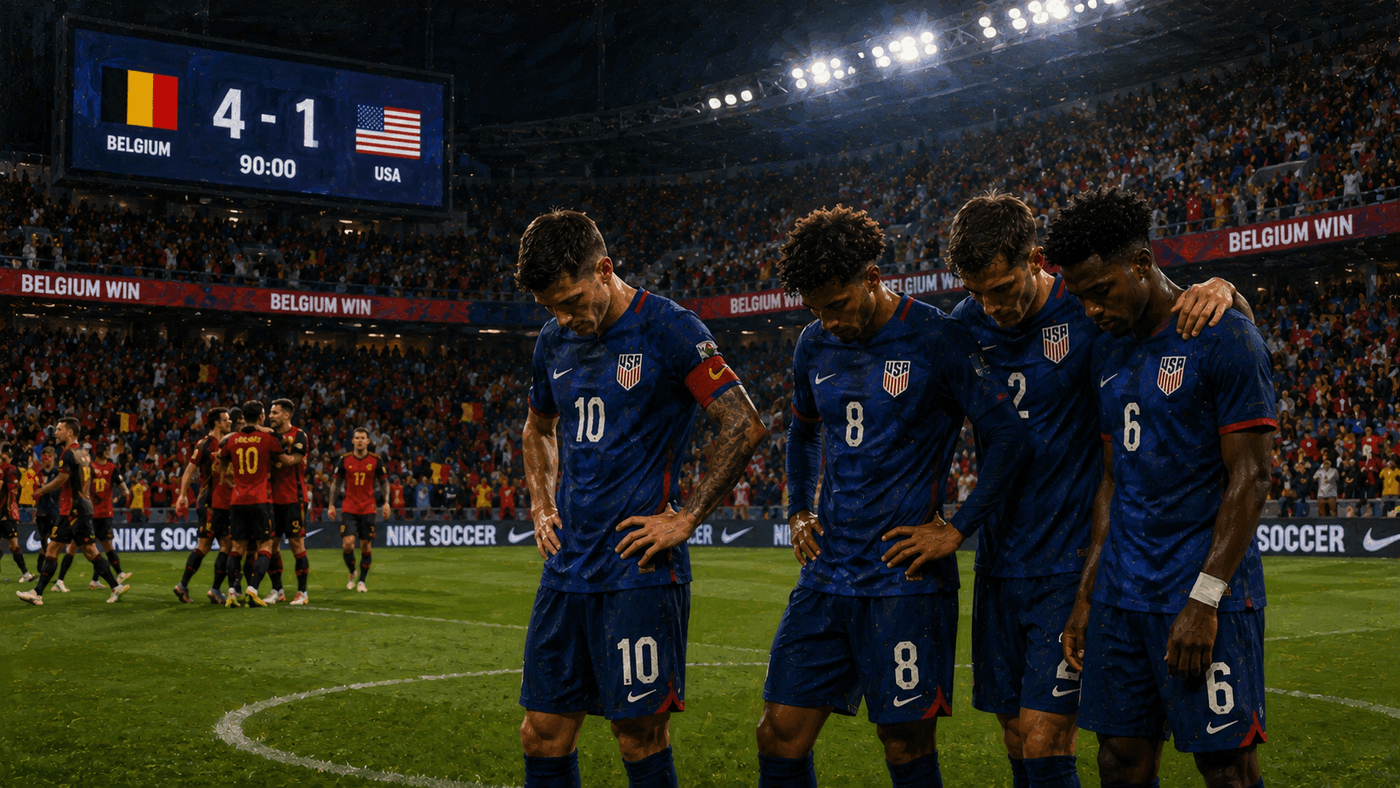
In the 57th minute at Lumen Field on Monday night, U.S. goalkeeper Matt Freese received a routine back pass, took a touch, and lost the ball to Charles De Ketelaere. Hans Vanaken ran onto De Ketelaere's cutback and slid it into an empty net. USA 1, Belgium 3. The stadium fell quiet. The home World Cup dream that had been building since the opening ceremony in Mexico City, through the improbable comeback win over Bosnia, through the Balogun controversy that dominated the days before this match — it was over. Belgium won 4-1, thoroughly, with an xG of 2.15 to the American team's 0.67. It was not a fluke. It was not bad luck. Mauricio Pochettino, speaking after the match, said he was disappointed by the "politics and manipulation" that had overshadowed the tournament exit. The result on the scoreboard needed no such context. Belgium was simply better.
What This Generation Gave American Soccer — and What It Couldn't
The match unraveled quickly. Charles De Ketelaere opened the scoring in the 9th minute, latching onto a Nicolas Raskin cross inside the six-yard box after the American defense was caught flat. Malik Tillman equalized brilliantly with another trademark free kick in the 31st — a deflection off Vanaken's head that wrong-footed Thibaut Courtois and gave the home side a moment of genuine belief. Two minutes later, De Ketelaere headed home Leandro Trossard's cross at the far post to restore Belgium's lead. The Freese error in the 57th made it 3-1. Romelu Lukaku, 31 years old and introduced as a substitute in the 67th minute, lashed in the fourth in stoppage time — clinical, unhurried, the final punctuation on an American night to forget. Balogun, the center of so much pre-match conversation, finished without scoring. Christian Pulisic hobbled through the second half after a knock in the 52nd minute. The team that had been praised for its composure in the Bosnia win looked a half-step slow to everything Belgium threw at it.
The honest assessment is complicated. This generation of American players — Pulisic, McKennie, Adams, Balogun, Tillman — arrived at this World Cup as the most technically accomplished USMNT in history, every one of them playing week in and week out in Europe's top leagues. They won a World Cup knockout match for only the second time ever. They showed, in moments, the quality their supporters had long insisted was there. And they ran into a Belgium side that was simply a level above them, exposed the defensive fragility and goalkeeping inconsistency that have plagued the program for years, and lost convincingly. The question of whether this generation delivered on its promise has no clean answer. The promise was enormous. The delivery was partial. That is, perhaps, exactly where American soccer is: better than it was, not yet where it wants to be, heading into a 2028 Olympics on home soil and a rebuilding window that begins now.
The quarterfinals that remain are extraordinary. Norway — Erling Haaland scoring twice to eliminate Brazil 2-1 in the Round of 16 — face Argentina. England face Morocco. Belgium face Spain. Colombia face Switzerland. For the first time in World Cup history, neither Germany, Brazil, nor Italy are in the quarterfinals — the three nations that between them have won eleven of the twenty-two tournaments ever held. The bracket has never been this open. Messi, 39 years old, leads Argentina toward what would be a storybook back-to-back title. Haaland, 25, has announced himself as the tournament's breakout star. The final is five matches away. American soccer, which helped build the stage, watches the rest of the show from home. That is not a failure. It is a progress report — and the next chapter has already begun.