
July 29: A New Agency, a Dark Ascent, and a Malibu Wedding
July 29 holds three stories about the power of institutional beginnings. In 1958, a president signed a law creating an agency that would put human beings on the moon eleven years later and has been extending humanity's reach into the cosmos ever since. In 1921, a veteran of the First World War with a talent for oratory and a genius for exploiting political chaos seized control of a minor German extremist party and began a transformation that would end in catastrophe on a scale the world had never seen. And in 2000, two of the most famous people on earth got married in Malibu in a ceremony that the tabloid press covered as though it were a state event — and that was over within five years. Three July twenty-ninths. Three institutions, each beginning on the same date, each heading in an entirely different direction.
We Choose to Go
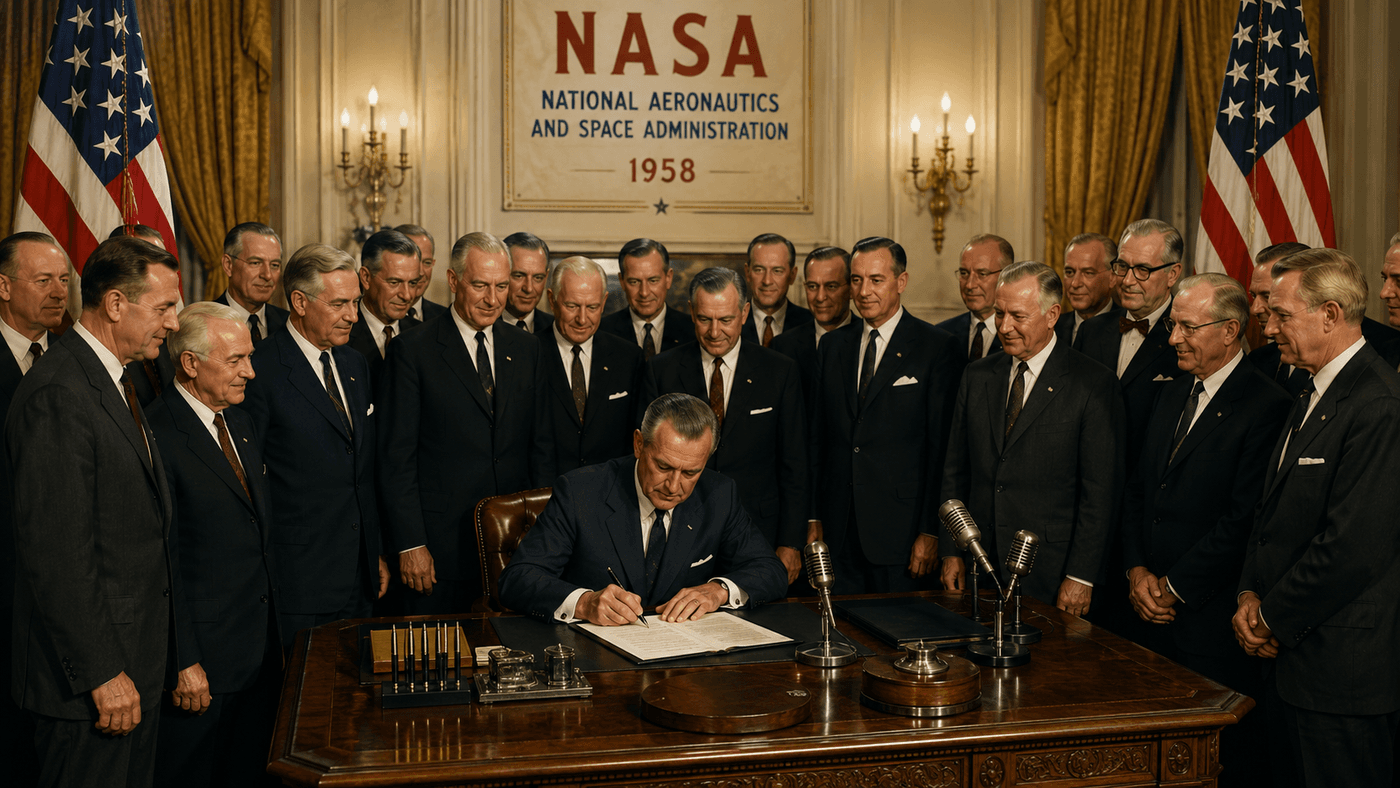
On July 29, 1958, President Dwight D. Eisenhower signed the National Aeronautics and Space Act into law, creating the National Aeronautics and Space Administration and formally committing the United States to the civilian exploration of space. The legislation came less than a year after the Soviet Union had launched Sputnik — the world's first artificial satellite — in October 1957, an event that had genuinely shocked the American political establishment and public, demonstrating that the Soviets had achieved a capability the United States had not yet matched. The Space Act was part of a broader American response that also included the creation of DARPA and a major expansion of federal science and mathematics education funding. The new agency absorbed the existing National Advisory Committee for Aeronautics and its facilities, along with personnel and projects from other federal departments, and was given a mandate to pursue space exploration for peaceful purposes while the military retained its own separate space programs.
NASA opened its doors formally on October 1, 1958, with about 8,000 employees inherited from its predecessor organizations. What it built from that foundation over the following decade is one of the great stories in the history of human ambition: Mercury, Gemini, Apollo — a sequence of programs that put the first American in space, developed the techniques of orbital rendezvous and spacewalking, and culminated in the lunar landing of July 20, 1969, just eleven years after the agency Eisenhower created had opened its doors. In the decades since, NASA has launched the Hubble Space Telescope, landed rovers on Mars, sent spacecraft beyond the edges of the solar system, and built and operated the International Space Station. The act signed on July 29, 1958, has proven to be one of the most consequential pieces of legislation in American scientific history — the founding document of an agency that extended human presence to other worlds and human knowledge to the edges of the observable universe.
Munich, 1921
On July 29, 1921, Adolf Hitler consolidated his control of the National Socialist German Workers' Party — the Nazi Party — at a meeting in Munich, assuming the position of chairman with essentially dictatorial authority over the organization. Hitler had joined the party in 1919, when it was a tiny fringe group with fewer than sixty members, and had quickly made himself indispensable through his extraordinary gifts as a public speaker and his talent for organizing mass meetings that drew crowds far beyond what the party's actual membership would suggest. By the summer of 1921, he had amassed enough internal support to force a crisis: threatening to resign unless the party's existing leadership structure was abolished and he was granted full, unchecked authority as chairman. The threat worked. On July 29, the membership voted to give Hitler the powers he demanded. He was thirty-two years old.
The party that Hitler took over on July 29, 1921, was still a marginal organization with no serious prospect of national power — an assessment that most of the German political establishment shared for the next decade, to catastrophic effect. The economic devastation of hyperinflation, the resentments of the Versailles Treaty, the structural weaknesses of the Weimar Republic, and the catastrophic global depression of the 1930s provided the conditions in which Hitler's movement grew from a Munich-based fringe party to the governing force of Germany within twelve years of the July 1921 meeting. The regime Hitler established after becoming Chancellor in 1933 and assuming absolute power in 1934 was responsible for the systematic murder of six million Jews and millions of others in the Holocaust, the deaths of an estimated 70 to 85 million people in the Second World War it started, and a transformation of the European political order whose consequences shaped the rest of the twentieth century. The meeting in Munich on July 29, 1921, at which a failed artist from Austria seized control of a small extremist party, is among the most consequential organizational moments in modern history — the day a catastrophe found its vehicle.

A Million-Dollar Sunset
On July 29, 2000, Brad Pitt and Jennifer Aniston were married at a private estate overlooking the Pacific Ocean in Malibu, California, in a ceremony that reportedly cost $1 million and was attended by roughly 200 guests drawn from the highest tiers of Hollywood celebrity. The couple had met in 1998 through their agents, dated for two years, and become, in the estimation of the entertainment press and its vast readership, something close to the platonic ideal of an American celebrity couple — he the brooding, physically extraordinary movie star, she the enormously popular television actress riding the peak of Friends' global dominance. The wedding was kept as private as any event of its kind could be, but the photographs and details that inevitably emerged were consumed worldwide with an appetite that spoke to the particular cultural function the celebrity couple had come to serve: a projection screen for aspirational fantasy, a shared point of attention in a fragmenting media landscape.
The marriage lasted four and a half years. In January 2005, the couple announced their separation, citing the now-famous explanation that they had "lovingly determined to formally separate." What followed was one of the most sustained tabloid narratives of the decade: the emergence of Pitt's relationship with Angelina Jolie, whom he had met on the set of Mr. and Mrs. Smith; the elaborate choreography of public sympathy and condemnation that the press assigned to the various parties; and years of continued celebrity media attention that the principals themselves had varying success at managing. The wedding on July 29, 2000, is remembered less as an event in the lives of two private people than as a moment in the cultural history of celebrity itself — a peak of early-millennium fascination with the lives of the famous that the subsequent decade would slowly, and not entirely, deflate.