July 23: A City Erupts, a General Finishes His Work, and a Crown Is Surrendered
July 23 is a day for reckonings that arrived long overdue. In 1967, a police raid on an unlicensed bar in Detroit's Black community ignited five days of violence that left 43 people dead and hundreds of buildings in ruins — the explosion of anger that had been building for years beneath the surface of a city that called itself prosperous while denying its Black residents the full benefits of that prosperity. Eighteen years later, the first African American woman to be crowned Miss America stood before reporters and surrendered a title she had fought to win, forced out by the publication of photographs taken before anyone thought her name would matter. And in 1885, a man who had saved the Union and then lost everything in a financial swindle sat in a mountain cottage in upstate New York, racing against throat cancer to finish the memoirs that would secure his family's future, and died four days after completing the final page. Three July twenty-thirds. Three lives and one city, each carrying more weight than any single day could comfortably hold.
12th Street
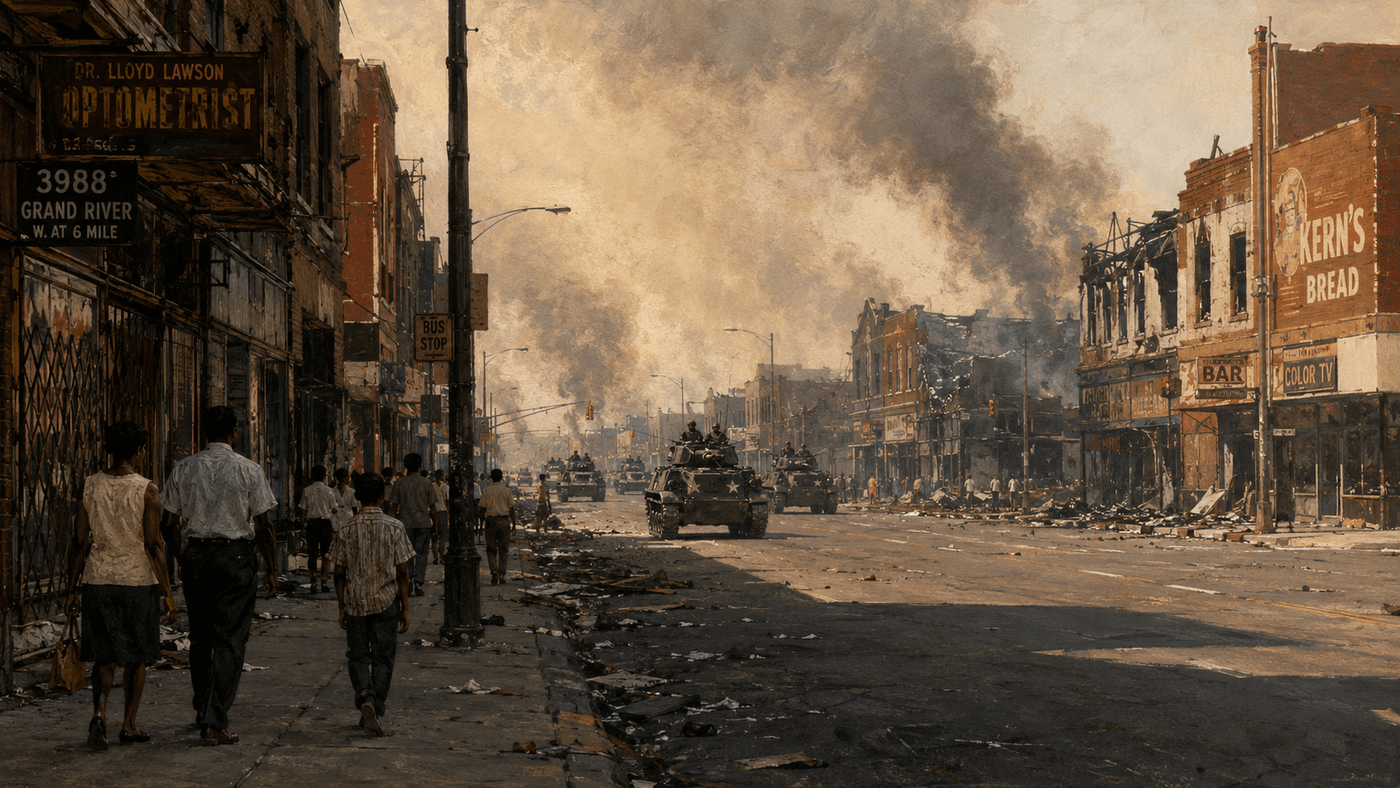
In the early hours of July 23, 1967, Detroit police raided a blind pig — an unlicensed after-hours bar — on 12th Street in the heart of the city's Black neighborhood, intending to arrest the patrons inside. They found eighty-two people celebrating the return of two Vietnam veterans, far more than the officers had anticipated, and as they began making arrests on the street outside, a crowd gathered and the situation deteriorated rapidly. By dawn, windows were being broken and fires had started. By evening, the National Guard had been called in. By the time President Johnson deployed federal Army troops four days later — for the first time since the 1943 Detroit race riot — the uprising had spread across large swaths of the city. When it finally ended, 43 people were dead, more than 1,400 buildings had been burned, and 7,200 people had been arrested.
The Detroit uprising of 1967 was the most destructive urban civil disturbance in American history to that point, and its causes ran far deeper than the immediate trigger of a police raid. For years, Detroit's Black community had endured discriminatory housing policies, systematic exclusion from the city's industrial prosperity, a police force widely regarded as occupying and harassing rather than protecting their neighborhoods, and the specific indignity of watching the city's white working class access union jobs, homeownership, and suburban mobility that remained largely out of reach for Black residents. The blind pig on 12th Street was the spark, but the fuel had been accumulating for decades. The uprising accelerated the white flight that would hollow out Detroit's tax base over the following decades, contributing to the city's long economic decline. It also prompted the most serious federal examination of urban racial conditions since Reconstruction: the Kerner Commission, appointed by President Johnson, released a report in 1968 warning that America was "moving toward two societies, one black, one white — separate and unequal." The warning was largely unheeded. The ruins on 12th Street stood for years.
The General's Last Campaign
On July 23, 1885, Ulysses S. Grant died of throat cancer at a rented cottage at Mount McGregor, in the Adirondacks of upstate New York, at the age of sixty-three. He had completed the final pages of his Personal Memoirs just four days earlier, racing death with a determination that those around him found both heroic and heartbreaking — whispering dictation to his stenographer through the pain of advanced cancer, writing in longhand when his voice gave out, driven by the knowledge that the proceeds of the book would be the only financial security he could leave his family. Grant had been left destitute by the collapse of the banking firm Grant and Ward in 1884, a swindle orchestrated by his business partner Ferdinand Ward that had wiped out not only Grant's own savings but those of investors who had trusted his name. The man who had accepted Lee's surrender at Appomattox Courthouse spent the last year of his life writing himself out of bankruptcy, and he succeeded.
The Personal Memoirs of Ulysses S. Grant, published by Mark Twain's company shortly after Grant's death, became an immediate bestseller and is today regarded as one of the finest military memoirs ever written in the English language — praised for its clarity, honesty, and complete absence of the self-aggrandizing prose typical of the genre. Twain, who had secured the publishing rights after learning that Grant had been swindled by another publisher offering unfavorable terms, ensured that the royalties — eventually more than $450,000 — went directly to Grant's widow, Julia. Grant's military career, which had taken him from near-obscurity in the early years of the Civil War to the command of all Union armies and ultimately to two terms as president, was defined by a relentless forward pressure that his contemporaries variously admired and condemned. His death on July 23, 1885, was a national moment of mourning that briefly set aside the political battles of the Reconstruction era and acknowledged what the country owed the general who had held it together.

The Crown
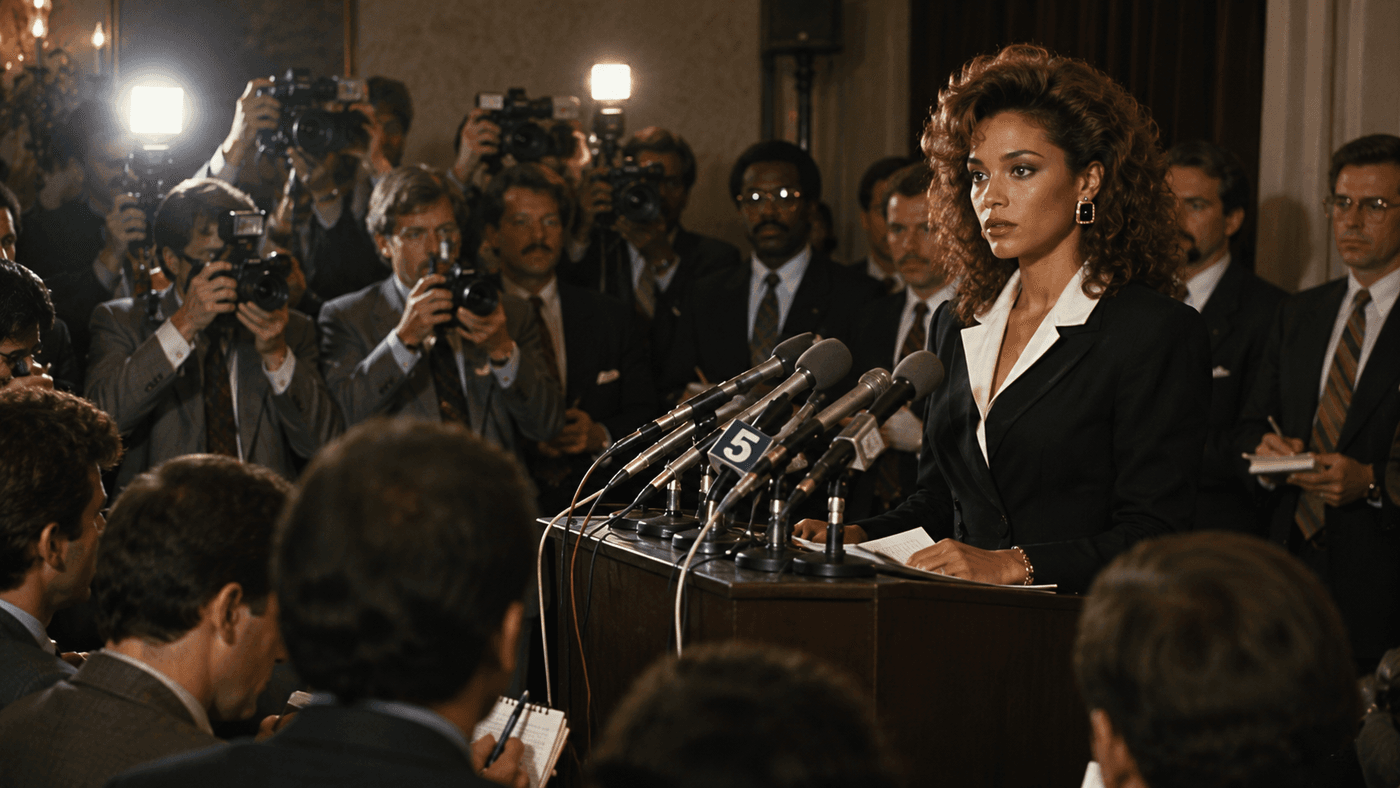
On July 23, 1984, Vanessa Williams stood before reporters at a press conference in New York City and announced that she was resigning as Miss America — becoming the first titleholder in the pageant's sixty-three-year history to relinquish the crown before the end of her reign. Williams had made history the previous September as the first African American woman ever crowned Miss America, a milestone that had drawn enormous celebration and that had been understood, by many observers, as a sign of changing attitudes in an institution that had excluded Black contestants entirely until 1970. The resignation came after Penthouse magazine informed the Miss America Organization that it intended to publish explicit photographs of Williams taken before her pageant career, and the organization's leadership presented her with what amounted to an ultimatum: resign or be stripped of the title.
The press conference on July 23, 1984, was a moment of public humiliation that Williams carried with dignity that struck many observers as far more impressive than the behavior of the organization that had forced it. Her successor, Suzette Charles, also African American, completed the reign — a fact that softened, somewhat, the symbolic blow of the first Black Miss America being removed from the title. Williams went on to build one of the most durable entertainment careers of her generation: a Grammy-nominated recording artist, a Tony-nominated Broadway performer, an Emmy-nominated television actress, and a respected figure across multiple entertainment industries who outlasted the scandal entirely. In 2015, at the Miss America pageant, the current CEO publicly apologized to Williams from the stage, acknowledging that the organization had treated her unfairly. The crown she surrendered on July 23, 1984, proved, in the end, to be the least significant thing she ever held.