The Most Dominant Champion in World Cup History
At 3:39 p.m. ET on Sunday afternoon, 39 seconds into the second half of extra time at MetLife Stadium in East Rutherford, New Jersey, Lamine Yamal beat two Argentina defenders on the right flank and delivered a low cross into the box. Nico Williams headed it into the path of Ferran Torres, a 62nd-minute substitute, who struck it from eight yards into the roof of the net. Spain 1, Argentina 0. The goal that ended the most watched, most talked-about, most geopolitically turbulent World Cup in history came from a player who hadn't scored in the tournament all summer, set up by one of three players on the pitch who had spent time at FC Barcelona, against a goalkeeper who made 11 saves — the most in a men's World Cup Final in history — and still couldn't stop it. Torres fell to the ground. His teammates sprinted toward him. On the other side of the pitch, Lionel Messi sank to his knees. The last dance was over.
One Goal. Eight Matches. History.
No World Cup champion in history had ever conceded only one goal on the way to the title — and Spain did it across eight matches, one more than any previous champion had played. The lone goal they conceded came against Belgium in the quarterfinals. Against Portugal, against France, against Argentina in the final, the net behind Unai Simón stayed untouched. Argentina, the defending champions, managed zero shots on goal across 120 minutes — the first team in World Cup Final history not to register a single shot on target. Emiliano Martínez's 11 saves, all of them from Spain's sustained, relentless attacking, stand as the most ever recorded in a World Cup Final. It was not a contest between equals. It was a masterclass of suffocation, delivered across three months of competition, that will be studied by coaches and analysts for decades. Luis de la Fuente, at 65 the oldest manager ever to win the World Cup, has built something that the history books will struggle to accommodate: an unbeaten run of 38 matches — surpassing Italy's record for the longest by any men's national team — conceding a single goal across eight World Cup games, winning every major tournament the team has entered since 2021. "Destiny was written," Torres said after the final whistle. "It was meant for us to win far away from our people."
The match turned definitively in Spain's favor in the third minute of second-half stoppage time, when Enzo Fernández — who had scored Argentina's equalizer in the England semifinal — was shown his second yellow card for a foul on Pau Cubarsí. Argentina, already scoreless and outplayed for 93 minutes, now had to defend with ten men for the entirety of extra time. They nearly survived. Martínez saved everything Spain produced in the first period of extra time, a one-man resistance against a team that had dominated the entire game. Then Yamal — 19 years old, voted the tournament's Best Young Player, once photographed as a five-month-old baby in the arms of the man he faced today — drove at the defense one more time and found Torres. The baby in the photograph had grown up to beat the legend. Messi walked to the podium, accepted his silver medal, and wept openly — tears streaming down his face as he looked around the stadium for what may have been the last time in an Argentina shirt. The image will endure. It already has.
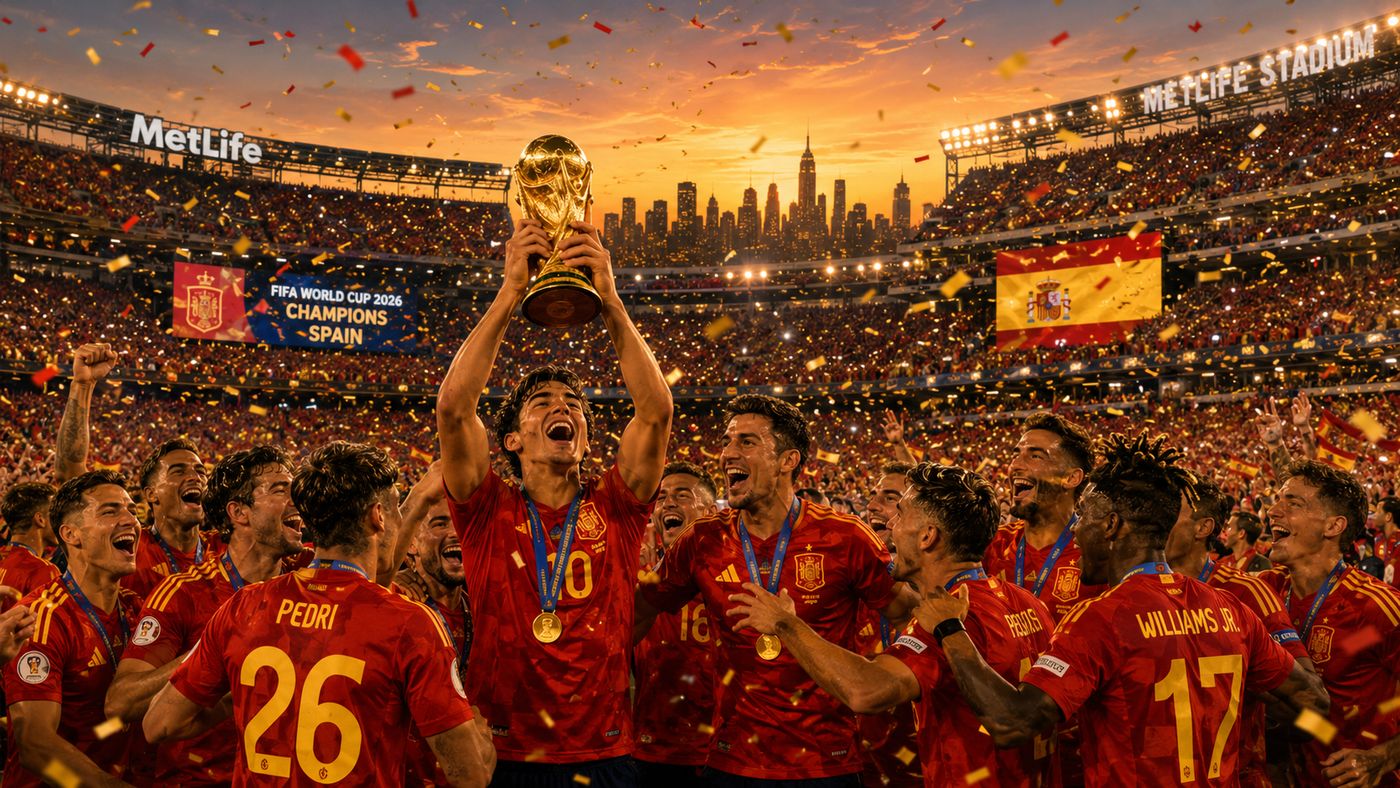
In the stands at MetLife, members of Spain's 2010 World Cup-winning team watched the trophy lifted again — sixteen years after Andrés Iniesta's extra-time winner in Johannesburg gave Spain its first. The trophy was presented to Spain's captain by President Trump, as confirmed before the tournament. Kylian Mbappé won the Golden Boot after scoring in the third-place match against England, finishing with nine goals. Messi ends his final World Cup with eight. Lamine Yamal won Best Young Player. Cubarsí won Best Defender. Simón won the Golden Glove. The most ambitious World Cup in history — 104 matches, 48 teams, 16 cities across three countries, 39 days — ended with a single goal in extra time and one of the greatest players who ever lived standing alone on the pitch, weeping, as the team he defeated celebrated around him. "When you have Messi on the other side, you are nervous," Torres said. "But we always depended on ourselves." Spain have won two World Cups. Both times, the margin was one goal. Both times, the goal came in extra time. Both times, the world held its breath. Last night, it exhaled.