The Mystery That Refused to Stay Solved
At 8:19 p.m. on July 17, 1996, TWA Flight 800 — a Boeing 747 bound for Paris, carrying 212 passengers and 18 crew — lifted off from John F. Kennedy International Airport into a clear summer evening over Long Island. Twelve minutes later, at approximately 13,700 feet, the aircraft exploded. Witnesses on beaches and boats across a wide stretch of the Long Island coast reported seeing a streak of light, then a fireball, then debris falling into the Atlantic Ocean eight miles south of East Moriches. All 230 people aboard were killed. It was the third-deadliest aviation accident in American history, and it set in motion four years of the most intensive accident investigation the United States had ever undertaken — a $40 million, NTSB-led effort that recovered more than 95 percent of a 170-ton jet from the ocean floor, physically reconstructed it in a hangar, and ultimately reached a definitive conclusion that a significant portion of the American public has never fully accepted.
Four Years, $40 Million, and a Hangar Full of Wreckage
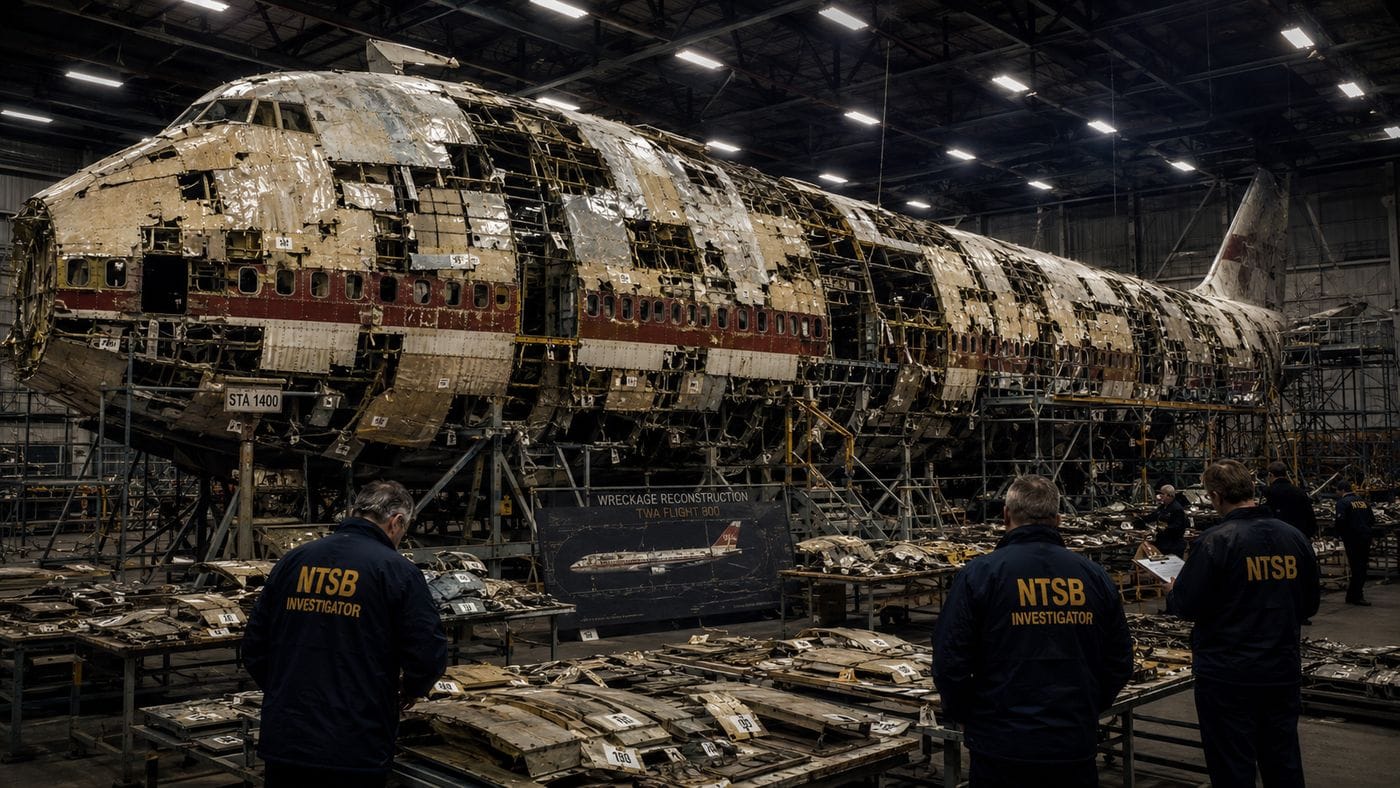
The investigation that began the morning of July 18, 1996, was unlike anything the NTSB had previously attempted. The crash occurred only weeks after the bombing of Centennial Olympic Park in Atlanta and three years after the first World Trade Center bombing — in a country primed to see terrorism wherever catastrophe appeared. The FBI launched a simultaneous criminal investigation alongside the NTSB's safety inquiry, creating jurisdictional tensions that complicated both. For more than two years, terrorism dominated the public narrative. Traces of explosives were found on wreckage — later determined to be residue from a K-9 detection training exercise conducted on the aircraft weeks earlier. The FBI interviewed 736 witnesses; 258 of them reported seeing a streak of light approaching the plane before the explosion. Investigators ultimately concluded those witnesses had seen burning jet fuel cascading from the already-stricken aircraft — a visual illusion created by the fireball's trajectory. Divers worked for more than ten months in waters approximately 120 feet deep, recovering the remains of all 230 victims and more than 95 percent of the aircraft. Investigators then physically reassembled the center portion of the fuselage in a hangar in Calverton, New York — a painstaking forensic reconstruction that took years and produced, piece by piece, the evidence that made the NTSB's conclusion possible.
In August 2000, four years after the crash, the NTSB issued its final report: the cause was an explosion of the center wing fuel tank, resulting from the ignition of a flammable fuel-air mixture in the nearly empty tank. The most likely ignition source, investigators concluded, was an electrical short circuit affecting the fuel gauge wiring — though the precise source was never definitively identified, because not all wiring components were recovered. No evidence of a missile, bomb, or any external cause was found. The FBI closed its criminal investigation. The NTSB's findings prompted sweeping aviation safety reforms: in 2008, the Department of Transportation issued a final rule requiring airlines to pump inert nitrogen gas into fuel tanks on new and many existing aircraft — eliminating the flammable vapor conditions that caused the Flight 800 explosion. The NTSB called it one of the most consequential safety changes in the history of American aviation. The reconstructed fuselage trained accident investigators for 25 years before being decommissioned in 2021.
The conspiracy theories, however, did not end with the NTSB report — and in some respects they never have. A 2013 documentary featuring former investigators claimed the official account was wrong. The NTSB accepted a petition for reconsideration in 2013 and formally declined to reopen the investigation in 2014, stating that the petitioners' evidence "did not show the original findings were incorrect." The Memorial to the 230 people who died sits at Smith Point County Park on Long Island, near the site of the crash — a quiet place looking out over the same ocean. Thirty years on, TWA itself no longer exists: the airline filed for bankruptcy, merged with American Airlines in 2001, and disappeared from American skies. The 747 that exploded that evening had been manufactured in 1971, had flown 93,303 hours over 25 years, and was on its way to Paris. On the anniversary of its last flight, what endures is the investigation it produced — the most thorough accounting of an American aviation disaster ever undertaken, and the safety rules that have protected every passenger who has flown since.