The Story That Has Outlasted Everything
Tonight, in special preview screenings across the country, Christopher Nolan's The Odyssey begins its theatrical run — with wide release following tomorrow. The film has been three years in the making, shot across six countries on IMAX 70mm film cameras in a technical undertaking that IMAX's own CEO called a deployment of technology never used before in cinema. Matt Damon stars as Odysseus, Tom Holland as his son Telemachus, Anne Hathaway as his wife Penelope, and Zendaya as the goddess Athena — alongside Robert Pattinson, Lupita Nyong'o, Charlize Theron, Jon Bernthal, and nearly every significant name in contemporary Hollywood. Early reviews have called it one of the most visually staggering films ever made. The story it tells, however, is not new. It is approximately 3,000 years old. And the fact that it still works — that it still makes audiences gasp and feel and wonder — is perhaps the most remarkable thing about tonight.
The Marvel of Its Day
The Odyssey is one of the two oldest surviving works of Western literature — the other being Homer's Iliad, which tells the story of the Trojan War that precedes it. Scholars believe both poems were composed in the 8th century BCE, approximately 2,800 years ago, drawing on oral traditions that stretched back centuries further. They were not written down in the form we know them for hundreds of years after they were first performed — sung, actually, by professional bards called rhapsodes who committed thousands of lines of verse to memory and performed them at festivals across the Greek world. Homer himself, if he existed as a single individual, remains one of history's great mysteries: some scholars believe the two epics were the work of one genius, others that they represent accumulated oral tradition attributed to a single name after the fact. What is not in dispute is what he — or they — created: a story of a man trying to get home, across seas full of monsters and gods and temptations and wars, that has not lost a single step in three millennia. Nolan, who described the poem as "the Marvel of its day," spent three years turning it into cinema — filming on the island of Favignana off Sicily, which many scholars believe to be Homer's "goat island" where Odysseus first landed with his crew; in Iceland, whose volcanic landscapes double for the supernatural; in Morocco, Scotland, Ireland, and Greece. The production filmed every frame on IMAX 70mm cameras — the largest film format in existence — making The Odyssey the first feature film in history shot entirely in that format.
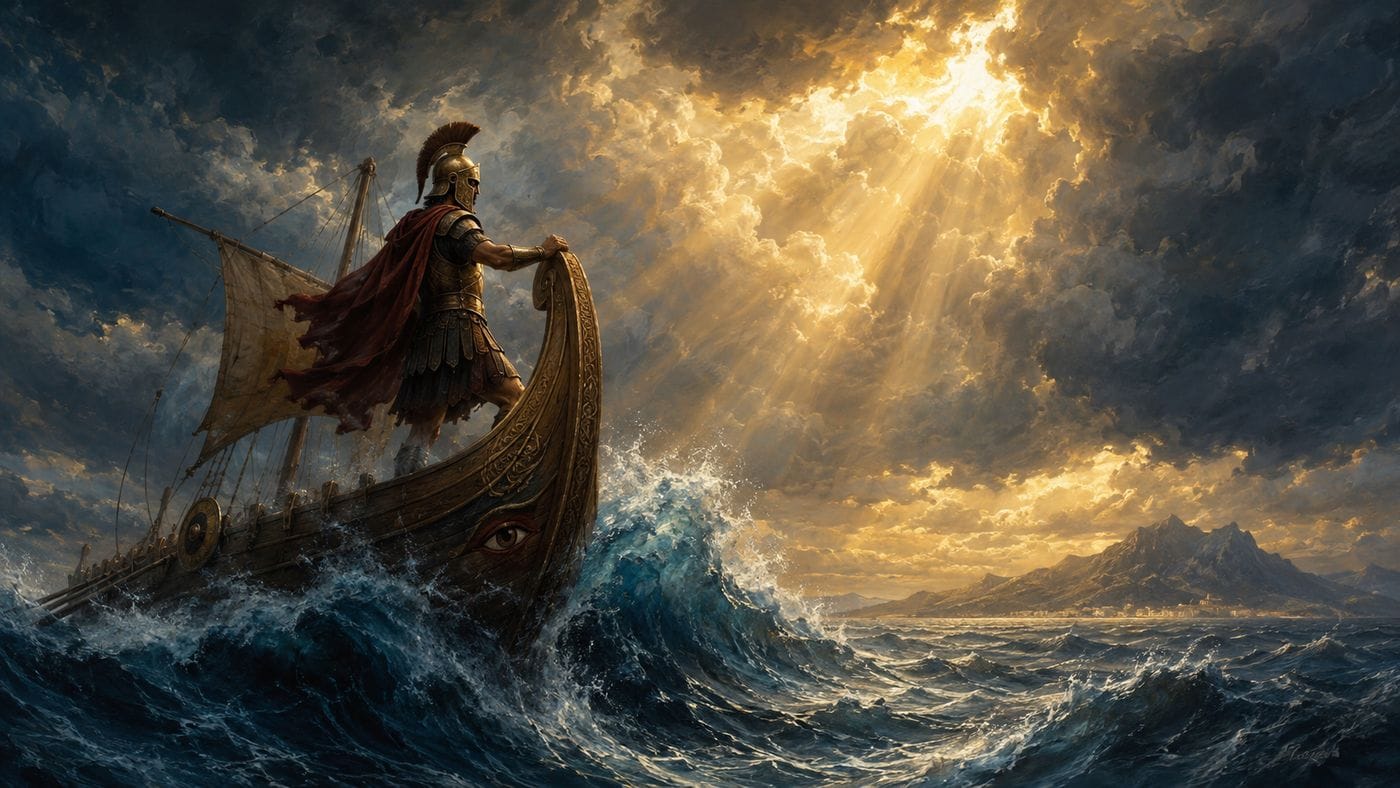
The story Nolan tells is the one Homer told: Odysseus, king of Ithaca, a decade after the Trojan War, still trying to get home. He has blinded the Cyclops Polyphemus, son of Poseidon, and the sea god's rage has extended his journey from weeks to years. He has been held on the island of the nymph Calypso. He has resisted the Sirens. He has passed through Scylla and Charybdis. Back in Ithaca, his wife Penelope — played by Hathaway in what early reviewers have called one of the film's towering performances — holds off a court full of suitors who believe Odysseus dead and want both his throne and his wife. His son Telemachus, played by Holland, has grown up without a father and sets out to find him. The goddess Athena, played by Zendaya, watches over them all. What makes the story endure is not the monsters or the gods or the scale of the adventure — it is Odysseus himself: a man who is clever enough to survive anything and who wants, above all things, to go home. That is not a 3,000-year-old desire. That is a permanent one.
The Odyssey is Nolan's 13th film and his first since Oppenheimer, which won seven Academy Awards including Best Picture and Best Director — his first. All twelve of his previous films carry a Fresh rating on Rotten Tomatoes. The early reviews of The Odyssey suggest it will not break that streak: multiple critics have described it as his most ambitious film, with sequences involving the Cyclops and the Sirens cited as among the most terrifying and spectacular things Nolan has ever put on screen. Composer Ludwig Göransson, who won the Oscar for Oppenheimer's score, returns — his compositions described in early reviews as flowing through the IMAX sound system in a way that is felt as much as heard. Nolan has said in interviews that he wanted the film to feel the way Homer's original audiences must have felt hearing the poem performed for the first time: overwhelmed by scale, moved by humanity, and certain, at the end, that the story they had just experienced was the greatest ever told. Tonight, audiences get to decide for themselves. Preview screenings begin this evening at select theaters nationwide. Wide release is tomorrow, July 17.