August 5: A Star Goes Out, a Cable Crosses an Ocean, and the Light Turns Red
August 5 is a day for things that changed how the world communicates, moves, and remembers. In 1962, the most famous actress in the world died alone in her Brentwood bedroom, and the circumstances of her death generated a mystery that has never been fully resolved and a grief that has never fully subsided. Ninety-six years earlier, an engineering project of breathtaking ambition was completed beneath the Atlantic Ocean — a copper wire stretched 2,500 miles across the seafloor, collapsing the distance between continents into minutes. And in 1914, at a busy Cleveland intersection, a red light and a green light clicked on for the first time, beginning the quiet revolution in how cities manage the movement of people and machines that has shaped every urban street in the world since. Three August fifths. Three inventions and one departure, each one changing something that could not be changed back.
Brentwood, 1962
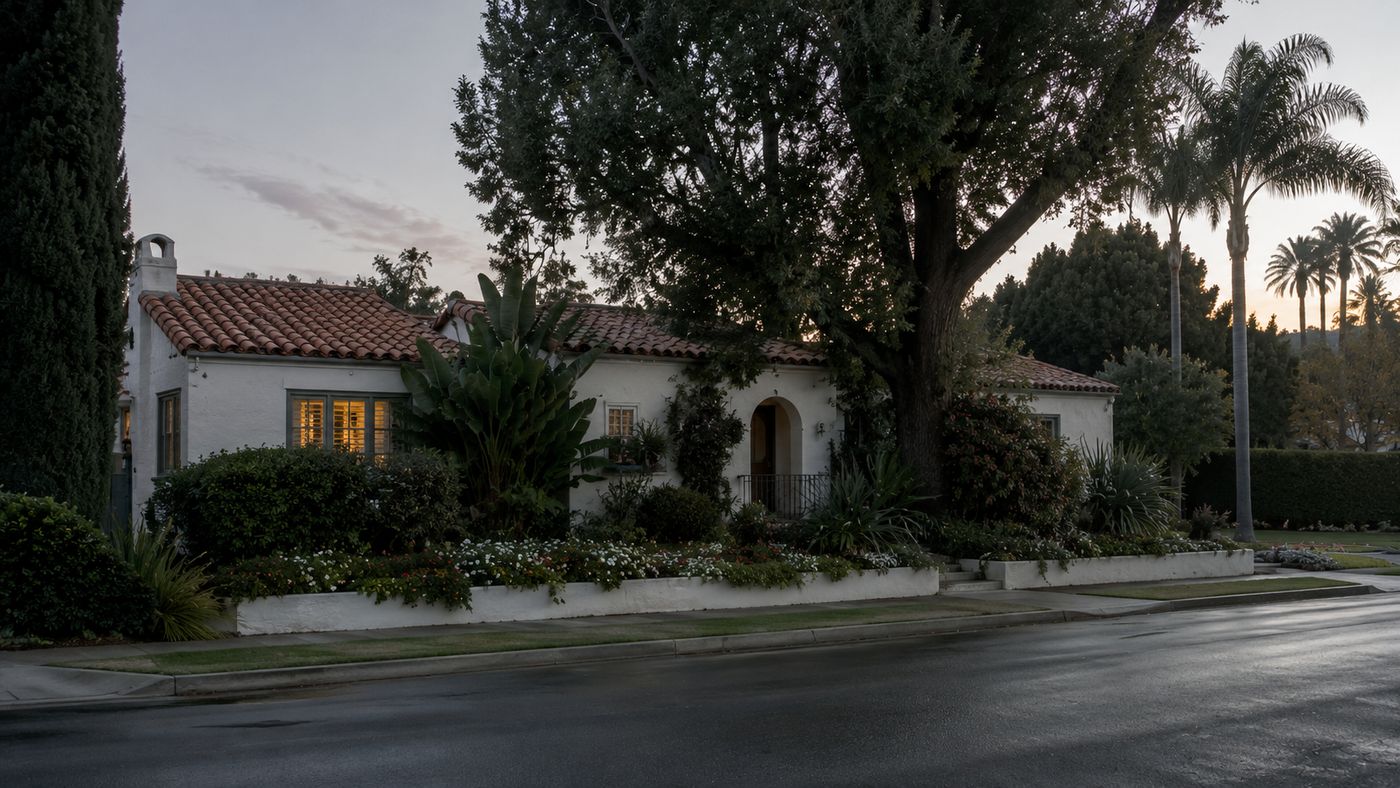
In the early hours of August 5, 1962, Marilyn Monroe was found dead in the bedroom of her home at 12305 Fifth Helena Drive in Brentwood, Los Angeles. She was thirty-six years old. Her housekeeper, Eunice Murray, had noticed a light under Monroe's bedroom door in the middle of the night and, unable to rouse her, called Monroe's psychiatrist, Ralph Greenson, who broke through a window to find her unresponsive, an empty bottle of Nembutal sleeping pills nearby. The Los Angeles County Coroner ruled her death a probable suicide from acute barbiturate poisoning. She had been born Norma Jeane Mortenson in Los Angeles in 1926, spent portions of her childhood in foster care and an orphanage, and built, through a combination of extraordinary beauty, genuine comic timing, and a vulnerability that the camera seemed to find irresistible, one of the most famous careers in the history of Hollywood.
The circumstances of Monroe's death have generated speculation, conspiracy theories, and unanswered questions for more than six decades, involving her relationships with President John F. Kennedy and his brother Robert F. Kennedy, the role of her psychiatrist and housekeeper in the hours before and after her death, and questions about the timeline of events that investigators and Monroe biographers have never satisfactorily resolved. What remains uncontested is the magnitude of her cultural presence — both during her lifetime and in the decades since. She had been the most photographed person in the world, the subject of Andy Warhol's most iconic series of silkscreens, and a figure whose image has been reproduced so many times that it has become almost entirely detached from the human being it originally depicted. The woman who died in Brentwood on August 5, 1962, had been, in the years before her death, deeply unhappy, struggling with addiction, and seeking a seriousness of professional purpose that the industry and the culture around her were largely unwilling to grant her. The icon endures. The person has been harder to remember.
2,500 Miles of Wire
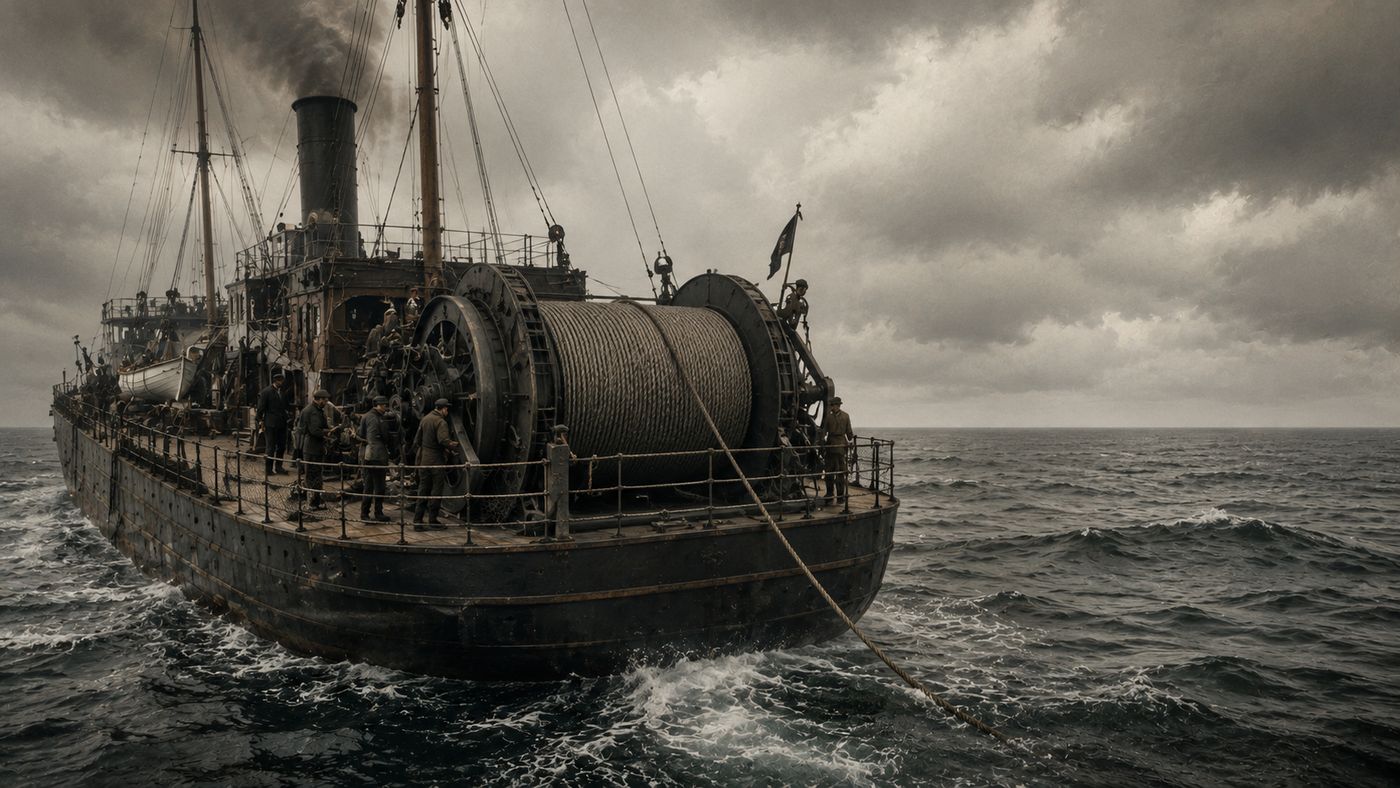
On August 5, 1858, the first transatlantic telegraph cable was completed, connecting Valentia Island off the southwestern coast of Ireland to Heart's Content in Newfoundland and enabling, for the first time in history, near-instantaneous communication between Europe and North America. The cable had been the project of American entrepreneur Cyrus Field, who had organized and financed the venture through years of technical setbacks, broken cables, and failed crossings that had consumed enormous capital and tested the patience of investors on both sides of the Atlantic. The successful completion came after multiple attempts — a cable had been laid in 1857 but failed before it became operational; the 1858 cable was completed on August 5 and began transmitting almost immediately. Queen Victoria sent President James Buchanan a congratulatory message; the transmission of 103 words took approximately sixteen hours, but it had crossed an ocean.
The 1858 cable's triumph was short-lived — the cable failed in September 1858 after just a few weeks of intermittent operation, a victim of the high voltage that the project's chief electricrist had applied in an attempt to speed up transmission. But the principle had been demonstrated, and Field persisted. A new cable was successfully laid in 1866 and remained in continuous operation, followed by additional cables that made the transatlantic link permanent and reliable. The compression of distance that the telegraph cable achieved had economic, military, and political consequences that reshaped how the world operated: financial markets on both sides of the Atlantic could now respond to the same information simultaneously; diplomatic crises could be managed in hours rather than weeks; the sense of the Atlantic as a vast, weeks-long separation between two worlds was replaced, for the first time, by something approaching connection. The cable completed on August 5, 1858, did not last — but what it proved has never been reversed.
Red and Green
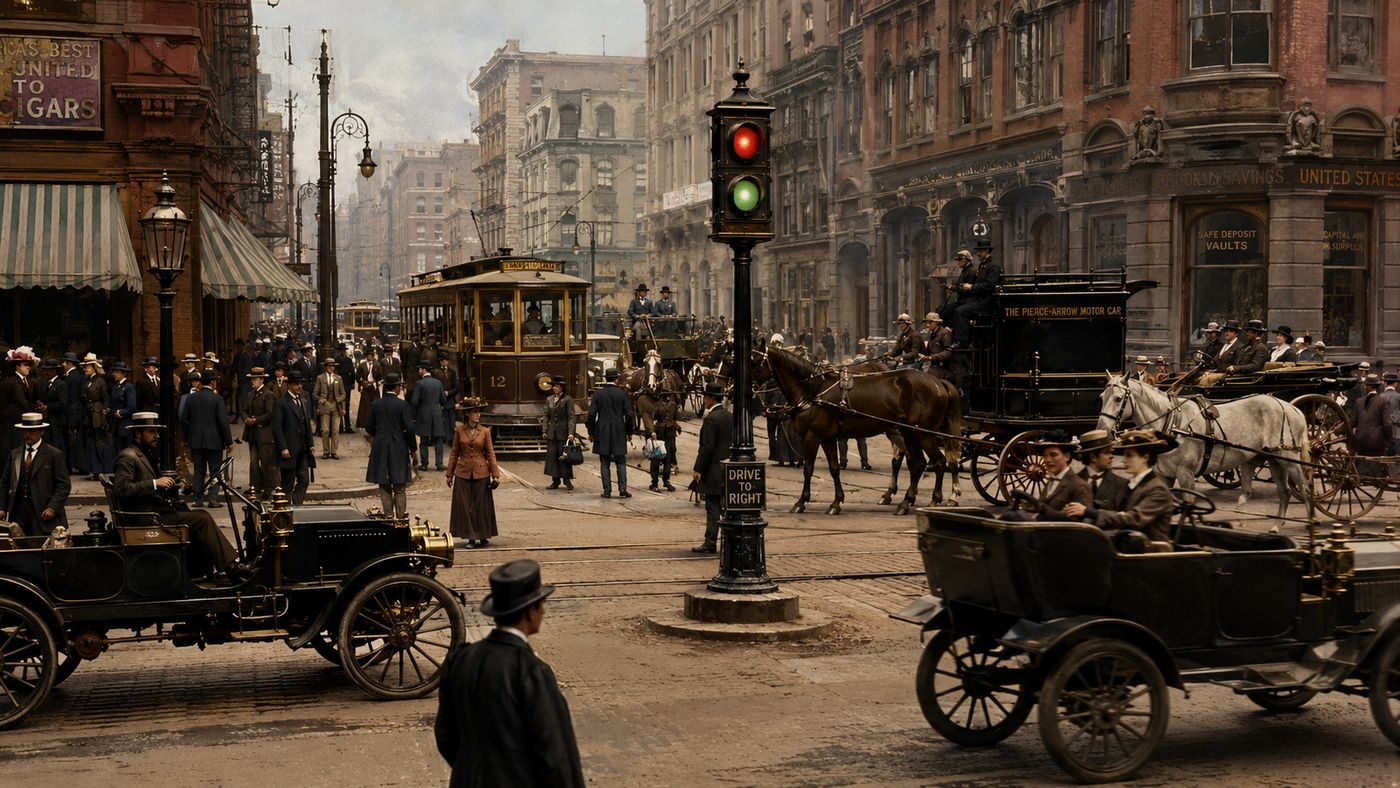
On August 5, 1914, the world's first electric traffic signal was installed at the corner of Euclid Avenue and East 105th Street in Cleveland, Ohio — a busy intersection at which the growing volume of automobiles, streetcars, and pedestrians had made manual traffic management increasingly difficult. The system, invented by James Hoge, featured red and green lights mounted on a tower at the intersection, controlled by a police officer in a nearby booth who could switch them manually as conditions required. The choice of red for stop and green for go drew on existing conventions from railroad signaling, which had used colored lights to manage train traffic for decades, making the new system intuitive for drivers and pedestrians who had already internalized those meanings from other contexts. The installation was a modest device by later standards, but it represented the first moment in which electric light was used to automate the management of road traffic.
The traffic signal installed in Cleveland on August 5, 1914, was the ancestor of a technology so ubiquitous that modern urban life is practically unimaginable without it. Within a decade, automatic and semi-automatic traffic signals had spread to cities across the United States and Europe, and the three-color system — adding amber for caution — had become the international standard. Today there are an estimated 300,000 traffic signals in the United States alone, and hundreds of thousands more across the globe, managing the movement of billions of vehicles and pedestrians every day through a system of conventions that have remained remarkably stable for more than a century. The Cleveland intersection that received the first electric traffic signal is now a street in a different kind of city than it was in 1914, but the logic of the device installed there on August 5 — a light, a color, a meaning that everyone agrees on — continues to govern every crossing in every city where cars and people share the road.