September 23: Two Explorers Return, a Planet Is Found by Math, and the Boss Is Born in New Jersey
September 23 is a day for arriving at what you had been looking for — or finding something you hadn't known to look for at all. In 1806, Lewis and Clark pulled their boats into St. Louis after two years and eight thousand miles and reported back to a country that had sent them west without knowing what was there, and what they brought back — maps, specimens, journals, diplomatic relationships — transformed American understanding of its own continent. In 1846, a German astronomer pointed his telescope at a position in the sky that a French mathematician had calculated, without ever having looked at it, that an undiscovered planet must occupy — and it was exactly there. And in 1949, in Long Branch, New Jersey, a child was born who would grow up to become one of the most important American musicians of the twentieth century — not because he invented a new sound but because he bore witness, with extraordinary fidelity and passion, to the sound of a country and a working class that popular music had been happy to overlook. Three September twenty-thirds. Three discoveries, each one revealing something about the world that had been there all along, waiting.
St. Louis, 1806
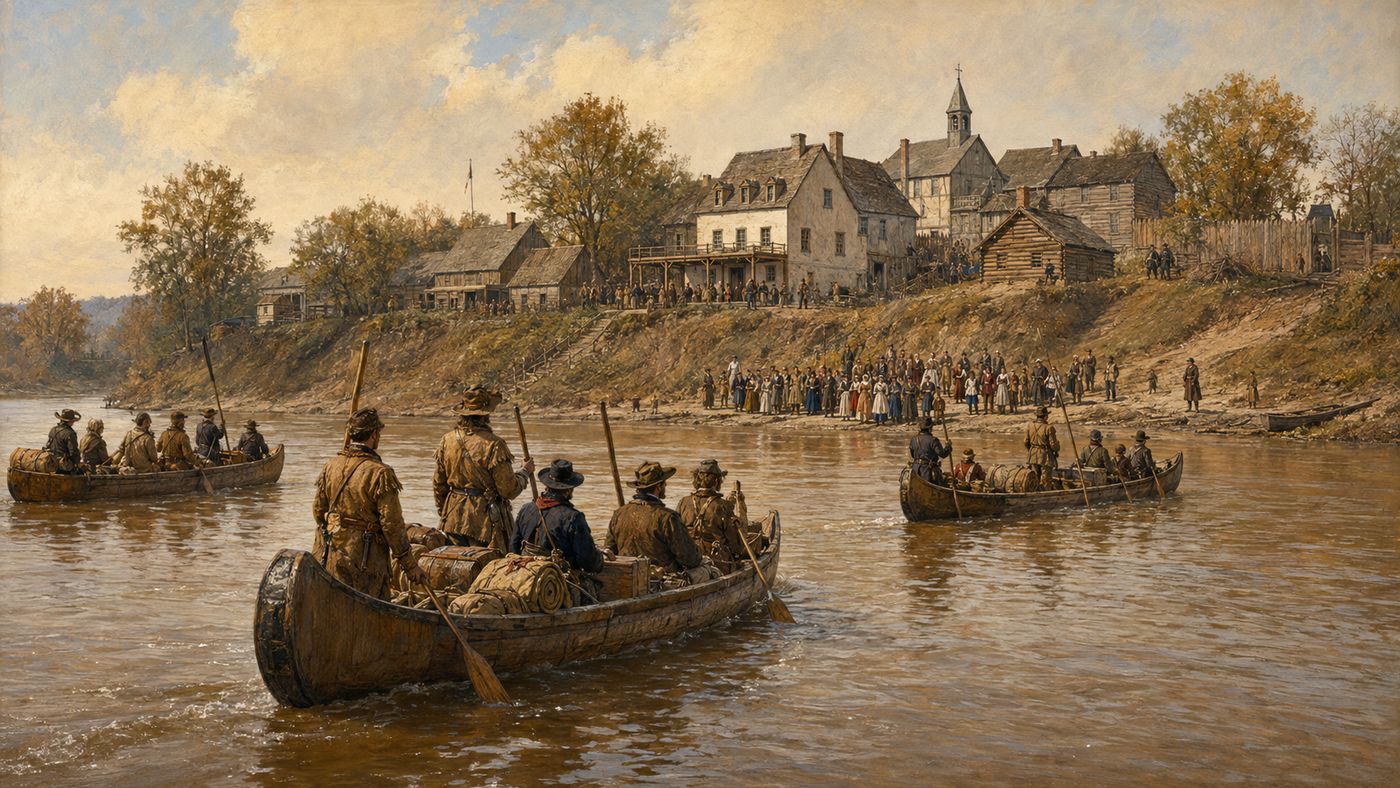
On September 23, 1806, Meriwether Lewis and William Clark and the surviving members of the Corps of Discovery arrived by boat in St. Louis, completing the most significant overland expedition in American history. They had departed from Camp Dubois, near St. Louis, in May 1804 — commissioned by President Thomas Jefferson following the Louisiana Purchase of 1803 to explore the vast territory the United States had acquired, to find a practical water route to the Pacific, to document the geography, flora, fauna, and peoples of the western interior, and to establish American diplomatic relationships with the Native nations who inhabited those territories. The Corps had traveled approximately 8,000 miles by river, overland, and by foot, crossed the Rocky Mountains, reached the Pacific Ocean in November 1805, and returned by a somewhat different route, arriving in St. Louis to a welcome that reflected the uncertainty the public had felt about whether they had survived at all — the expedition had been largely out of contact for over a year.
What Lewis and Clark brought back to St. Louis on September 23, 1806, reshaped American understanding of the continent. Their detailed maps of the Missouri and Columbia River systems provided the first reliable geographic picture of the western interior. Their journals documented more than 200 plant species and 122 animal species previously unknown to European science, along with detailed observations of the landscapes, climates, and peoples they encountered. Their diplomatic contacts with dozens of Native nations — conducted through the assistance of Sacagawea, the Shoshone woman who joined the expedition at Fort Mandan and whose knowledge and relationships proved indispensable — began the complicated and often tragic process of official American engagement with western tribes. The expedition did not find the Northwest Passage — there is no continuous water route across North America, and the Rocky Mountains made the prospect impossible — but it found something more useful: a comprehensive picture of what the continent actually contained. The knowledge Lewis and Clark returned with on September 23, 1806, made the American West imaginable as a destination, and the settlers and developers who followed over the next century followed in the paths the Corps had mapped.
The Planet Found by Math
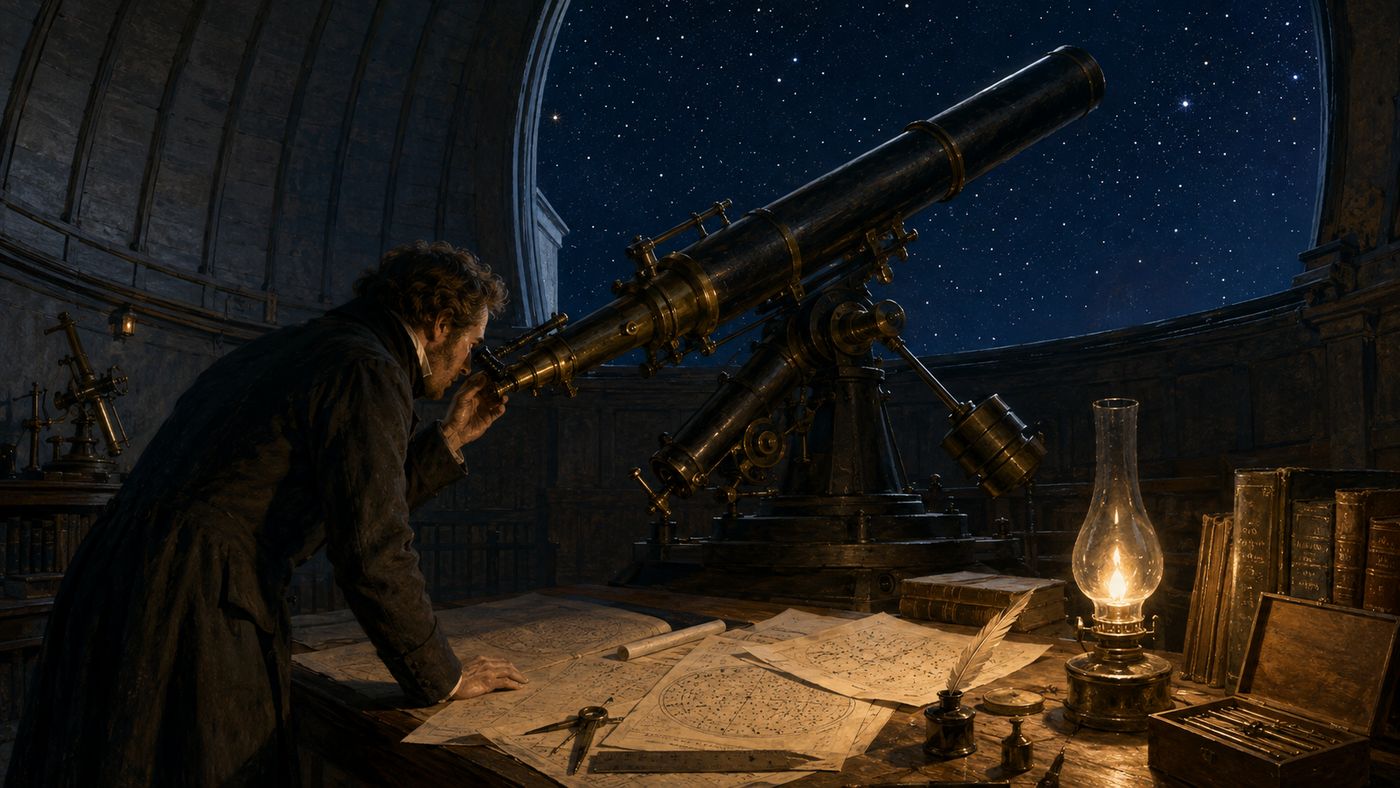
On the night of September 23, 1846, German astronomer Johann Gottfried Galle at the Berlin Observatory pointed his telescope at a position in the sky that French mathematician Urbain Le Verrier had specified in a letter, and found a planet — the first planet in history to be discovered not by observation but by mathematical prediction. Le Verrier had spent months analyzing the observed irregularities in the orbital motion of Uranus, which had been behaving in ways that Newton's gravitational laws could not fully explain if the only objects acting on it were the known planets. He concluded that the irregularities were caused by the gravitational pull of an undiscovered planet in a specific position, and he calculated where that planet must be. He sent his prediction to Galle in Berlin — the Paris Observatory had declined to act on it quickly — and Galle found Neptune within one degree of the predicted position on the first night he looked. The discovery was one of the most dramatic confirmations of Newtonian mechanics ever achieved.
The discovery of Neptune on September 23, 1846, was accompanied by one of the most bitter priority disputes in the history of science. British astronomer John Couch Adams had independently calculated a nearly identical prediction for the position of the unknown planet approximately a year before Le Verrier, but the British astronomical establishment had been slow to act on his calculations, and it was Le Verrier's prediction that was sent to Galle and led to the discovery. The subsequent dispute over credit — between Le Verrier and Adams, between France and Britain — was fierce and personal, and was only resolved through the passage of time and the diplomatic fiction that both men deserved equal credit. The resolution has largely held: both are now recognized as co-predictors of Neptune's position, though the telescope that confirmed it was pointed by Galle on Le Verrier's instructions. Neptune, the eighth and outermost planet in the solar system, orbits the sun at an average distance of about 2.8 billion miles; a single Neptunian year lasts approximately 165 Earth years. It was visited by a spacecraft for the first and only time when Voyager 2 flew past it in 1989 — 143 years after Galle found it on September 23, 1846, by looking where the math said to look.
Long Branch, 1949
On September 23, 1949, Bruce Springsteen was born in Long Branch, New Jersey, the son of Douglas Springsteen, who worked various jobs — bus driver, factory worker, prison guard — in the industrial decline of postwar Freehold, and Adele, who worked as a secretary. He grew up in Freehold, was largely indifferent to school, and found in music — especially in the guitar, which he took up after seeing Elvis Presley on The Ed Sullivan Show — the thing that made sense of everything else. He played in local bands through his teens, moved to Asbury Park, New Jersey, and built a following in the clubs there with the E Street Band before signing with Columbia Records and releasing his debut album in 1973. His first two albums were critically praised but commercially modest; his third, Born to Run (1975), was the breakthrough — a record so fully realized in its ambition and so precise in its evocation of a specific American landscape that it landed him simultaneously on the covers of Time and Newsweek.
The career that began in Long Branch on September 23, 1949, has produced one of the most sustained bodies of work in American popular music — from Darkness on the Edge of Town (1978) and The River (1980) through Nebraska (1982) and Born in the USA (1984) to The Rising (2002) and beyond, with twenty studio albums across more than fifty years of recording. What has distinguished Springsteen from the generation of rock musicians who came of age with him is less the individual records — several of which are extraordinary — than the consistency of subject and moral attention: the working-class New Jerseyans and Americans whose stories he has told across a half-century, the insistence that their lives and struggles deserve the full resources of musical art, the live performances of legendary duration and commitment that have been his most complete expression of everything the music is about. He was awarded the Presidential Medal of Freedom in 2016. He sold his catalogue and masters in 2021 for a reported $500 million. The child born in Long Branch, New Jersey, on September 23, 1949, found the guitar at the right age and never put it down.