September 20: A Storm That Exposed Everything, a Match That Changed Sports, and the Last Walls of Rome
September 20 is a day for reckonings that arrived in the form of weather, or a tennis match, or an army at the gate. In 2017, Hurricane Maria made landfall in Puerto Rico and within hours had collapsed the electrical grid of an American territory, revealing — to the world and to the island's residents — the depth of a systemic neglect that had been building for decades and that the federal response would do almost nothing to address. Forty-four years earlier, in a stadium in Houston, a tennis player named Billie Jean King won a match against a man who had said women couldn't play, and ninety million people watched, and something shifted in the cultural understanding of what women were capable of in sport and beyond it. And in 1870, Italian troops breached the walls of the city that had been the seat of papal temporal power for more than a thousand years, and the Papal States ceased to exist, and the process of Italian unification was complete. Three September twentieths. Three moments when something that had seemed permanent was revealed, abruptly, to be otherwise.
Maria
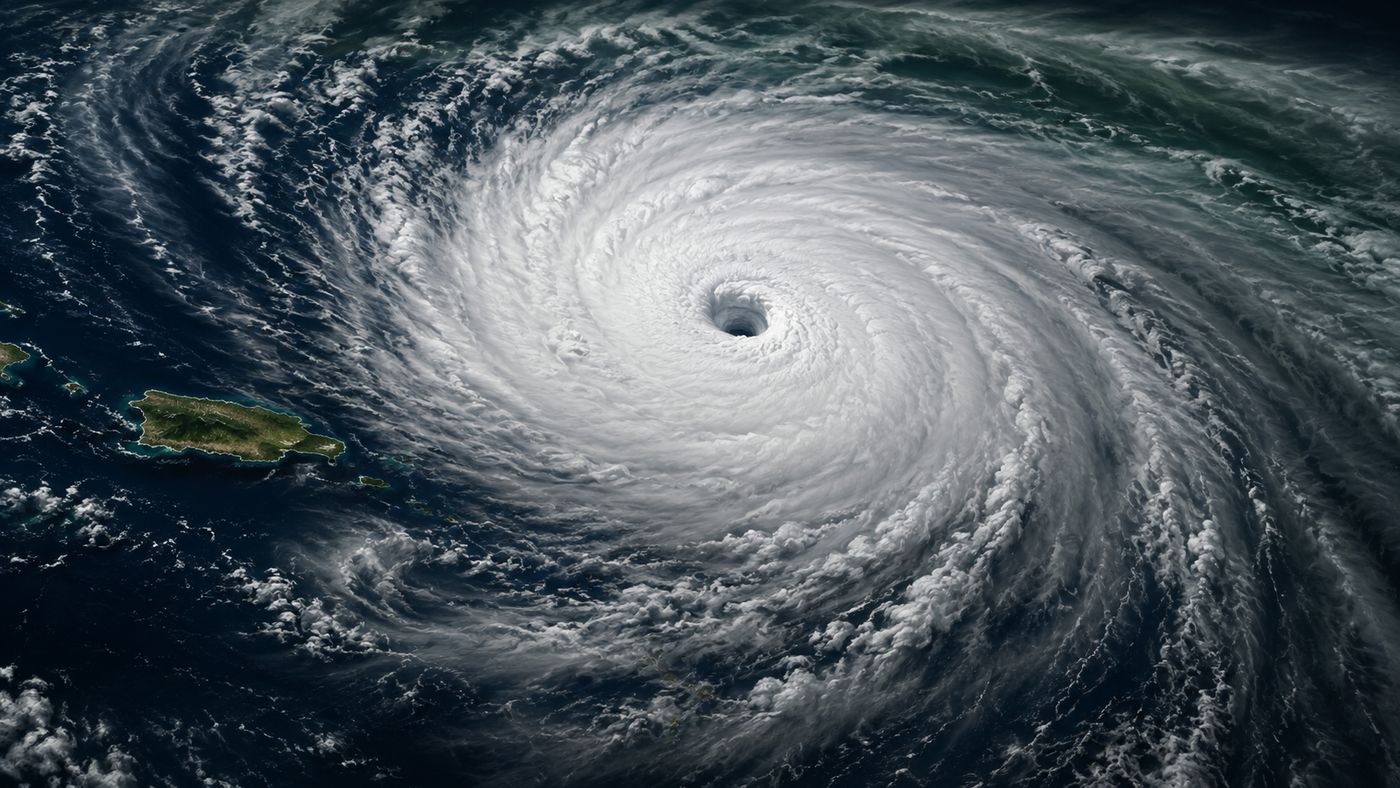
On September 20, 2017, Hurricane Maria made landfall near Yabucoa, Puerto Rico, as a Category 4 storm with sustained winds of 155 miles per hour — the strongest hurricane to strike Puerto Rico since 1928 and the most destructive in the island's recorded history. The storm's passage over the island destroyed or heavily damaged virtually every sector of its infrastructure: the electrical grid, already in disrepair from decades of underinvestment by its state-owned utility PREPA, failed completely, leaving the island's 3.4 million residents — who are American citizens — without power. Flooding, landslides, and wind damage destroyed roads, bridges, hospitals, homes, and telecommunications infrastructure. The official death toll was initially recorded at sixty-four; a subsequent study by researchers at Harvard University estimated the true death toll at approximately 4,645 people, with most of those deaths occurring not during the storm itself but in the weeks and months that followed, from the collapse of medical care, clean water access, and other life-sustaining systems that the island's recovery failed to quickly restore.
The federal response to Hurricane Maria, which made landfall on September 20, 2017, was widely characterized as inadequate — slower, less resourced, and less effective than the responses to comparable mainland disasters. President Trump's visit to Puerto Rico was marked by his distribution of paper towels to survivors in what many Puerto Ricans and commentators found an inadequate symbolic response to a catastrophic humanitarian crisis, and by his public disputes with Puerto Rico's governor about the scope of the disaster and the adequacy of the federal response. The slow restoration of power — the last customers did not have power restored for approximately eleven months after the storm — and the difficulties encountered in accessing federal disaster relief funds produced a sustained public debate about the second-class citizenship of Puerto Ricans, the political implications of their lack of congressional representation, and the structural vulnerabilities of the island's economy and infrastructure. Maria's landfall on September 20, 2017, was a natural disaster. What it revealed was largely political and structural — a series of choices made over decades about investment, governance, and the obligations of the federal government to its non-voting citizens.
The Astrodome
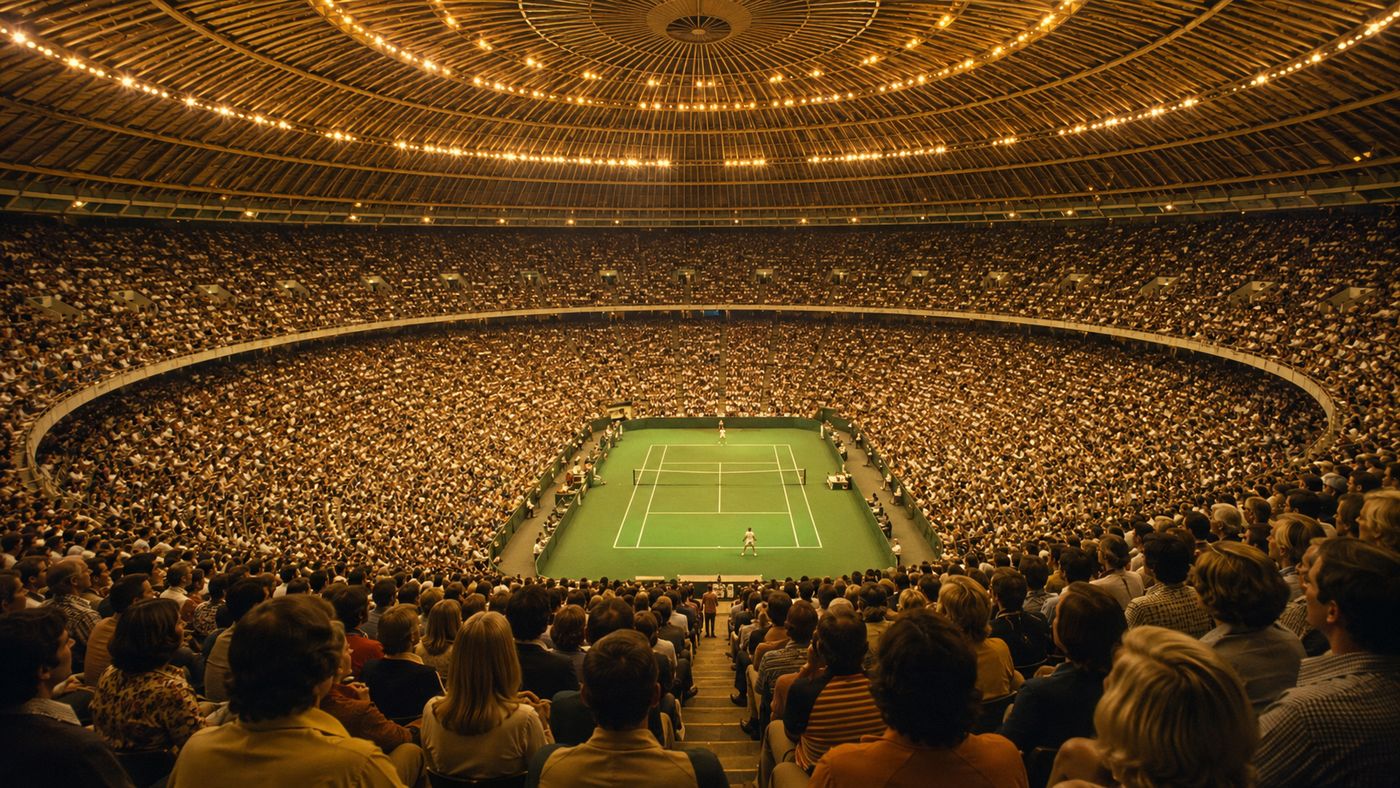
On September 20, 1973, Billie Jean King defeated Bobby Riggs 6-4, 6-3, 6-3 in the Houston Astrodome before a crowd of approximately 30,472 people — the largest audience ever to witness a tennis match at that point — while an estimated 90 million additional viewers watched on television worldwide. The match had been promoted as the "Battle of the Sexes" after Riggs, a fifty-five-year-old former Wimbledon champion, had publicly claimed that women's tennis was so inferior to men's that he, at his age, could beat any woman in the top of the game. He had earlier defeated the then-world number one, Margaret Court, in a match in May 1973 that had received considerable attention. King, who was twenty-nine and the world's top-ranked women's player, accepted Riggs's challenge after the Court defeat — both because she believed she could win and because she understood the larger stakes of refusing. The match was preceded by elaborate theatrical staging: King was carried onto the court on a litter by men dressed as ancient slaves; Riggs arrived in a rickshaw pulled by women in skimpy outfits. Then they played tennis, and King won decisively.
The victory Billie Jean King achieved on September 20, 1973, has been credited with effects that extended well beyond tennis. The match was widely covered as a referendum on women's capabilities in sport and, by extension, in professional and public life more broadly — a framing that Riggs had encouraged and that King accepted as the appropriate context for what she was doing. Her decisive victory undermined the argument that women's athletic performance was so inferior to men's that even middle-aged former male champions could dominate them, and it did so in front of one of the largest sporting television audiences of the era. King used the match's aftermath to advocate for equal prize money in tennis — she had been a founding member of the Women's Tennis Association in 1973, the same year as the match — and for the broader recognition of women's sports as a legitimate commercial enterprise deserving comparable investment and coverage. She has continued to be one of the most prominent advocates for gender equity in American public life for the fifty years since September 20, 1973. Bobby Riggs, who died in 1995, reportedly told King he was glad she had beaten him, because the match and its result had done more good than a Riggs victory could have.
Porta Pia
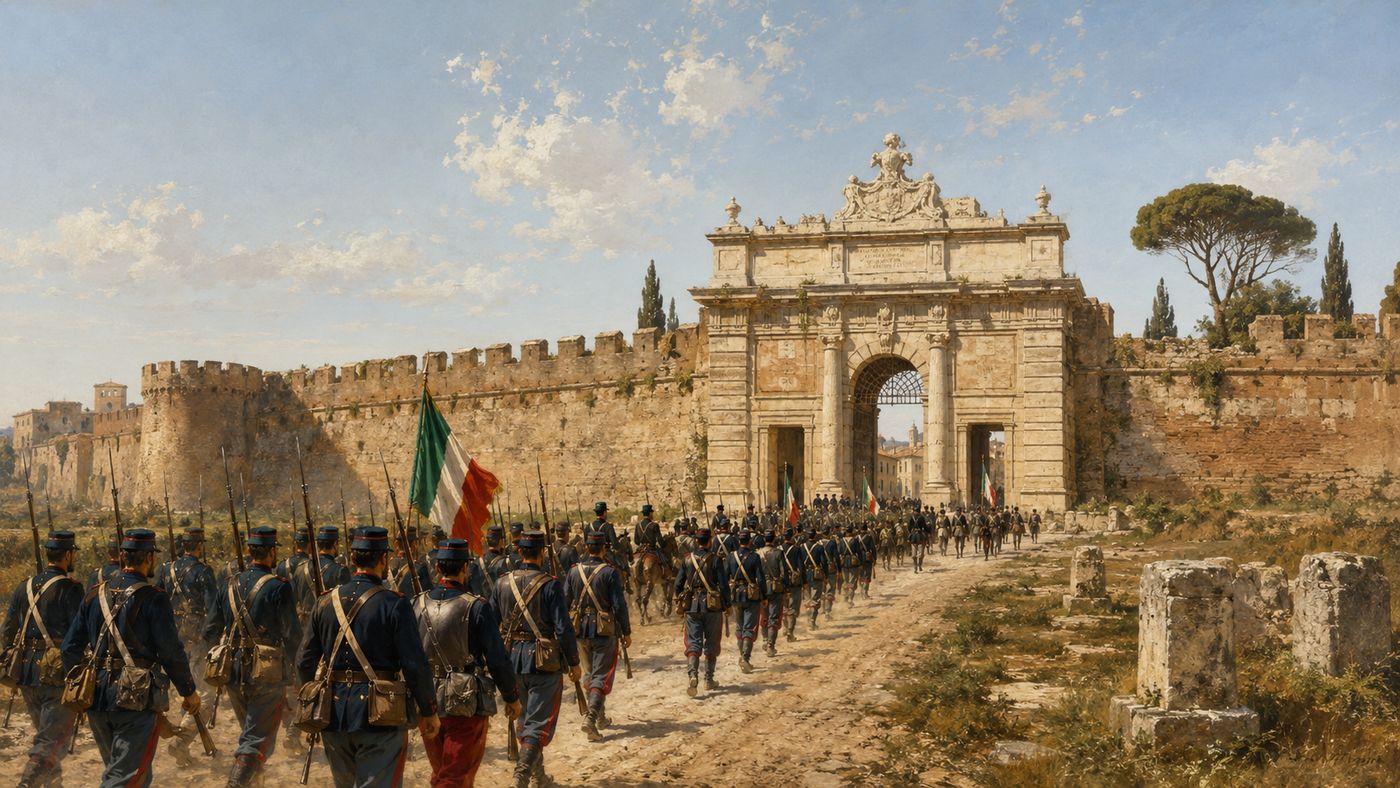
On September 20, 1870, Italian troops breached the walls of Rome at the Porta Pia gate and entered the city, ending the temporal rule of the papacy over Rome and the Papal States — a political authority that the Catholic Church had exercised, in various forms, for more than a thousand years. The military action had been enabled by the withdrawal of French troops who had been garrisoning Rome as protectors of Pope Pius IX; France's defeat in the Franco-Prussian War in 1870 made the maintenance of that garrison impossible, and without it the Papal States had no effective defense against the Kingdom of Italy, which had been unified under King Victor Emmanuel II through the military and diplomatic work of Camillo di Cavour and Giuseppe Garibaldi over the preceding decade. Pius IX refused to negotiate or surrender; after a brief and largely symbolic resistance by papal forces, the walls were breached and Italian troops entered Rome. The pope declared himself a prisoner of the Vatican and refused to recognize the new Italian state.
The entry of Italian troops through Porta Pia on September 20, 1870, completed the Risorgimento — the century-long Italian national unification movement — and made Rome the capital of a unified Italian state for the first time since the fall of the Western Roman Empire in 476 CE. The relationship between the papacy and the Italian state created by this act remained hostile and unresolved for nearly sixty years: the popes refused to leave the Vatican, declined to recognize Italy, and forbade Italian Catholics from participating in Italian politics. The conflict was resolved by the Lateran Treaty of 1929, in which Mussolini's government and Pope Pius XI formally recognized each other's authority — the papacy accepting Italian sovereignty over Rome in exchange for recognition of Vatican City as an independent state and the Catholic Church's special status in Italy. The breach at Porta Pia on September 20, 1870, is commemorated in Italy as a national holiday — the day the modern Italian state claimed its capital and the power of a millennium-old ecclesiastical sovereignty was definitively ended.