September 2: A Nation Declares Itself, a City Burns, and a Machine Dispenses Cash
September 2 is a day for things that announced their own arrival — loudly, with fire, or simply by dispensing cash for the first time. In 1945, Ho Chi Minh stood before half a million people in Hanoi and declared Vietnam a republic, seizing a brief window of opportunity created by Japan's surrender to proclaim an independence that France was not prepared to grant and that the United States, for complicated reasons, was not yet prepared to support — beginning a story that would cost millions of lives over the following thirty years. In 1666, a fire that started in a bakery on Pudding Lane consumed medieval London over four days and four nights, destroying thousands of buildings and the old city's cramped, plague-ridden fabric and giving Christopher Wren and his contemporaries a blank canvas from which to build a new one. And in 1969, on the exterior wall of a Long Island bank branch, a machine accepted a magnetic card and dispensed cash to a customer outside banking hours for the first time in American history, inaugurating a technology that is now so ubiquitous it is essentially invisible. Three September seconds. Three things that, once they existed, the world could not imagine doing without.
Ba Dinh Square
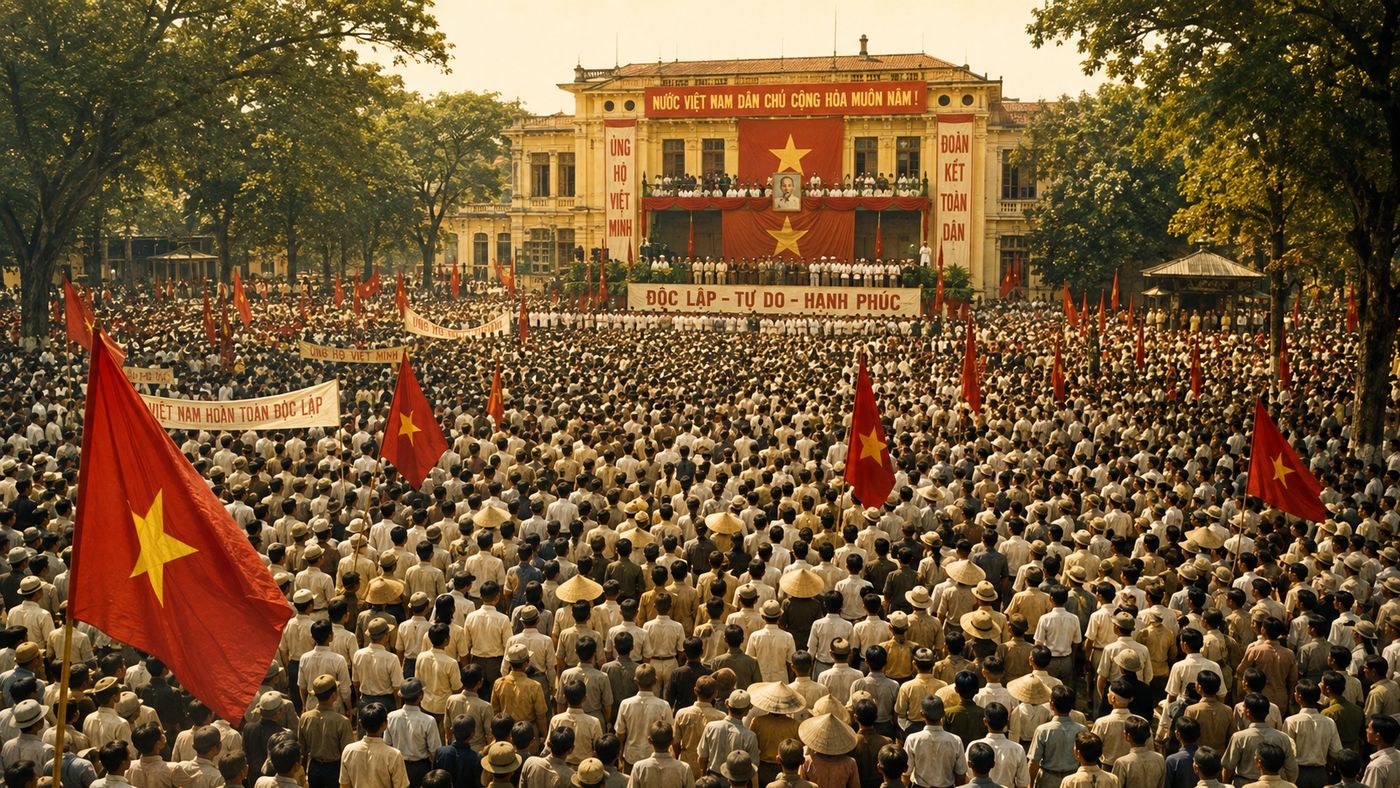
On September 2, 1945 — the same day that Japan's formal surrender was signed aboard the USS Missouri in Tokyo Bay, officially ending the Second World War — Ho Chi Minh stood before a crowd of approximately half a million people in Ba Dinh Square in Hanoi and read aloud the Declaration of Independence of the Democratic Republic of Vietnam. The document he read opened with the words of the American Declaration of Independence: "All men are created equal. They are endowed by their Creator with certain inalienable rights; among these are Life, Liberty, and the pursuit of Happiness." Ho Chi Minh, who had spent decades organizing Vietnamese communist and nationalist resistance to French colonial rule, was making a deliberate rhetorical appeal to the United States — which had backed the Viet Minh against the Japanese during the war and whose support he hoped to secure for Vietnamese independence against France's anticipated effort to reassert control of its Indochina colonies.
The declaration of September 2, 1945, did not produce the outcome Ho Chi Minh had hoped for. France moved to reassert control of Indochina within months, and the First Indochina War — between France and the Viet Minh — began in December 1946 and continued until the French defeat at Dien Bien Phu in 1954. The Geneva Accords that followed temporarily divided Vietnam at the 17th parallel, with the Democratic Republic of Vietnam in the north and the Republic of Vietnam in the south — a division intended to be temporary, pending national elections that were never held. The United States, alarmed by Ho Chi Minh's communist affiliations and the Cold War logic of falling dominoes, began supporting South Vietnam's government, a commitment that deepened over the following decade into the full military involvement of the Vietnam War. The war that followed the declaration of September 2, 1945, cost more than three million Vietnamese lives and more than 58,000 American ones before the fall of Saigon in 1975. The Democratic Republic of Vietnam that Ho Chi Minh declared in Hanoi Square that morning outlasted everything that was done to prevent it.
Pudding Lane
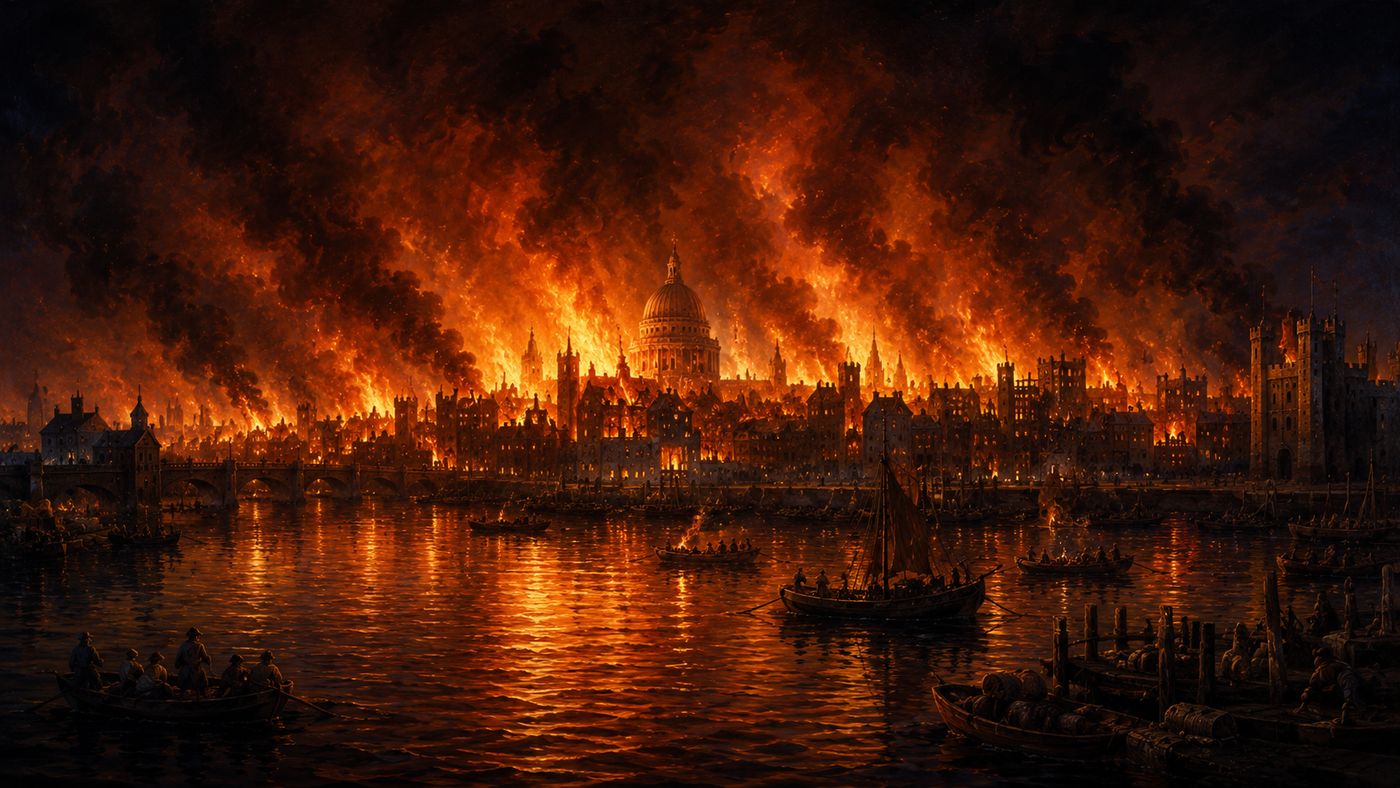
In the early hours of September 2, 1666, a fire broke out in a bakery on Pudding Lane in the City of London — a narrow street near London Bridge in the dense, timber-framed medieval heart of the English capital. The fire spread rapidly through buildings that stood close together, many of them dry after a long summer, in streets too narrow for any effective firefighting. By the time it burned itself out four days later, on September 5, it had destroyed approximately 13,200 houses, 87 parish churches including the medieval St. Paul's Cathedral, and most of the buildings within the ancient walls of the City of London. Remarkably, the official death toll was very low — only six deaths were recorded, though historians suspect the true number was higher, as the deaths of the poor were often not documented. An estimated 100,000 people — roughly a sixth of London's population — were left homeless.
The Great Fire that began on September 2, 1666, destroyed medieval London and created the conditions for the city that replaced it. Christopher Wren, appointed to the commission overseeing the rebuilding, designed the new St. Paul's Cathedral — the iconic domed structure that stands today — along with 52 other churches and contributed to the broader replanning of the City's streets. The rebuilt London was more fireproof: brick and stone replaced timber, the streets were widened, and building regulations were introduced that fundamentally altered the character of urban construction in England. The fire also had an unexpected public health consequence: it destroyed the overcrowded, rat-infested neighborhoods of the old City that had harbored the plague, and the Great Plague of 1665-1666 — which had killed approximately 100,000 Londoners — never recurred at that scale after the fire. The disaster of September 2, 1666, remade London in ways that its inhabitants could not have predicted and did not initially welcome, but that shaped the city for the three and a half centuries that followed.
The First Hole in the Wall
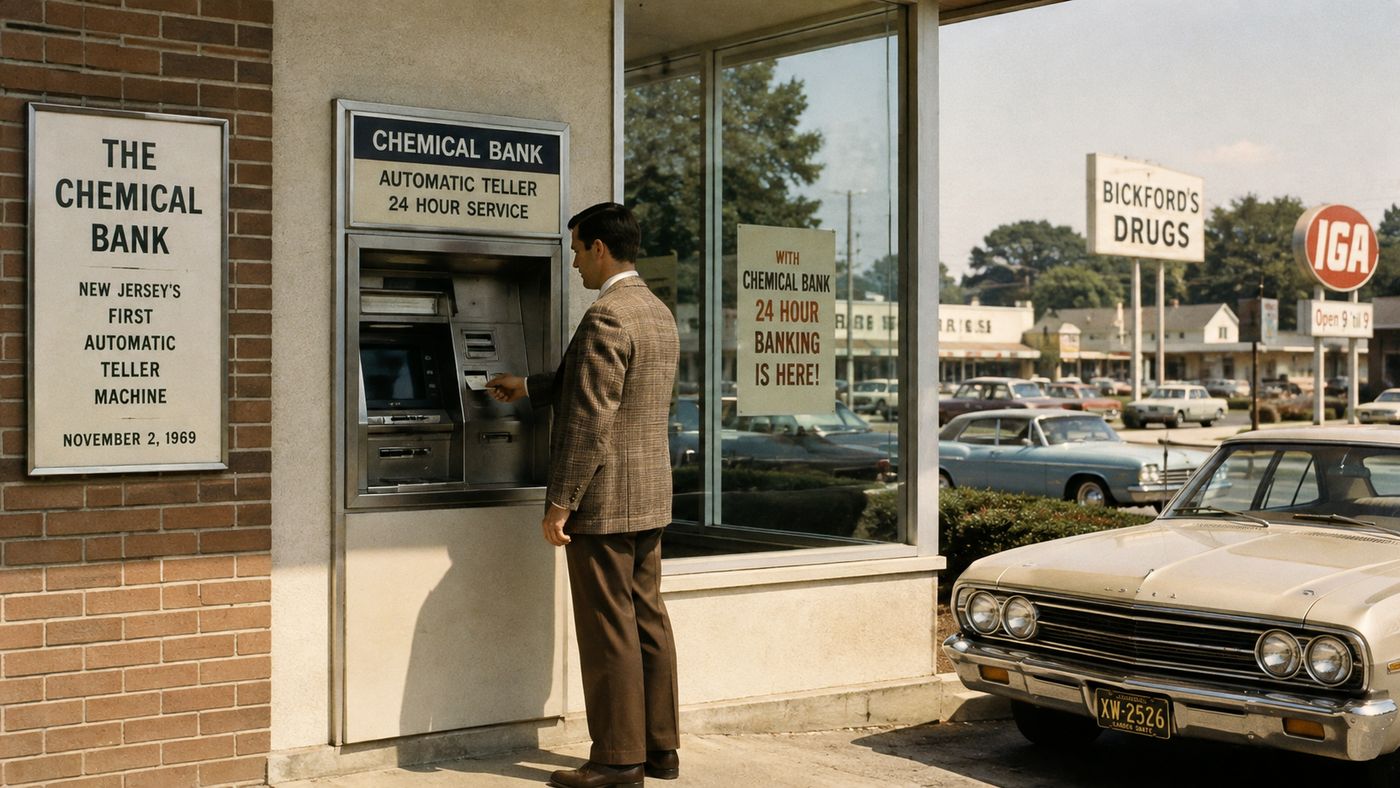
On September 2, 1969, a Chemical Bank branch in Rockville Centre, New York, activated the first ATM in the United States — a machine developed by Donald Wetzel, an engineer at Docutel, that accepted a magnetic card and dispensed a fixed amount of cash to customers outside of normal banking hours. The machine had been previewed in a Chemical Bank advertisement that asked: "On September 2, our bank will open at 9:00 and never close again." The concept it embodied — that access to cash should not be limited to the hours when bank tellers were available — was simple and proved immediately appealing, though early ATM technology was considerably more limited than what followed: the machines were expensive, prone to malfunction, and capable of dispensing only fixed cash amounts rather than the flexible transactions that later technology would enable. The history of ATMs was not entirely American — the first ATM anywhere in the world had been installed by Barclays Bank in Enfield, north London, in 1967 — but the Chemical Bank installation marked the beginning of what became a specifically American technological rollout.
The ATM network that grew from the installation of September 2, 1969, is now one of the most ubiquitous pieces of financial infrastructure in the world. There are approximately 470,000 ATMs in the United States and an estimated 3.5 million worldwide, collectively processing billions of transactions annually. The technology has been so thoroughly absorbed into daily life that the generation that grew up after its widespread adoption has no lived memory of a world without it — no memory of planning cash withdrawals around banking hours, of being stranded on a weekend without access to funds, or of relying on travelers' checks for out-of-town travel. The machine on the Chemical Bank wall in Rockville Centre on September 2, 1969, was neither elegant nor particularly powerful. It was, however, the beginning of a convenience so fundamental that the world has reorganized itself around it without quite noticing it had done so.