September 1: A Chess King Crowned, a City Destroyed, and a Stamp That Said Something
September 1 is a day for arrivals — some catastrophic, some triumphant, some quietly significant in ways that only become clear over time. In 1972, a twenty-nine-year-old from Brooklyn sat across a chessboard from the defending world champion in Reykjavik and won a match that had been followed as closely as any political summit of the Cold War era, ending twenty-four years of Soviet dominance over the game the Soviets had turned into a propaganda instrument. In 1923, the most destructive earthquake in Japan's recorded history struck the Tokyo-Yokohama region at midday, when cooking fires were burning across the city, and killed more than 140,000 people in the collapse and the fires that followed. And in 2001, the United States Postal Service issued a stamp celebrating Eid al-Fitr — a small, deliberate act of recognition for a community of millions of Americans whose holiday had never before appeared on the country's most democratic form of public acknowledgment. Three September firsts. Three moments when something that had not existed before came into being.
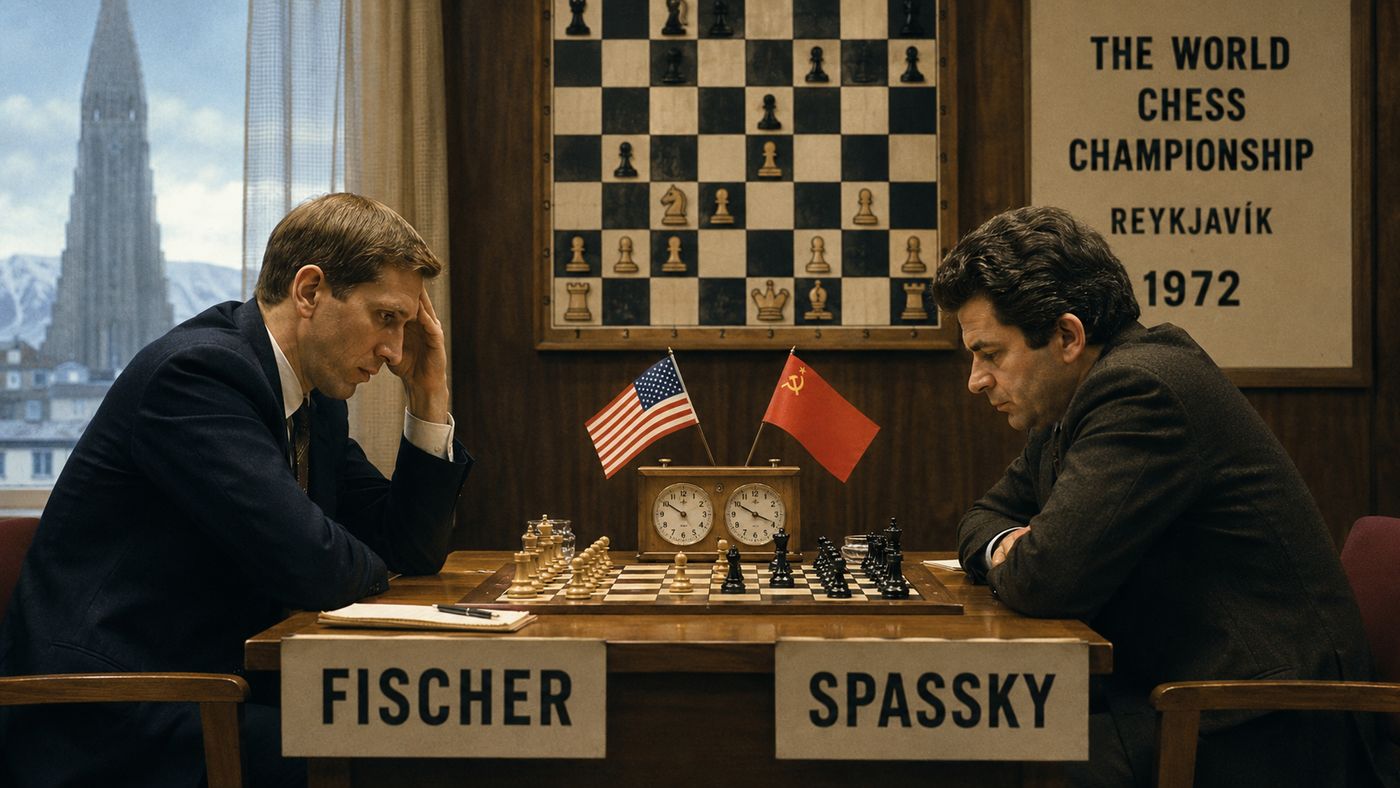
Reykjavik, 1972
On September 1, 1972, Bobby Fischer of the United States defeated Boris Spassky of the Soviet Union in Game 21 of the World Chess Championship in Reykjavik, Iceland, winning the match and becoming the first American to hold the world chess title — ending the Soviet Union's unbroken dominance of the championship that had lasted since 1948. The match had been one of the most closely followed sporting and political events of the Cold War era: Fischer, an abrasive, brilliant, and profoundly difficult personality who had learned chess on the streets of Brooklyn and refused to conform to any expectation the chess world had of how a prodigy should behave, had demanded impossible conditions, threatened to withdraw repeatedly, and arrived late to his own championship match — then proceeded to play some of the most extraordinary chess of his generation. Spassky, a polished and formidable champion, found himself facing an opponent who seemed to operate according to different rules entirely.
The victory Fischer completed on September 1, 1972, was received in the United States as a Cold War triumph of almost athletic proportions — a single American genius dismantling the collective product of the Soviet chess machine, which had invested enormous institutional resources in producing and training world-class players as a demonstration of communist intellectual superiority. Fischer's own relationship with his triumph was characteristically complicated: he refused to defend his title in 1975 over a dispute about match conditions, forfeiting the championship without playing a game, and subsequently retreated from public life into increasingly eccentric and eventually deeply troubling behavior, making virulently anti-Semitic statements — Fischer was himself Jewish — and expressing support for the September 11 attacks. He died in Iceland in 2008, the country where he had won his greatest victory. The chess he played in Reykjavik in 1972, and the match he won on September 1 of that year, remain among the most brilliant competitive performances in the history of the game.
The Great Kanto Earthquake
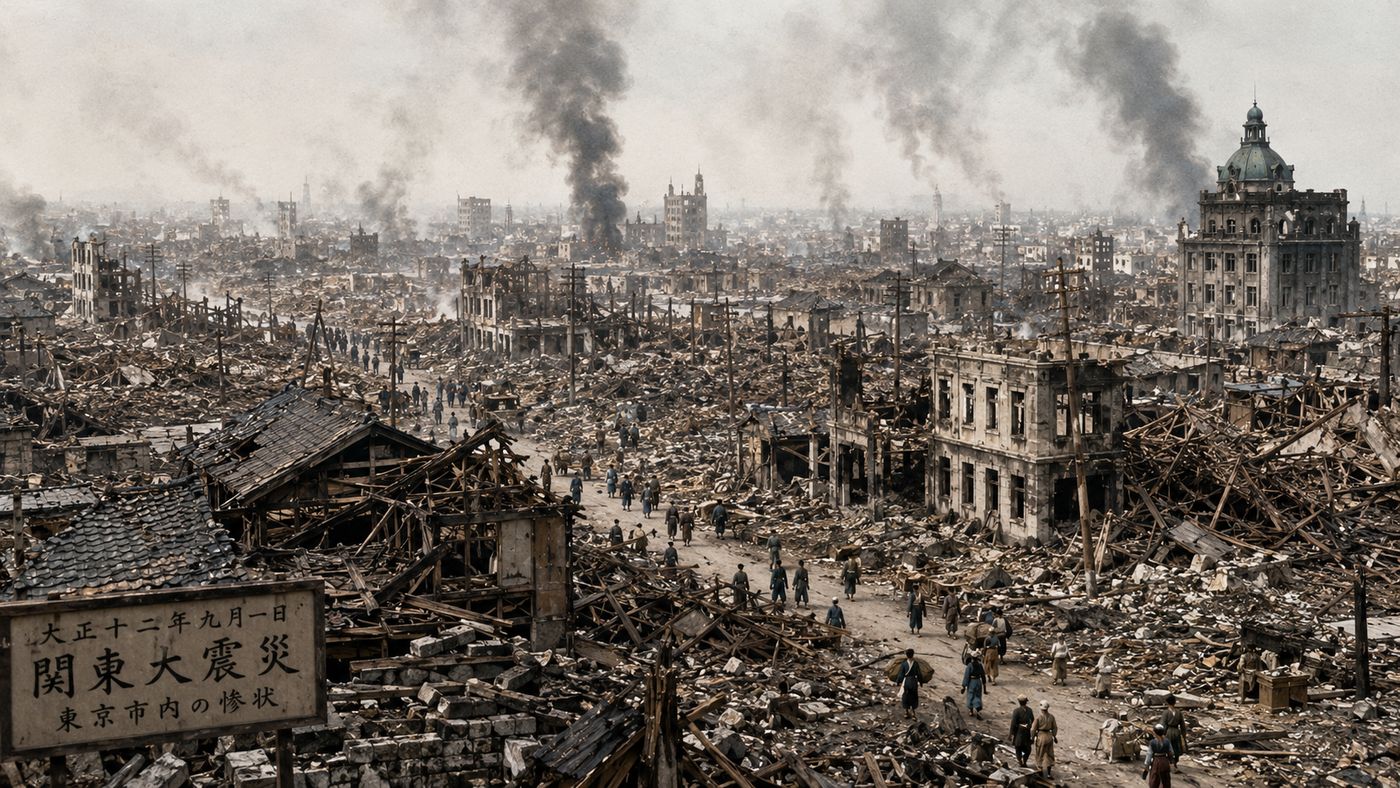
On September 1, 1923, at 11:58 in the morning, a magnitude 7.9 earthquake struck the Kanto region of Japan, centered in Sagami Bay south of Tokyo, and devastated the cities of Tokyo and Yokohama with a force that the built environment of the era had no means of withstanding. The timing was catastrophic: midday in Japan meant that millions of households across the region had cooking fires burning — charcoal braziers and wood-burning stoves preparing the noon meal — and when the earthquake collapsed buildings across the region, those fires spread simultaneously through the wreckage. Firestorms swept through the wooden residential neighborhoods of Tokyo and Yokohama in the hours that followed, killing tens of thousands of people who had survived the initial collapse. The fires burned for two days. An estimated 140,000 people died; nearly two million were left homeless; and the physical infrastructure of both cities was largely destroyed.
The Great Kanto Earthquake of September 1, 1923, produced consequences that extended far beyond the immediate destruction. The disaster was exploited by nationalist and militarist elements in Japanese society: rumors — deliberately spread and widely believed — accused Korean residents of Japan of poisoning wells and committing crimes in the chaos following the earthquake, producing a wave of vigilante violence in which an estimated 6,000 Koreans were killed. Chinese residents and labor activists were also targeted. The massacres are now acknowledged as one of the darkest episodes of the earthquake's aftermath, though they received limited official acknowledgment for decades. The rebuilding of Tokyo that followed the disaster produced, under the direction of Home Minister Shinpei Goto, a modern city with broader streets, parks, and reinforced construction — an urban transformation that shaped the Tokyo that exists today. The earthquake that struck on September 1, 1923, destroyed an old city and created a new one, at an enormous and in several respects still-unacknowledged human cost.
Eid Mubarak
On September 1, 2001, the United States Postal Service issued its first stamp commemorating an Islamic holiday — a stamp featuring gold calligraphy reading "Eid Mubarak," meaning "Blessed Eid," designed by artist Mohamed Zakariya in the traditional Ottoman calligraphic style called thuluth. The stamp was issued to mark Eid al-Fitr, the holiday celebrating the end of Ramadan, and represented the first time the USPS had acknowledged an Islamic observance in its holiday stamp series, which had for decades included stamps marking Christmas, Hanukkah, and Kwanzaa. The decision to issue the stamp was the product of years of advocacy by Muslim American organizations who had sought the same recognition for their holidays that other faith communities had received — and it came after the USPS had already recognized that the diversity of American religious practice deserved representation on the country's most widely distributed form of public communication.
The Eid stamp issued on September 1, 2001, carries an additional historical resonance: it was released ten days before the September 11 attacks, which transformed the position of Muslim Americans in the country's public life in ways that made the stamp's timing feel, in retrospect, both prescient and bittersweet. In the months and years following September 11, the stamp was reissued multiple times — in 2002, 2006, 2007, 2008, and 2011 — in part because postal officials and Muslim American leaders understood that the symbolic act of recognition it represented had become more rather than less important after the attacks. Mohamed Zakariya, the calligrapher who designed it, went on to receive the National Heritage Fellowship from the National Endowment for the Arts in 2008 in recognition of his role in bringing traditional Islamic calligraphy to American audiences. The stamp issued on September 1, 2001, was a small rectangle of paper. Its timing gave it a weight that no one had anticipated when it was designed.