The Game That Decides Everything
Last night in San Antonio, Victor Wembanyama walked into the Frost Bank Center wearing an Eid al-Adha robe, changed into his uniform, and played 28 minutes that felt like a career statement. He hit three 3-pointers in the first quarter. He finished with 28 points, 10 rebounds, 3 blocks, and 2 steals, shooting 4-of-9 from three. The Spurs led wire-to-wire, blew the game open with a 22-0 run in the third quarter — during which the Thunder went scoreless for eight straight minutes — and won 118-91 in the most dominant performance of the series. Shai Gilgeous-Alexander scored 15 points on 6-of-18 shooting, was a minus-28 in 28 minutes, and has now shot 40 percent or below from the field in five of the six games. Tomorrow night, Game 7. Oklahoma City. 8 p.m. ET on NBC and Peacock. The winner faces the New York Knicks in the NBA Finals. This is what the playoffs are for.
What Game 7 Has Always Been
The NBA has staged roughly 130 Game 7s since the league formalized the best-of-seven format — and the history of those games is a history of the sport's most concentrated mythology. The 1976 triple-overtime Game 5 between the Celtics and Suns is often called the greatest game ever played; it wasn't a Game 7, but it produced the template for what a decisive playoff game can be. The actual Game 7s that loom largest in basketball memory tend to share a quality: they are not necessarily the best-played games in a series, but they carry the weight of everything that preceded them, and that weight transforms even ordinary moments into something that feels permanent. Willis Reed limping onto the Garden floor in 1970. Larry Bird stealing the inbound pass against Detroit in 1987, finding Dennis Johnson, layup, game over. LeBron James's chase-down block in Game 7 of the 2016 Finals — arguably the single most replayed moment in NBA history — with the Warriors three minutes from a championship and LeBron covering 80 feet in two and a half seconds to deny Andre Iguodala at the rim. These moments did not feel inevitable as they happened. They feel inevitable now, because of what came after them: because they were Game 7, and because Game 7 is where basketball becomes something closer to literature.
Tomorrow night's game carries stakes that run in two directions simultaneously. For San Antonio, a win means the franchise's first Finals appearance since 2014 — when Duncan, Parker, Ginobili, and Kawhi Leonard won the championship in five games over Miami — and the arrival, formally and undeniably, of Wembanyama as a superstar capable of carrying a team to the biggest stage in the sport. He has been extraordinary in this series: 41 points and 24 rebounds in Game 1, 33 points in Game 4, 28 points last night. In the three games the Spurs have won, Wembanyama has averaged 34 points, 18 rebounds, and 4 blocks. In the three games they lost, he averaged 18 points on 37 percent shooting. The series has been, in the most literal sense, a Wembanyama series — the Spurs have been exactly as good as he has been, game by game, with almost no exceptions. For Oklahoma City, a win means back-to-back Finals appearances — something only the Golden State Warriors have done since 2015 — and vindication of the long, patient rebuild that SGA has led since the Durant era ended. The two-time MVP candidate has struggled in this series by his own extraordinary standards, but he has also been the best player in the league for two consecutive seasons, and Paycom Center tomorrow will be the loudest building in basketball. Game 7s have a way of returning players to themselves.
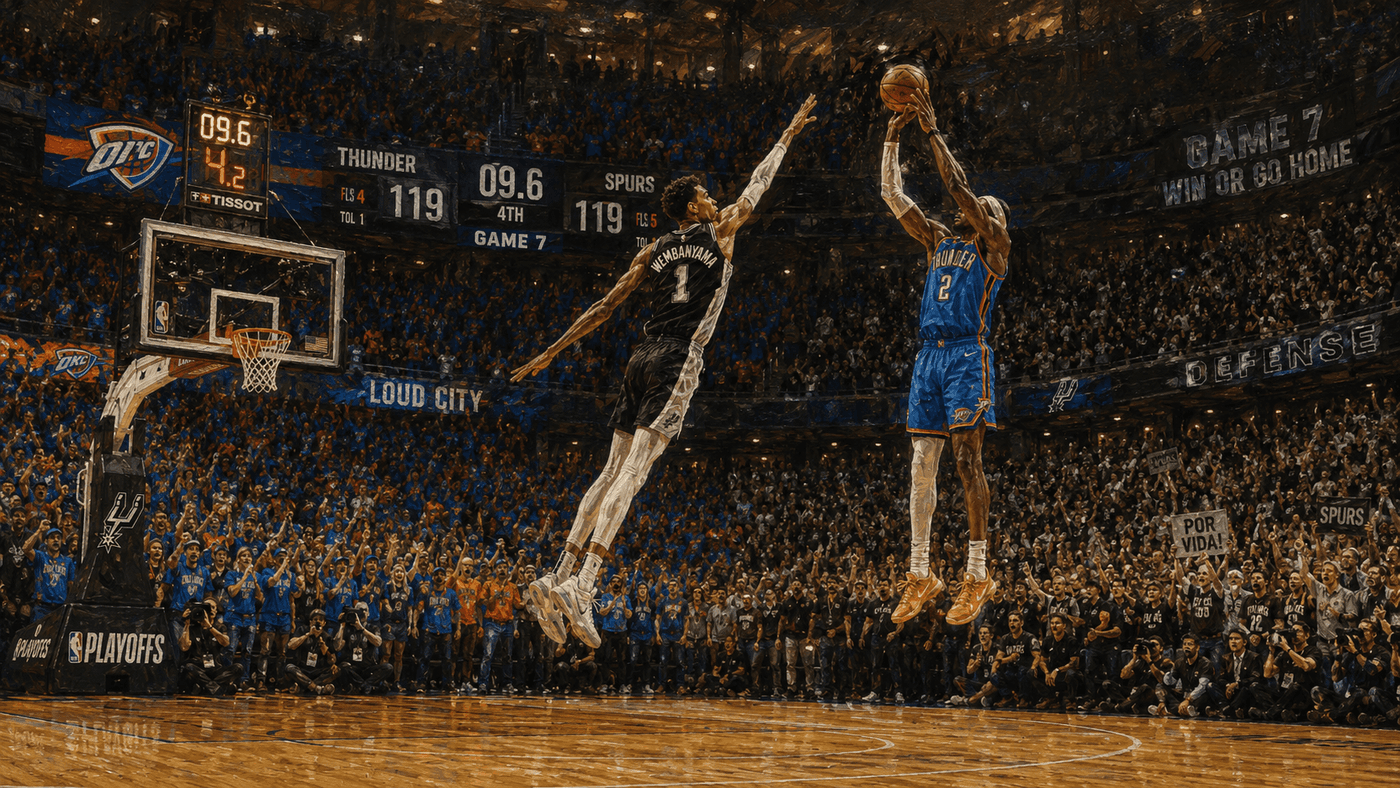
The series average margin of victory is 15.3 points — meaning every game has been a blowout, yet somehow the series is tied 3-3. That paradox is the best possible advertisement for what tomorrow night might produce: two teams capable of dominating each other, neither capable of doing so predictably, meeting for the final time in a building that has waited all week for this. The NBA has not had a Western Conference Finals go to Game 7 since 2019, when the Warriors and Blazers met in a series that Portland lost badly. The last truly dramatic Game 7 in the West was Golden State's comeback against Oklahoma City in 2016 — a different OKC team, a different era, but the same building, the same crowd, the same hunger for a Finals that kept slipping away. Tomorrow night, for the first time, this Oklahoma City team will play a Game 7 at home with everything on the line. Wembanyama will be on the other side of the floor, in the building where his career goes to the next level or gets tested for another year. The Knicks are waiting. Madison Square Garden is ready. Whatever happens tomorrow night in Oklahoma City, it will be remembered. Game 7s always are.